





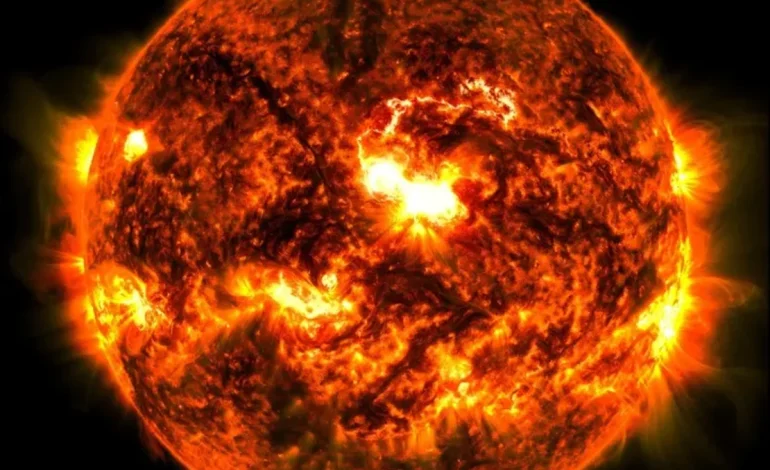

A powerful solar storm, classified as a level 4 on a scale of 1 to 5, is heading towards Earth and could bring vibrant auroras to areas like Alabama and Northern California, much farther south than usual, on Thursday evening, CNN reports.
The National Weather Service’s Space Weather Prediction Center (SWPC) has issued a warning, noting the storm, which originated from a solar flare and coronal mass ejection from the sun, could also disrupt communications, power grids, and satellite operations.
The storm is expected to reach Earth between early morning and 12 p.m. ET on Thursday and could last until Friday.

The storm’s full intensity and characteristics, traveling at over 2.5 million miles per hour (4 million kilometers per hour), will not be fully understood until it reaches the Deep Space Climate Observatory and the Advanced Composition Explorer satellites orbiting 1 million miles from Earth.
These satellites will measure the speed and magnetic intensity of the storm, which is expected to arrive at Earth 15 to 30 minutes after reaching the observatories, explained Shawn Dahl, service coordinator for the SWPC, at a Wednesday briefing.
This week has seen a series of intense X-class solar flares, the most powerful type, emanating from the sun, accompanied by coronal mass ejections (CMEs) on Tuesday.
CMEs are massive clouds of ionized gas, or plasma, and magnetic fields that erupt from the sun’s outer atmosphere. When directed towards Earth, they can cause geomagnetic storms, major disturbances of Earth’s magnetic field.
“Geomagnetic storms can impact infrastructure in near-Earth orbit and on Earth’s surface,” according to the SWPC.
The SWPC has notified the Federal Emergency Management Agency, the North American power grid, and satellite operators to prepare for potential disruptions, especially considering ongoing hurricane relief efforts for Hurricane Milton.
While G4 storms are common during a solar cycle, G5, or extreme geomagnetic storms, like the one on May 10, are exceptionally rare. This new storm has a 25% chance of escalating to a G5, according to Dahl.
The sun is nearing solar maximum, the peak of its 11-year cycle, expected this year. During this period, the sun becomes more active, leading to increasingly intense solar flares.
This heightened solar activity causes auroras that dance around Earth’s poles, known as the northern lights (aurora borealis) and southern lights (aurora australis). When energized particles from CMEs reach Earth’s magnetic field, they interact with atmospheric gases, creating those mesmerizing colored lights.
Currently, the SWPC predicts visible auroras in central Eastern states and the lower Midwest, but whether the storm will cause a global aurora phenomenon like the G5 in May remains to be seen. If it escalates to a G5, auroras could be visible across southern states and globally.
The NOAA recommends using the SWPC’s aurora dashboard to check the visibility of northern and southern lights in specific locations. The dashboard is continuously updated and can show potential aurora locations within minutes of new information becoming available.
The chances of witnessing auroras have also increased dramatically with the earlier sunsets of this time of year. Skywatchers in the US who observed auroras during a G3 storm over the weekend were able to witness the northern lights within an hour or two of nightfall, according to Dahl.



The latest news in your social feeds
Subscribe to our social media platforms to stay tuned