





The original story by Renée Jean for Cowboy State Daily.
Japan is eyeing Wyoming’s natural gas — not just for its abundance, but because it’s cleaner than a lot of competing supply. And thanks to new export terminals under construction in Mexico, that gas may finally have a realistic pathway to Asian markets.
The big question now: can Wyoming, long boxed out of West Coast export routes, turn this into a real global energy play?
Japan wants to keep some fossil fuels in its energy mix but still hit carbon reduction targets. That’s where Wyoming comes in.
“Wyoming’s natural gas is preferable to anybody else’s at this point,” Gov. Mark Gordon said in October. “Because we can meet the UN protocol, so these countries that still have commitments to reducing their carbon really like Wyoming gas.”
Japan is looking for reliable fuel that fits with its climate promises. Wyoming offers exactly that: carbon-reduced natural gas produced under increasingly strict emissions standards.
It’s also a trade issue. Japan wants to narrow its trade deficit with the US, and one way to do that could be investing in infrastructure — like pipelines or joint projects — that move American gas to export terminals serving Asian buyers.
For years, Wyoming has run into a political brick wall trying to move fossil fuels to the Pacific for export. West Coast states blocked coal ports and made gas projects nearly impossible to permit.
So advocates started looking south.
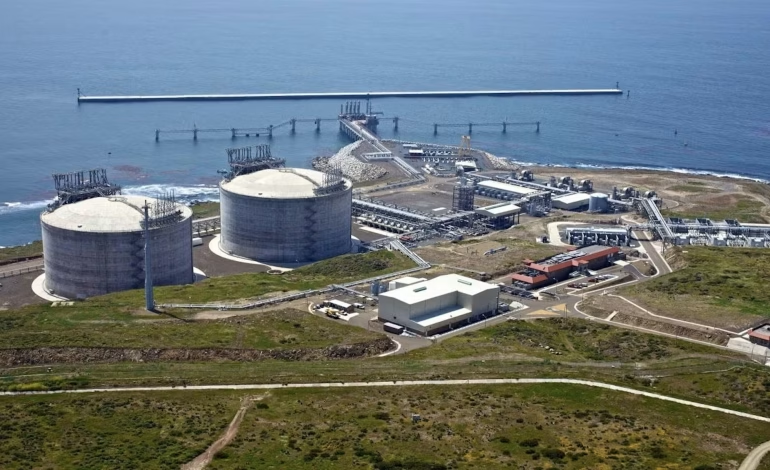
Just 30 miles below the California border, in Baja California, Mexico, Sempra Infrastructure is building the Energía Costa Azul (ECA LNG) terminal — a key piece in this new strategy.
It started life as an import facility, designed 20 years ago when the US thought it would need to bring in gas from overseas. That world is long gone. Now, the plant is being retrofitted to export US and Rocky Mountain gas to Asia, said Andrew Browning, president of Western States and Tribal Nations, a group pushing North American gas exports.
“Phase one of the project is the retrofit of an intake facility that was built 20 years ago, when we thought we’d be importing 20% of our gas,” Browning said. “By this point, the first phase has been under construction, and I think it’s over 95% complete. My understanding is that it’s due for commercial exports in the spring of 2026.”
Phase one will move about half a billion cubic feet of gas a year, already under contract. Phase two is where it gets big: a planned expansion would quadruple capacity.
“We are advocating that that facility utilize Rocky Mountain gas,” Browning said. “And we think our report makes a great case for that.”
Western States and Tribal Nations recently released a roadmap laying out two main ways Wyoming and Rocky Mountain gas could reach Asian buyers:
- Southwest route – via pipelines to Baja California and out through export terminals like Energía Costa Azul.
- Pacific Northwest route – through states like Washington or Oregon, if politics and policy eventually shift.
The second route has been dead in the water for years. Washington state blocked a major coal export terminal and Oregon’s Jordan Cove LNG project was denied key state permits despite federal approvals.
But Browning thinks the mood might be changing.
“There is more energy needed,” he said. “You are seeing significant development in need for gas for load growth, especially by power generation, and in some parts driven by clean energy targets and renewable portfolio standards.”
Add in the explosion of AI data centers and electrification, and power demand in the Pacific Northwest is rising fast.
“They’re looking at a significant power shortage by 2030,” Browning said. “And natural gas is really one of the only things that could kind of fill that void.”
It’s not just volume Wyoming can offer — it’s branding.
Producers like Jonah Energy and PureWest Energy have spent years reducing emissions, tightening up methane leaks and proving it with data.
“These efforts have earned Jonah Energy the gold standard rating from the United Nations oil and gas methane partnership,” Browning said. “They’re a leader in low emissions natural gas production and showing how the Rockies can supply the world.”
Western States ran a life-cycle emissions analysis on exporting Rocky Mountain gas to Asia. The result: a 40–50% drop in emissions compared to some alternatives, according to Browning.
“You don’t have to throw away your climate goals to use natural gas,” he said. “We’re part of the solution.”
That kind of message is tailor-made for countries like Japan and South Korea — and for US policymakers trying to balance climate policy with energy security.
Energy talks between Wyoming and Japan aren’t just about gas.
Gov. Gordon also pitched opportunities tied to carbon capture and advanced manufacturing. One example: Kawasaki Heavy Industries’ carbon capture technology, tested at the Wyoming Integrated Test Center (ITC) near Gillette.
The ITC, attached to Basin Electric’s Dry Fork power plant, gives companies real-world access to flue gas so they can test and scale up carbon capture and CO₂-use technologies beyond the lab.
Japan could invest not only in taking Wyoming gas overseas, but also in manufacturing components tied to these carbon capture systems and other petrochemical or carbon-utilization projects.
Nothing about this is simple. New pipelines, export contracts, terminal access, state and federal approvals — it all takes years and billions of dollars.
But the pieces are starting to line up:
- Japan wants lower-carbon, reliable gas.
- Wyoming can offer exactly that.
- Mexico’s new LNG export terminals provide a route that sidesteps West Coast bottlenecks.
- And low-emissions branding gives Rocky Mountain gas an edge in a world where climate metrics increasingly shape energy decisions.
For Wyoming, long locked out of global markets by geography and politics, this could be its best shot yet at turning its gas fields into a long-term international business — and not just for fuel, but for technology, manufacturing and carbon innovation too.



The latest news in your social feeds
Subscribe to our social media platforms to stay tuned