





The original story by Andrew Rossi for Cowboy State Daily.
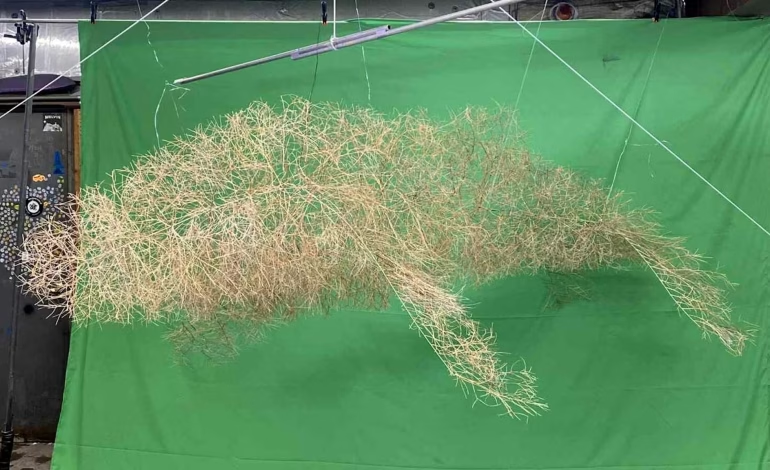
When Central Wyoming College opens its new Jackson campus, visitors walking into the main building will be greeted by something you definitely don’t expect in landlocked Wyoming: a 70-foot whale, floating overhead.
And it’s made out of tumbleweeds.
The massive hanging sculpture, dubbed the “Tumblewhale,” is the latest project from Jackson artist Ben Roth, who’s been commissioned to create the piece through the Wyoming Arts Council’s Art in Public Buildings Program.
Roth is now on a very Wyoming-style material hunt: collecting about 300 pounds of tumbleweed to turn into a life-size, moving whale that looks like it’s swimming through the air.
“I plan to make it interactive,” Roth told Cowboy State Daily. “A viewer can come up and pull some handles, and when they do, the whale will swim like a giant marionette.”
For Roth, it’s his most ambitious project yet — and a rare chance to install a permanent signature piece in his hometown.
“Public art has a lot of moving parts, figuratively speaking,” he said. “I enjoy it, but it’s challenging to get those jobs. Getting to build this piece in Jackson is delightful.”
Roth isn’t new to making animals out of unusual materials.
His portfolio is full of creatures welded and shaped from things that don’t normally resemble wildlife:
- A bike chain owl;
- Steel-screen fish, chameleons and penguins;
- Large-scale temporary pieces made from wood, metal and sand.
He’s even worked with tumbleweeds before — building a tumbleweed Christmas tree for Hotel Terra in Jackson Hole, and a floating tumbleweed “cloud” that still hangs in a local physical therapist’s office.
But the Tumblewhale is on a completely different scale.
“I’ve made larger-scale sculptures with a bigger budget, but I’ve never made a single permanent sculpture like this,” he said. “I definitely haven’t made anything this big with tumbleweed.”
The idea’s been rattling around in his head for years. In 2023, he created a 10-foot mini tumbleweed whale for Moonshot 5×5, a Jackson event that challenges artists to make unconventional work tied to environmental themes.
That caught the eye of one of the architects working on CWC’s new Jackson campus.
“One of the architects of the new CWC building reached out and asked if I’d be interested in doing a full-sized whale,” Roth said. “I proposed two ideas to the Wyoming Arts Council, and they decided on the Tumblewhale.”
Even Roth admits a whale sounds like an odd fit for Wyoming.
But to him, it makes perfect sense.
“I’ve always loved whales, and I’ve always loved the ocean,” he said. “The rocks across Wyoming tell us that our state was an inland sea in the past, and it looked a lot different a long time ago. And I see what’s happening to our oceans today, and it worries me.”
He sees the Tumblewhale as a bridge between past and present — a reminder that Wyoming was once underwater, full of massive “sea monsters,” and that today’s oceans are under threat.
Imagining a ghostly whale made from tumbleweed, drifting through a college lobby in Jackson, doesn’t feel that far-fetched to him.
Right now, Roth is racing winter.
He needs clean, intact tumbleweeds, which means gathering them before Jackson gets buried in snow.
“I’m scrambling to collect my tumbleweed so that they’re in good shape when I build the sculpture next summer,” he said. “When they’re under the snow, they start to mold.”
He’s rented space in a friend’s pole barn and fenced off an area with chicken wire so the tumbleweeds can stay dry but still outdoors.
Tumbleweed, it turns out, is great sculpting material.
“The inside of the tumbleweed is sort of like Styrofoam,” Roth said. “I can slide the stem onto a pin covered with epoxy, and it glues really well. It creates volume, but it’s very light and renewable, and it’s invasive, so no one minds if you collect them.”
The whale will have a steel skeleton made of thin-gauge rod, bent to match the form of a real whale — strong enough to hold the structure, but subtle enough you don’t really see it.
To get the shape just right, Roth is studying whale skeletons and anatomy. Once the framework is built, he’ll start attaching tumbleweeds, then trim them down.
The main tool? Not a torch. Not a saw.
“Scissors,” he said. “Once you get the rough shape, you just sculpt with a pair of scissors.”
The steel frame will be painted to match the tumbleweeds so it disappears visually.
“The illusion is that it’ll look like the entire whale was grown as a giant plant,” Roth said.
Roth expects the final Tumblewhale to be 60–70 feet long and weigh about 400 pounds — “likely the lightest whale in the world,” he jokes.
He’s been told to be ready to assemble it in July 2026, once the new CWC building is prepared. His studio is less than a mile from the construction site, which he loves for both convenience and symbolism.
“That’ll keep my carbon footprint small,” he said. “There will be very little waste in this project. The whole thing is elegant in its simplicity.”
The plan is to lay out a full-size template — probably using newspaper — on the building floor to fine-tune the scale, then build the whale on-site over four to five days.
Engineers working on the campus will help install rigging in the ceiling to safely suspend the Tumblewhale. Because the sculpture will move like a marionette when viewers interact with it, the mounting has to handle both the weight and the motion.
For Roth, that motion — the illusion of a tumbleweed whale swimming through the air — is one of the most exciting parts.
“It’s not just a static thing to look at,” he said. “I want it to feel alive.”
The latest news in your social feeds
Subscribe to our social media platforms to stay tuned