


Helicopters, Hunters and Hard Feelings: Battle over Access to Wyoming’s Landlocked Public Land

The original story by Mark Heinz for Cowboy State Daily.
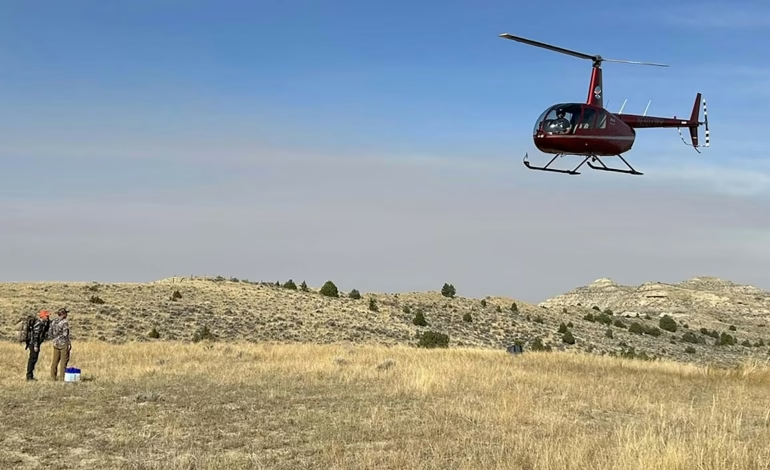
Some hunters in Wyoming have found a workaround for reaching public land that’s boxed in by private property: they’re flying over it.
By chartering helicopters to drop them onto “landlocked” public parcels, these hunters say they’re simply exercising their right to access land — and big game — that legally belongs to everyone. But the strategy is stirring up tension with ranchers and outfitters who say the noisy flights disrupt operations and undercut long-standing access deals.
When hunter and outdoor writer David Faubion moved from Idaho to Sheridan in 2020, he was thrilled by how much public land Wyoming has. That excitement faded a bit when he realized how much of it is landlocked by private ranches.
He estimates roughly 4 million acres of public land in Wyoming — and about 15 million across the West — can’t be reached without crossing private property.
“There’s huge chunks of land, and I realized you can’t access them without going across private land,” Faubion said.
Someone eventually told him the only realistic way in was from the air.
“That was a light bulb moment,” he said.
In 2021, Faubion started searching for a pilot who would actually fly hunters into those isolated parcels. It wasn’t easy.
Some pilots didn’t have the right certifications. Others, he said, simply didn’t want to rock the boat.
“A lot of them were scared of incurring the wrath of ranchers,” he said, especially when those same ranchers or their chosen outfitters were used to having the area almost to themselves.
At one point he even explored using a hot air balloon.
“It’s probably, to this day, the strangest conversation I have ever had,” he laughed.
By early 2024, he’d finally lined up a helicopter pilot: Tony Chambers of Wind River Air. Since then, Faubion has organized three fly-in hunts in Wyoming. None went unnoticed.
On one trip, he says a rancher tried to steal the head of a bull elk a hunter had legally taken. On others, ranchers showed up at staging areas to confront the group.
“It can be spooky enough that a good number of people wouldn’t want to do this,” Faubion said. “They’re not wired for confrontation.”
One rancher, contacted by Cowboy State Daily, declined to go on the record but called the fly-in hunt disruptive and suggested “there’s most likely a whole lot more to the story.”
Pilot Tony Chambers says his business has mostly focused on sightseeing and dropping hikers into remote areas. Adding fly-in hunts to landlocked public land feels like a natural extension.
“I’m a big believer that public lands belong to the public. They belong to the taxpayer and everybody should have access to them,” he said.
New Mexico hunter Dave Romero, who joined one of the trips, has a foot in both worlds. He owns a cattle ranch and has worked as a hunting guide, so he understands why ranchers like having de facto control over nearby public ground.
“If you’re a rancher, that’s a really cool deal,” he said. “But if you’re not a rancher, that kind of sucks too, because they can lock it up and you can’t access it. It belongs to you, but you can’t get to it.”
In New Mexico, Romero said he eventually decided it was easier to allow people to cross his property to reach public land than to constantly repair damaged fences and roads.
He also gets why landlocked parcels are attractive to outfitters.
“It’s a neat thing when you’re on the inside and you can keep other people locked out,” he said — but he still believes the public’s right to access public land will ultimately prevail. “There’s no battle to be had” on that principle, he said.
While more hunters are experimenting with fly-ins, it probably won’t become the next big craze, according to Moorcroft outfitter and Wyoming Game and Fish Commissioner Fonzy Haskell.
He said they did notice an uptick in aircraft use this year in Elk Hunt Area 123 in northeast Wyoming — a couple of helicopters and some small planes.
Fly-in hunting, he said, can rub outfitters the wrong way.
“Some personally take opposition to that. They might say, ‘I was hoping to hunt that animal free of competition, but now other guys are going into that area,'” Haskell said.
But he doubts it will explode in popularity, in part because of cost.
“I don’t think that it will become really trendy,” he said. “A lot of people won’t be willing to pay that kind of money.”
Faubion said charter costs typically run “less than $2,000” per hunter if a group splits the bill. By comparison, he said, trespass fees or outfitter fees to cross private land into the same areas can run several thousand dollars per person.
Faubion expects more pushback, including possible arguments that flying hunters in counts as “transporting or aiding hunters in the field,” something that usually requires an outfitter’s license.
He doesn’t see it that way.
On state and BLM land, he said, aircraft can only land on existing roads.
“We’re being flown from a road to a road,” he explained, which he argues keeps them within the rules and out of that “in the field” category.
As for future fights over the practice, Faubion is blunt.
“There’s no gray area here, it’s black and white,” he said. “There’s nothing people can do to keep us off that public land, but they sure as hell will try.”


The latest news in your social feeds
Subscribe to our social media platforms to stay tuned