



The original story by Andrew Rossi for Cowboy State Daily.
Cyclists now know what’s in store for the 2026 Tour de Wyoming — and it’s a big one.
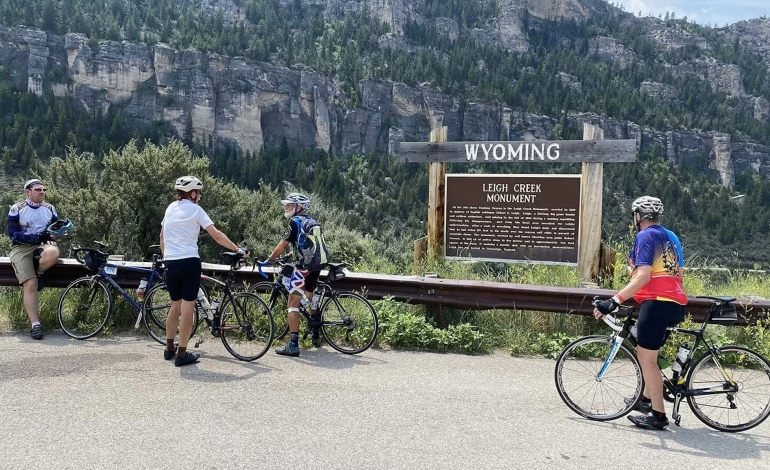
Organizers have unveiled the route for the six-day, 406-mile ride through northwest Wyoming’s Bighorn Basin, with a quick hop into Montana, set for July 2026. Only 250 riders will take part in what’s now considered one of the best fully supported bike tours in the country.
Instead of one long loop, the 2026 edition will use day rides out of a few host towns, giving cyclists more time to relax — and less time packing up camp.
“We’ve found that spending two nights in three different towns was very well-received by our riders,” longtime tour director and wildlife biologist Amber Travsky said. “It’s a lot easier than moving every single day.”
This will be the 27th Tour de Wyoming, and while the ride heads back to familiar territory, it still has a few fresh twists.
“We haven’t been in that corner of Wyoming for a while, and the communities have been outstanding to work with,” Travsky said. “It’ll be a nice homecoming for many of us.”
The tour kicks off July 12 in Powell and sticks mostly to the Bighorn Basin, with some serious scenery and one big test piece:
- Day 1 – Powell loop (56 miles):
Riders start with a 56-mile loop out of Powell, heading past Cowley, Lovell and Byron before returning to Powell for a second night. - Day 2 – Powell to Red Lodge, Montana (74 miles):
A long climb north into Red Lodge offers big views and a big workout. - Day 3 – Red Lodge to Cody (65 miles):
Riders enjoy a “nice descent” on the way to Cody after the previous day’s uphill grind. - Day 4 – Cody to Yellowstone East Entrance and back (107 miles):
The toughest day of the tour: a 107-mile out-and-back to the East Entrance of Yellowstone National Park for those who want the full challenge. - Day 5 – Cody to Lovell (77 miles):
Things ease up slightly with a scenic 77-mile ride to Lovell. - Day 6 – Lovell to Powell (28 miles):
The final day is a short 28-mile spin back to Powell to close out the tour.
“It’ll be a nice, familiar route but still a little different from what we’ve done before,” Travsky said.
One of the reasons the Tour keeps coming back to northwest Wyoming is simple: pavement.
“Our ride is 100% pavement, which makes it tricky to pick a good route,” Travsky said. “If you look at a Wyoming map, there’s not a lot of pavement. Northwest Wyoming has a lot of small, paved roads and lanes that let us get off the highway and away from traffic.”
The tour caps participation at 250 riders — a limit set after organizers tried upping the number and found out the hard way it was too much.
“We tried 350 people, and it got to be like a job,” Travsky said. “Even 250 people is like moving a small town every day, but we can handle the logistics. That’s our sweet spot.”
Small towns are also a feature, not a bug.
“We get lost in big towns,” she joked. “It’s hard to find routes to get in and out safely without losing a few cyclists along the way as they miss a turn. Small towns work well for what we do.”
When Tour de Wyoming started back in 1997 with just 44 riders, the idea was to keep it “all Wyoming.” But after nearly three decades, the planning committee has gotten a little more flexible.
“There are only so many routes you can pick that stay entirely in Wyoming,” Travsky said. “We’ve popped into Colorado, Idaho and South Dakota in the past, and we’ll be able to hit Montana next year, but we try to stay mostly in Wyoming. It’s the Tour de Wyoming, after all.”
Riders now come from all over the country, but about a third are Wyomingites — including many of the 19 volunteers who help plan and run the event.
“We have people who come every year, so it’s like a reunion,” Travsky said. “I know people all across the country because of the tour.”
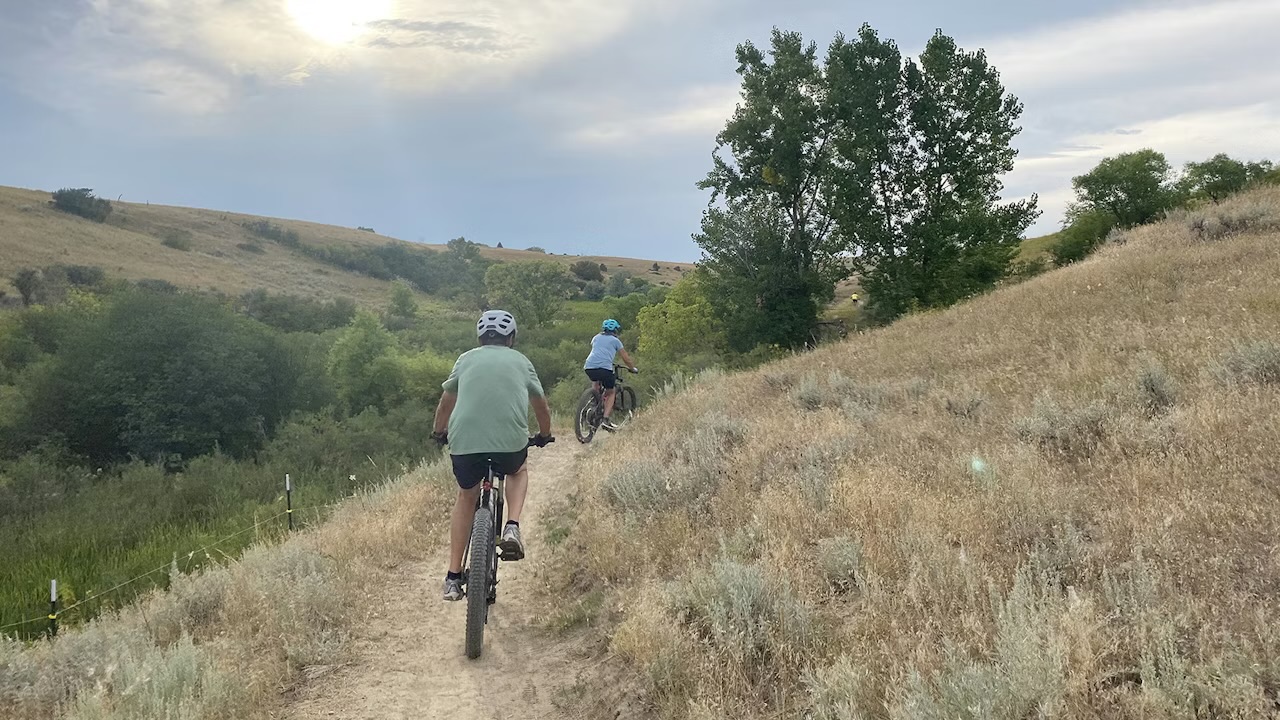
The Tour de Wyoming isn’t about finishing first. It’s about making the miles enjoyable.
“We have an aid station every 15 to 20 miles to make sure our riders are fed and watered,” Travsky said. “We carry all their luggage, we have a caterer that makes all our meals, and a bike repair station available on route. If someone decides they’ve had enough for one day, they can get a ride to the next stop.”
Past tours have even featured a massage therapist and “fancy coffee” from Coal Creek Coffee in Laramie.
“We’re a little small town for a week,” Travsky said. “That’s why we need our volunteers.”
Spots for the Tour are awarded by a random lottery that runs every February. For the 2026 ride, the lottery will be open Feb. 1–28.
“There’s no priority for anyone,” Travsky said. “When we didn’t do the lottery, we were filled within the first nine minutes. With the lottery, everyone’s treated the same. It’s just practical.”
Groups can apply together so friends or families don’t get split up. And there are a couple of soft “loopholes”: become a volunteer or talk someone you know into it.
“The one way that people can get in without going through the drawing is to coax a friend or a spouse, or volunteer to be a volunteer,” Travsky said.
Entry fees are kept as low as possible, she added, with any extra money going back into local communities through bike programs, trail building and similar projects.
“We’re probably one of the least expensive, fully supported bike tours around,” she said. “We don’t want it to be cost-prohibitive.”
The Tour de Wyoming is entirely volunteer-run, including Travsky herself, who’s been at it since the beginning.
“When you start something like this, you don’t know that it’s going to be a lifetime commitment,” she said. “The riders are the reason I keep doing it.”
For her and many others, returning to the Bighorn Basin in 2026 will feel like coming home.
“I get excited to see everybody come back every year,” she said. “I like northwest Wyoming, particularly the Bighorn Basin, and I’m looking forward to seeing new riders and old friends. It’s a really nice community.”



The latest news in your social feeds
Subscribe to our social media platforms to stay tuned