





Germany backs two-state vision, Israel rejects it, Merz’s first Israel visit lays bare the rift
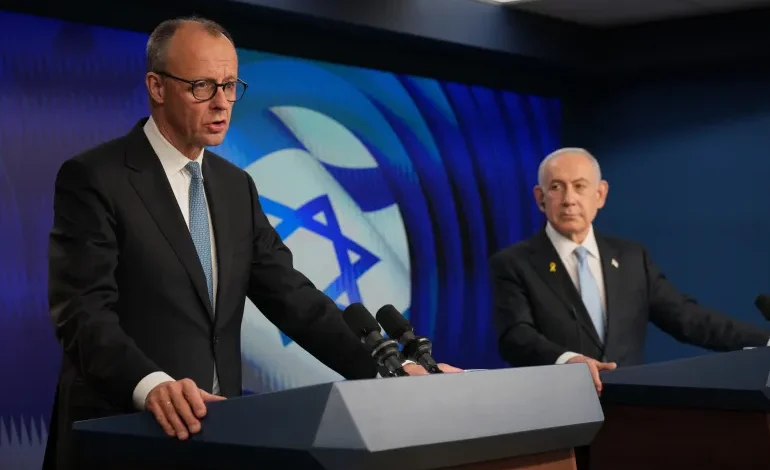

German Chancellor Friedrich Merz arrived in Israel for his first official visit with a familiar diplomatic message, Berlin still supports the idea of a Palestinian state. His host, Israeli Prime Minister Benjamin Netanyahu, wasted no time delivering the counterpoint: absolutely not.
The joint press conference in Jerusalem on Sunday brought the divide into full view. Merz, leading one of Israel’s most reliable allies, said Germany sees the creation of a Palestinian state alongside Israel as the clearest path to a different Middle East.
“Our conviction is that the prospective establishment of a Palestinian state alongside Israel presumably offers the best prospect for this future,” he said.
But he also made clear Berlin isn’t rushing recognition. Recognition, Merz argued, “should come at the end, not the beginning, of such a process (peace negotiations)”, distancing Germany from France, Spain and the United Kingdom, which have moved toward formal recognition already.
Netanyahu stood firm. He said Israelis reject a two-state outcome and repeated his long-held argument that “the purpose of a Palestinian state is to destroy the Jewish state”, without elaboration. He also noted that annexation of the occupied West Bank remains a topic of discussion, though not imminent, and signalled progress on Donald Trump’s Gaza plan, expecting “very important conversations” later in December before meeting Trump.
The timing of Merz’s trip speaks volumes. It comes against the backdrop of Israel’s war on Gaza, which Merz does not consider a genocide, and a relationship strained in recent months. In August, Berlin restricted weapons sales for use in Gaza, prompting frustration from Netanyahu. Merz, unusually for a German leader, openly criticised Israel’s civilian toll. The restrictions were lifted two weeks ago, yet political frost has not fully thawed.
On Sunday, Merz stressed that the pause in arms deliveries did not signal a shift in Germany’s core commitments: support for Israel’s security, and military assistance where appropriate. Still, the atmosphere felt cooler than the script of unconditional solidarity Germany usually follows.
Notably, a reciprocal visit to Berlin wasn’t on the table. Asked about Netanyahu visiting Germany — despite the ICC issuing an arrest warrant for him over alleged war crimes in Gaza — Merz replied: “We did not discuss the possibility… there is no reason to discuss this at the moment.” If time allowed, he said, an invitation might come “if appropriate” — diplomatic language for not now.



The latest news in your social feeds
Subscribe to our social media platforms to stay tuned