


Greater Yellowstone Grizzly Deaths Nearly Match Last Year’s Record High

The original story by Mark Heinz for Cowboy State Daily.
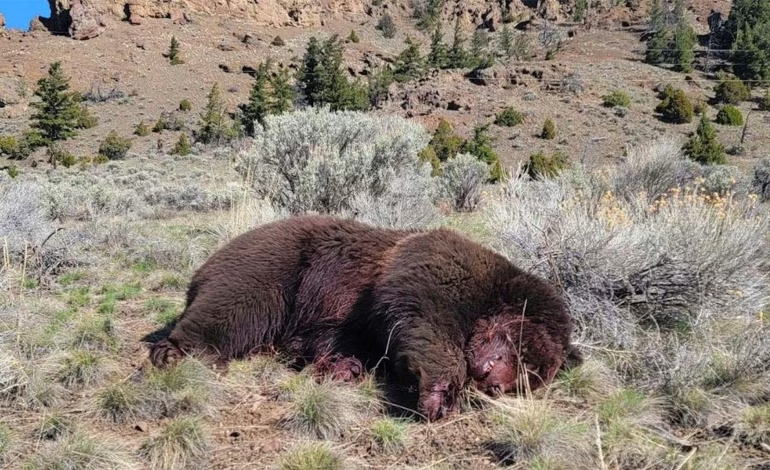
With 2025 almost in the books, grizzly bear deaths in the Greater Yellowstone Ecosystem are on pace to match last year’s record — and that has a lot of people talking.
So far this year, 71 grizzlies have died in and around Yellowstone, just shy of the record 72 deaths in 2024. In total, 73 mortalities have been documented in 2025, but at least two of those were skeletal remains believed to be from previous years.
Most of the causes haven’t changed much. According to mortality reports from the US Geological Survey’s Interagency Grizzly Bear Study Team, this year’s toll includes:
- About 30 grizzlies killed after attacking livestock;
- At least eight hit by vehicles;
- Seven killed by other bears;
- Twelve deaths still under investigation, with no official cause listed yet.
Other recent high-mortality years include 68 deaths in 2021 and 69 in 2018.
The Greater Yellowstone Ecosystem (GYE) — centered around Yellowstone National Park and spreading into parts of Wyoming, Montana and Idaho — is thought to support roughly 1,000 grizzly bears.
The most recent recorded death was an injured, orphaned female cub euthanized by wildlife agents near Cody’s South Fork area on Nov. 2.
Throughout the year, agents have trapped and killed grizzlies for attacking or killing cattle, pigs, sheep and alpacas, or for repeatedly hanging around homes and getting into garbage and other human food sources.
Not everyone sees the high death toll as a sign of trouble for the population.
Seasoned black bear hunter Joe Kondelis of Cody says the numbers make sense, given how many grizzlies he’s seeing on the landscape.
“I’m not surprised,” said Kondelis, president of the American Bear Foundation. “From my perspective Cody country seemed more loaded with griz this year than normal, which was already high.”
“This spring, while black bear hunting, I saw 35 grizzlies in 20 days,” he said.
Grizzlies in the Lower 48 are still listed as a threatened species and managed primarily by the federal government. Kondelis thinks that’s part of the problem.
“I think it’s just a product of how the state is being forced to manage these bears,” he said. “Their hands are tied by the feds, and until that changes it’s going to continue to be an issue.”
Wyoming Game and Fish large carnivore specialist Dan Thompson says that from a biological standpoint, grizzlies in the GYE are doing well.
“With the abundance, density and distribution of grizzly bears we have in the GYE, we should not be surprised to see levels of mortality higher now than they were even a decade ago,” he said.
“Mortality is not limiting this population — that is the most important part of the discussion that is many times overlooked,” Thompson added. “Bears are born and survive every year; death is part of the story. While we focus on how bears live, there is a societal focus on how bears die.”
Others see the situation much differently.
Renowned wildlife photographer Tom Mangelsen of Jackson worries the official numbers might only tell half the story. Many bear deaths likely go undetected, he said.
If that’s the case, Mangelsen estimates the real number this year could be closer to 140 dead grizzlies.
“Assuming there are around 1,000 grizzlies in GYE, that’s well over 10% of the population,” he said. “It’s similar to last year’s record number, which at that rate is unsustainable. Delisting grizzlies is not an option.”
There’s been a push to remove grizzlies from federal Endangered Species protection and hand full management authority over to the states — a move that could eventually open the door to a grizzly hunting season in Wyoming. Mangelsen is firmly against that.
He also believes there are practical steps that could cut down on bear deaths, especially those tied to human conflict and self-defense claims.
“Why aren’t hunters required to carry bear spray? We have to wear seat belts,” he said.
Mangelsen also points to ideas like:
- Better surveillance and range riders to protect livestock;
- Quicker removal of roadkill carcasses along highways so bears aren’t drawn to roads;
- Agencies being more proactive instead of “turning a blind eye,” as he put it.
“Removing roadside ungulate kills ASAP — that would be simple and economical,” he said. “If we work together more, it would help. If agencies were more vigilant, there would be far fewer deaths of grizzlies and we may even be able to co-exist. Imagine that?”
Grizzly advocate Randy Rannow of Boise, Idaho, also finds the rising death toll alarming.
He points to climate change, human encroachment into bear country and what he calls poor management by federal agencies as drivers of more frequent conflicts.
“There is ongoing feuding among USFW and USGS scientists and ill-equipped state officials,” said Rannow, a scientist and member of the International Association for Bear Research and Management. “When these people cannot even agree to what ‘conflict’ means, we will see continued escalation of grizzly bear deaths — deaths that are preventable.”
“Killing grizzlies or allowing the killing of grizzlies is not a sustainable management plan,” he said.
Whether the near-record 2025 death toll is a red flag for the grizzly population or a side effect of a growing one depends on who you ask — but everyone seems to agree on one thing: how we manage the future of Yellowstone’s grizzlies is only getting more complicated.

The latest news in your social feeds
Subscribe to our social media platforms to stay tuned