



The original story by Renée Jean for Cowboy State Daily.
Wyoming loves to take shots at California — but when it comes to housing, the Cowboy State is starting to look a little too much like the Golden State.
That uncomfortable comparison came into sharp focus recently when Harvard economist Eric Protzer shared a map with Albany County leaders showing just how “inelastic,” or rigid, Wyoming’s housing market has become. In plain terms: prices keep rising, but new housing isn’t keeping up — the same problem that’s plagued places like San Francisco for years.
“Elasticity just means when prices go up, does the housing supply go up too?” Protzer explained. “In some places it does, and that helps control prices. In other places, prices go up and supply doesn’t budge at all — and that’s a really bad situation.”
Wyoming, it turns out, is now firmly in that second category.
According to Protzer’s analysis, every county in Wyoming now shows at least some level of housing inelasticity. Even in places that are small, rural and remote — like Albany County and Laramie — home prices are running well above what economists would normally expect based on income, population and location.
“If you take population, income level and remoteness into account, almost every county in Wyoming is priced higher than it statistically should be,” Protzer said. “And Albany County is no exception.”
When supply stops responding to demand, prices start to climb faster than wages. That makes it harder for businesses to hire, families to settle and communities to grow — a problem Jackson Hole has struggled with for years and one now spreading across the state.
That disconnect is something Vinicius Bueno and Connor Christensen, both policy analysts with the Wyoming Business Council, know firsthand.
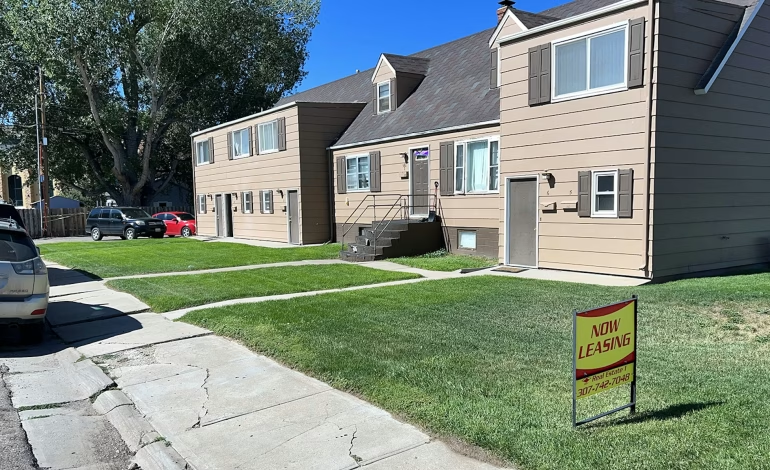
Bueno chose Laramie for its university vibe, younger crowd and walkability. Originally from Brazil, he liked the town’s international feel and the mountains in the background. Finding the right apartment, however, proved far harder than expected.
“Most of the apartments here are for students,” he said. “It was really difficult to find something downtown for people who are older and not in school.”
Because Bueno doesn’t own a car, he wanted to live close to downtown. Instead, he ended up in student housing on the edge of town.
“It was a tradeoff between being close to the grocery store and the rec center or being downtown,” he said. “I’d love to be downtown to enjoy the shops and restaurants, but I couldn’t make that work.”
Christensen’s challenge has been buying. He hoped to find a starter home in Laramie, but prices quickly shocked him.
“I thought housing would be a lot cheaper here than it is,” he said.
Homes in the $275,000 to $300,000 range — his target — go fast, often with multiple buyers competing.
“There’s a lot of competition,” he said. “Once my wife gets a job here, we’ll see what’s even possible.”
Protzer says the economics are straightforward: not enough supply equals higher prices — the same basic principle driving up beef prices when cattle numbers drop.
“With five, six, seven people competing to buy the same home, prices ratchet up very fast,” he said. “Poor supply is directly linked to price growth.”
One of the biggest culprits, he says, is overregulation, especially minimum lot-size rules.
Research shows that stricter land-use rules can drive housing prices up 20% to 40%, and even small increases in regulation can speed up price growth by 10%.
“When communities eliminate minimum lot sizes and let the market decide, supply often responds quickly,” Protzer said.
Cheyenne offers a real-world example of how loosening regulations can work.
The city scrapped its 7,000-square-foot minimum lot size and eased several other costly development rules. Now, developers can build on much smaller lots, and parking requirements were reduced to encourage smaller apartment projects.
“We now have no minimum lot size,” said Cheyenne Mayor Patrick Collins. “We’ve got a developer planning to build on 2,750-square-foot lots.”
The results have been immediate. Cheyenne is seeing nearly double the number of building permits this year compared to last year, and one new project alone will add 46 one-bedroom apartments.
“It’s just incredible,” Collins said. “A lot of the work we did, we’re now seeing developers take advantage of it.”
The bigger picture, Protzer said, is that Wyoming’s housing prices are now outpacing its economic fundamentals — something that used to be mostly confined to ultra-hot markets like California.
“It used to be easier for people to accept high prices in coastal cities,” he said. “But now we’re seeing that same dynamic in rural states, and it’s much harder to justify.”
For workers like Bueno and Christensen, the issue isn’t academic — it’s daily reality. And for Wyoming leaders trying to recruit new businesses and young professionals, housing is fast becoming one of the biggest obstacles.
If supply doesn’t catch up soon, Wyoming may find itself sharing more with California than just jokes — including a housing crisis that’s tough to unwind.


The latest news in your social feeds
Subscribe to our social media platforms to stay tuned