





The original story by for WyoFile.
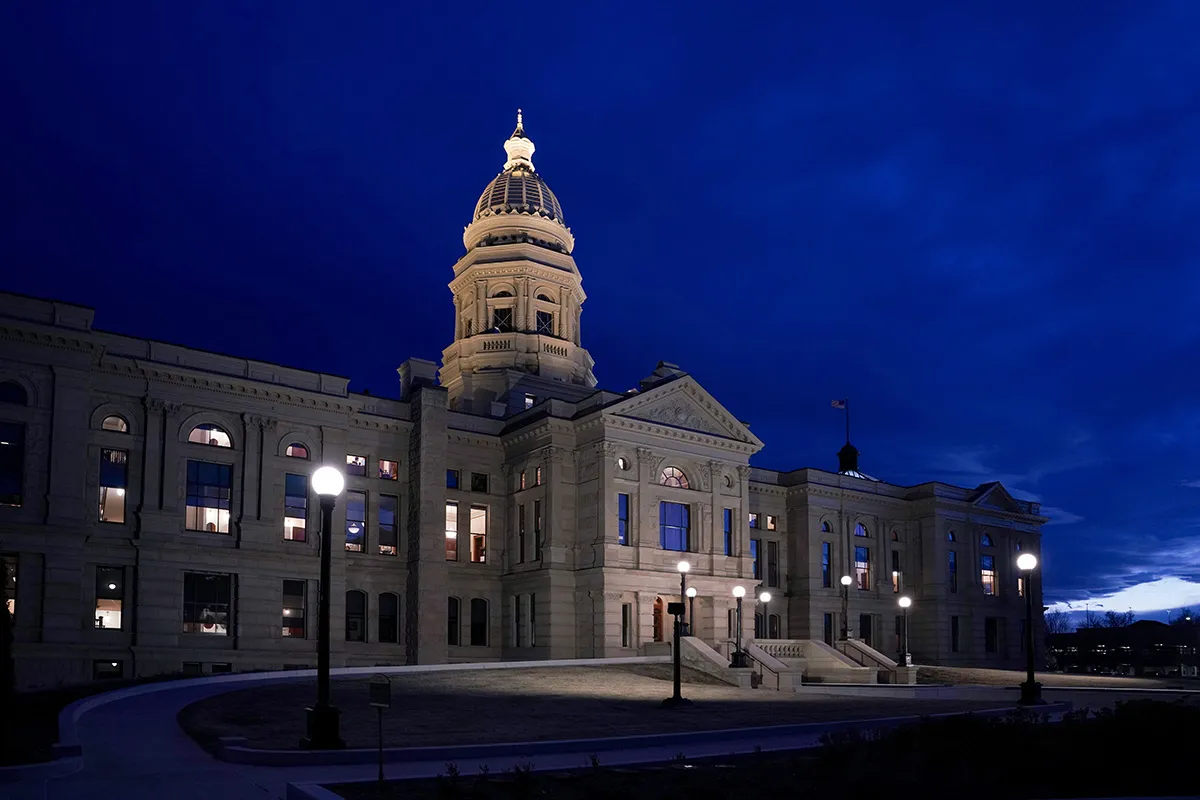
Competing ideas about Wyoming’s economic future crashed into each other at the Capitol on Thursday as the Wyoming Business Council pitched its next budget to the Legislature’s Joint Appropriations Committee.
On one side: lawmakers who say government shouldn’t be in the business of economic development at all. On the other: the state’s official business agency warning that Wyoming is already sliding into long-term economic decline.
“The markers of GDP, the markers of wages, the markers of [the] number of job opportunities, the outmigration of our youth and the widening gap between our population and our workforce all spell that our economy is not where we want it to be,” said Josh Dorrell, CEO, Wyoming Business Council.
The hearing was part of the first round of budget meetings ahead of the 2026 legislative session, and the Business Council found itself very much in the hot seat — especially after at least one lawmaker floated the idea of eliminating the agency entirely.
Created in 1998, the Business Council is Wyoming’s statewide economic development arm. For the next two-year budget (2027–28), it’s asking for about $112 million.
Gov. Mark Gordon has recommended about $55 million — roughly half that amount — and even that, Dorrell said, won’t really move the needle, especially for communities trying to build basic infrastructure like water and sewer lines to business parks.
Senate Appropriations Chairman Tim Salazar, R-Riverton, pushed the issue:
“For you to be successful, you believe your budget should be somewhere over a billion, correct?”
“Mr. Chairman, yes,” Dorrell replied.
House Appropriations Chairman Rep. John Bear, R-Gillette, pressed Dorrell on why the governor had recommended cutting the council’s request in half.
“I don’t see any other agencies where he’s denying half of the requests,” Bear said.
Dorrell said he told the governor that neither number was enough, but acknowledged Gordon has to balance the entire state budget. Gordon’s office later reminded everyone that his proposal is just a recommendation and that lawmakers ultimately decide where the money goes — including whether to restore cuts.
A big part of Thursday’s tension wasn’t just about dollars — it was about philosophy.
Bear and others questioned whether government should be involved in recruiting and supporting private businesses at all.
“Prior to that, we went 150 years without government intervening in private sector business,” Bear said, noting the United States will turn 250 years old next year. “Don’t you agree that we have a great history in this country of private sector production?”
“Of course, I would agree with that,” Dorrell answered. “I don’t get to go back 100 years to when states didn’t compete. I get to solve the problem I have today.”
And that problem, he said, is stark: Wyoming is losing its own people.
A 2024 analysis prepared for the Business Council by Harvard researchers found that 60% to 70% of Wyoming-born residents leave the state permanently by age 30.
“Our outmigration of our youth and people who are born in this state is greater than any other state in the nation,” Dorrell said.
Not everyone on the committee was buying the Business Council’s numbers.
Rep. Ken Pendergraft, R-Sheridan, said his own research — including US Census Bureau data — contradicts the outmigration figures.
“I just say that because I’m really interested in the truth,” he said.
Dorrell responded that he’d love to be wrong, but the state’s demographic trends back up the concern.
Pendergraft also raised a familiar criticism: that the council “picks winners and losers” when it awards grants, pointing to a Sheridan County metal fabricator that received funding while other similar businesses did not.
Dorrell replied that the council can only evaluate and fund those who actually apply, and invited Pendergraft to send names of other businesses that might be interested.
Pendergraft also said he “rejects” the results of a statewide poll the Business Council commissioned this fall, which found strong voter support for proactive, community-led economic growth and keeping young people in Wyoming. He argued the survey questions were flawed.
At the heart of the debate was a bigger question: who should pay for the basic infrastructure that makes business expansion possible — states and communities, or the private market?
Pendergraft put it bluntly:
“How do you answer those that say it is not the role of government to build infrastructure? Leave that to the free market.”
Dorrell argued that Wyoming has, in effect, been running that experiment already — and it hasn’t gone well.
“The idea that the state or that the community shouldn’t pay for infrastructure, that experiment is sort of running right now,” he said. “And what it’s saying is that people are leaving and what it’s saying is our economy is in decline.”
The Business Council is also pushing for policy changes, including updates to its Business Ready Community grant and loan program, to better help towns and counties prepare sites for new jobs and investment.
The Appropriations Committee will keep working through agency budget requests this week and will reconvene Jan. 5 to continue hearings. No formal votes on the budget bill are expected until the week of Jan. 12.
In the meantime, the central question hanging over the Business Council — and Wyoming’s economy — is still unresolved:
Should the state step up and invest more aggressively in economic development, or step back and let the market sort things out, even as jobs, wages and young workers drift away?


The latest news in your social feeds
Subscribe to our social media platforms to stay tuned