





The original story by for WyoFile.
A brewing legal battle in Campbell County is putting public land access back under the microscope in Wyoming — and it’s one that hunters and access advocates are watching closely.
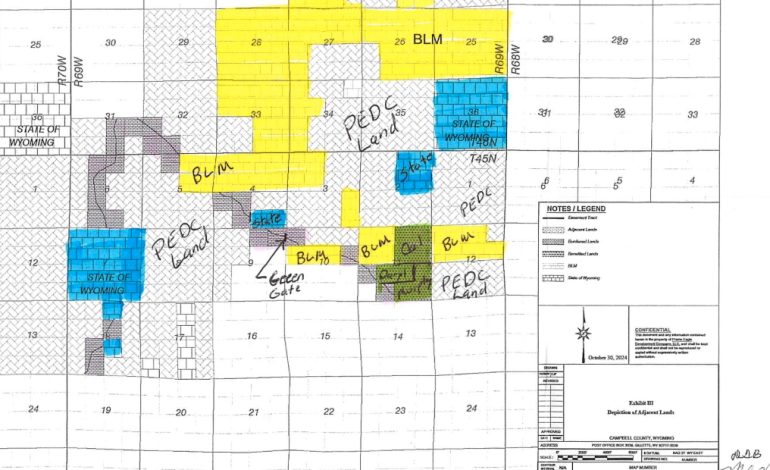
At the center of the dispute is Rozet resident Calvin Ten Braak, who has a legal road easement that runs about 10 miles across private land in the Powder River Basin so he can reach his remote cabin. Along that same road sits more than 16,500 acres of otherwise landlocked public land managed by the Bureau of Land Management.
Now, the owners of the surrounding private property — Frank and Michael Maestri — are suing Ten Braak, arguing that while he can legally use the road to reach his cabin, he has no right to stop and hunt on public land along the way.
The conflict exploded into public view in June, when Ten Braak received a cease-and-desist letter from the Maestris’ attorney after the family bought thousands of acres the road runs through.
The letter argued that the easement is strictly for getting to and from Ten Braak’s land — nothing more.
“The purpose of the Easement is to allow access to the grantees’ property, not public property,” the letter states. “This Easement shall solely be used for ingress and egress.”
The Maestris also claimed the easement does not give Ten Braak the right to use the road as a “thoroughfare” to reach public land for hunting.
Ten Braak fired back through his attorney, Alan Harding of Laramie, calling the accusations “baseless and in bad faith.”
“Public lands are held in trust for the benefit of the public,” Harding wrote. “Access to such lands cannot be curtailed by private parties absent statutory authority or ownership interest.”
Less than three weeks later, the Maestris formally filed suit.
The case is still in its early stages. Harding filed a motion to dismiss in August, the Maestris responded in September, and last week District Court Judge Mike McGrady held a hearing on the matter.
No quick resolution appears likely: the trial is now scheduled for December 2026.
Ten Braak and his attorney declined to comment on the case. Frank Maestri, however, pushed back on the idea that this is about blocking access to public land.
“This is a private land case,” he said. “It has nothing to do with access to public land.”
But maps of the easement show the road cuts across private land, state land, and BLM ground, making the public land unreachable without crossing the Maestris’ property.
For the past seven years, Ten Braak has shared access to the road with Hunting with Heroes, a Casper-based nonprofit that takes disabled veterans outdoors for hunts and fishing trips.
Guide Terry Wilkerson of Sundance says those trips have changed lives.
“We had a 90-year-old Korean War vet who could hardly walk, and we got him a nice bull,” Wilkerson said. “We had a 100% disabled Air Force vet with terminal brain cancer, and he got a nice bull, too.”
Wilkerson is now worried the lawsuit could shut down those hunts — and open the door to even broader restrictions statewide.
“If this is upheld, I think it’s going to have a tremendous negative impact on access to a lot of public land,” he said.
The case is also reviving memories of Wyoming’s recent corner-crossing battle, which ended in a win for public access after years in court and national attention. That ruling affirmed that hunters can step from one public parcel to another even when private land meets only at a corner.
Now, some lawmakers and advocates see this Campbell County case as the next major test.
State Rep. Karlee Provenza, D-Laramie, who often supports public land access, says the lawsuit sends a troubling message.
“This is a demonstration of the lengths that someone will go to, to block access to public land,” she said. “I’m grateful for Mr. Ten Braak standing up to this and saying no.”
If the Maestris prevail, legal experts and access advocates fear it could give private landowners a new way to effectively shut off public land that can only be reached by crossing private property — even when lawful easements exist.
For now, Ten Braak can still use the road and still hunt public ground. But with a trial set two years out, the outcome could reshape how access works across large swaths of Wyoming — and the West.


The latest news in your social feeds
Subscribe to our social media platforms to stay tuned