





After Brutal Fire Season, Lawmakers Weigh Inmate Fire Crews and Brace for Vet Shortage

A year after wildfires tore through parts of Wyoming, lawmakers are trying to shore up the state’s defenses — not just against future fires, but against growing strains in agriculture and animal health, Gillette News Record reports.
On Tuesday, the Legislature’s Joint Appropriations Committee (JAC) spent much of the day focused on the outdoors, hearing from the Wyoming Department of Agriculture, the Wyoming Livestock Board, and taking up a slate of wildfire and forestry bills backed by Gov. Mark Gordon.
Gordon framed the effort in a statement after the meeting: Wyoming’s strength, he said, has always come from “the people who work this land and protect it,” and that means backing agriculture and building a stronger wildfire response.
Wyoming Department of Agriculture (WDA) Director Doug Miyamoto walked lawmakers through the agency’s budget and mission, boiling it down to a simple goal: the department’s job, he said, is “to keep farmers farming and keep our ranchers ranching.”
That mission stretches beyond crops and cattle. WDA oversees six divisions, including Consumer Health Services, which regulates food establishments, inspects meat and even tests water quality in public pools.
Miyamoto also highlighted the agency’s role in pushing back on parts of the BLM’s Rock Springs Resource Management Plan, particularly language that would have made “preservation” a primary use of federal land. WDA argued that would undercut the long-standing multiple-use doctrine and hurt livestock grazing.
Lawmakers also drilled into money mechanics, including concerns from Sen. Dan Laursen, R-Powell, about mandatory administrative fees on small commodity groups, like the Dry Bean Commission. Legislative Service Office staffer Don Richards defended the cost-recovery system but said the overall salary cost allocation impact is under 1%.
The committee asked for more data — like overtime costs for State Fair staff and breakdowns of local vs. statewide event expenses — to help guide budget decisions in January.
Next up was the Wyoming Livestock Board (WLSB), where the tone shifted from budgets to warning lights.
Director Steve True outlined the board’s work: administration, animal health, brand inspection and recording, plus a tiny law enforcement unit — just two officers for the whole state. He said a partnership with county sheriffs appears to be paying off, with livestock theft reports down about 50%.
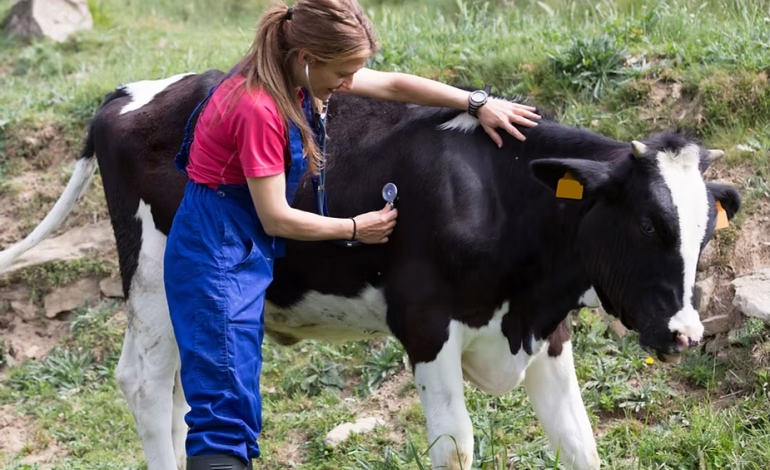
But the bigger issue, according to State Veterinarian Dr. Hallie Hasel, is capacity.
A recent federal reorganization at the Animal and Plant Health Inspection Service (APHIS) cost the federal office five staff members, including three veterinarians. The fallout: the state is now down to three veterinarians handling all WLSB animal health responsibilities across Wyoming.
Hasel told lawmakers that means something has to give.
“The one thing that we can let go — that we don’t want to let go, but we’ll probably have to — is the education of our producers and our veterinarians,” she said.
Whenever a major animal health emergency hits — like avian influenza or new world screwworm — staff have to drop everything else. With fewer vets, there’s even less room to manage outreach and prevention.
Lawmakers also revisited the long-running debate over electronic identification (EID) tags for cattle. The Legislature had previously directed WLSB to ask neighboring states if they’d accept brands as official ID instead of federal EID tags for traceability.
True told the committee the answer was almost universally no — every state except Utah flatly rejected the idea, leaving Wyoming with limited flexibility if it hopes to keep cattle moving smoothly across borders.
The heart of the wildfire discussion came in the form of four policy bills aimed at boosting the State Forestry Division. Three of the four made it through the committee, with some changes.
1. Inmate Conservation Crew: A 12-Person Wildland Fire Team
One bill, “Forestry conservation program inmate crew module,” would create a 12-person wildland fire suppression crew to lead inmate forestry conservation projects statewide.
The original price tag was $1.58 million, but lawmakers adopted amendments from Rep. Jeremy Haroldson, R-Wheatland, bumping the funding up to $2,572,000 and setting an effective date of April 1, 2026.
The crew structure was also tweaked to add a regional manager, matching the administration’s recommendation more closely. With those changes, the bill passed the committee.
2. Inmate Crew Leaders: Start Date Snag
A related bill, “Forestry conservation program inmate crew leaders,” proposed two full-time positions to oversee inmate crews, funded at $750,000 with staggered start dates.
But State Forester Kelly Norris warned that the proposed July 1 effective date would put staff behind schedule for the fire season. Lawmakers agreed the timing and fiscal note needed work and tabled the bill until a future meeting.
3. Better Retirement Plans for Wildland Fire Staff
The third bill, “State forestry division–retirement plans,” would move wildland fire staff within the Office of State Lands and Investments into more competitive retirement plans.
Wyoming Retirement System Director David Swindell told the committee the change would actually help the system due to amortization requirements built into the plans. That bill also cleared the committee.
4. Hazard Pay and Leave for Fire Staff
The final bill, “Firefighters — paid leave and hazard pay,” focuses on the people supervising inmate crews on the fire line.
Norris said the lack of hazard pay and paid time off in line with federal policies has turned into a retention crisis, with the BLM acting as “an excellent recruiter” for State Forestry staff because it offers better benefits.
Lawmakers amended the bill to move the effective date to May 1, and increase funding from $390,000 to $422,500 to cover the earlier rollout.
With those adjustments, the bill passed.
Taken together, Tuesday’s meeting painted a pretty stark picture:
- Wildfire seasons are getting tougher, and the state is trying to build out inmate fire crews, boost benefits, and keep experienced staff from leaving.
- Animal health capacity is stretched thin, with just three veterinarians now responsible for the entire state.
- Agriculture agencies are still fighting for multiple-use federal policy, fair cost structures, and enough data to justify their budgets.
The message from agencies was consistent: Wyoming’s rural backbone — the people who raise livestock, grow food and protect land from fire — is under real pressure. And lawmakers now have to decide how much they’re willing to invest to keep that system from cracking.


The latest news in your social feeds
Subscribe to our social media platforms to stay tuned