


EXCLUSIVE: A Look at Trump’s New Europe Strategy. Tough Love, Not a Break-Up.


For decades, the US–EU relationship was almost boring: the biggest trade and investment link in the world, NATO in the background, and a constant story about “shared values.” The unwritten deal was that Washington paid most of the security bill while Europe focused on markets, regulations and diplomacy. Donald Trump’s return has ended that comfort.
In a recent short interview to Wyoming Star Steven Pifer, an affiliate of Stanford’s Center for International Security and Cooperation and a former US ambassador to Ukraine, said:
“The Trump administration’s approach toward the European Union treats it as a threat… indeed, a greater threat to US interests than that posed by a revisionist Russia that is conducting the largest war Europe has seen since 1945. That frankly bizarre assessment is a striking departure from how other US presidents have regarded the European Union… There have been frustrations in the past with specific EU policies, but Europe remains America’s largest trade and investment partner. While the recently-released Trump National Security Strategy expressed concern that the EU’s anti-democratic forces could make Europe “unrecognizable in 20 years or less,” most European countries rank equal to or higher than the United States on freedom indexes.”
From Trump’s vantage point, though, Brussels plays its own game. It regulates US tech, pushes its climate and digital agenda extraterritorially, and, in his view, uses the rhetoric of liberalism to ignore angry electorates. For Trump-world, this isn’t a protection racket; it’s a demand that rich democracies start matching real power to their own political choices.
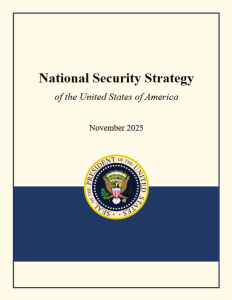
The new 2025 National Security Strategy (NSS) makes that demand official. The document openly pivots US priorities back to the Western Hemisphere and the Indo-Pacific – a Trump-era add-on to the old Monroe Doctrine that some commentators already nickname the “Donroe Doctrine.” Europe still matters, but it is no longer the main theatre.
The Europe chapter is blunt. It warns that mass migration and EU centralisation could leave some NATO allies “majority non-European” within decades and accuses EU elites of “subverting democratic processes” by overruling voters who want peace in Ukraine or tighter borders. It calls on Washington to “cultivate resistance” to Brussels inside member states. Carl Bildt calls the strategy “to the right of the extreme right in Europe,” and European leaders have queued up to denounce it as meddling and ideological warfare.
Underneath the drama, the logic is cold: Europe is rich, mostly safe and, in Trump’s view, perfectly capable of taking “primary responsibility” for its own defence so Washington can focus on China and instability closer to home. The free ride is over, but the door is not closed.
Eastern Europe is where this stops being theoretical. Romania’s original 2024 presidential vote was annulled after intelligence services warned of a huge Russian influence operation. In the rerun, George Simion – an AUR ultranationalist who calls himself Trump’s “natural ally,” rails against EU leaders and questions open-ended Ukraine aid – topped the first round comfortably. Western coverage casts him as a far-right spoiler who could turn a frontline NATO state into a disruptor inside the EU. Trump-world sees a system that cancels a ballot, then panics when voters double down on the one candidate openly promising a “return to constitutional order.”
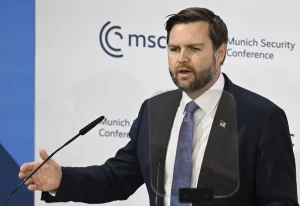
JD Vance’s speech at the Munich Security Conference turns that frustration into doctrine: he accuses EU governments of using “disinformation” laws and security services to keep populists out and hints that future US backing will depend on how far they actually trust their own electorates. Next door, Moldova’s recent parliamentary elections – hailed by US analysts as “a win for democracy” and a setback for Putin’s alleged meddling – show you should not treat every anti-Brussels vote as illegitimate.
Trump’s answer is to lean into national-conservative partners who still campaign on borders, birth rates and sovereignty. Viktor Orbán calls the new NSS “the most important and interesting” strategy in years because it finally acknowledges Europe’s “civilisational crisis” and salutes the rise of “patriotic parties” inside the EU. A companion piece in Hungarian Conservative describes US–Hungary ties at a “historic high,” built on energy deals and a shared focus on national interest rather than lectures.
Pifer reads this as flirting with autocrats:
“The Trump administration’s pivot toward Hungary and far-right, populist “patriotic” political parties such as Germany’s Alternative for Deutschland suggests an alarming turn toward embracing autocratic forces that threaten to divide and weaken Europe. A weaker Europe would be a less capable partner for the United States in dealing with the challenges posed by Russia and China. Ultimately, that would weaken America.”
Trump’s team insists it is backing voters who feel written off by a Brussels establishment that equates dissent with extremism.
US strategists now summarise the emerging line as “America First, Europe Fourth”: the homeland, then the Western Hemisphere, then the Indo-Pacific, and only then Europe. European security analysts, from the EU Institute for Security Studies to Carnegie Europe, have been warning for years that the EU must prepare for exactly this world of “low trust” across the Atlantic by turning talk of “strategic autonomy” into real capabilities and higher defence budgets. Europe is no longer the centre of gravity but a theatre that should be able to look after itself while the US focuses on China and nearby instability.
Seen in this light, Trump’s Europe policy looks less like vandalism and more like a stress test. It assumes European democracies will either step up – spending more on defence and taking ownership of Ukraine and migration policy – or drift into strategic irrelevance while China and Russia dominate Washington’s attention. The transatlantic bond survives, but as a partnership of adults, not a permanent American babysitting service.


The latest news in your social feeds
Subscribe to our social media platforms to stay tuned