



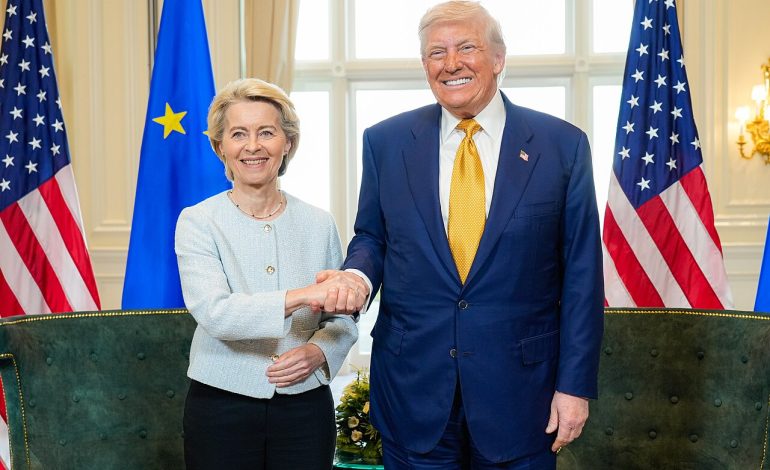

For 70-plus years, US presidents mostly treated Europe like delicate china: praise in public, pressure in private, and an unspoken promise that America would always pick up the security tab. Donald Trump has ripped that script up – and the new National Security Strategy (NSS) is the formal notice.
Foreign-policy veteran Dr. Daniel S. Hamilton, a nonresident senior fellow at the Brookings Institution’s Center on the United States and Europe, president of the Transatlantic Leadership Network, and senior fellow at the Foreign Policy Institute of Johns Hopkins University’s School of Advanced International Studies (SAIS), founding director of the SAIS Center for Transatlantic Relations, a former deputy Assistant Secretary of State, spoke to Wyoming Star and described the evolution of Trump’s view on the US-EU relations:
“Republican and Democratic presidents since the end of World War II encouraged European allies to build their security together, rather than against each other; to build down barriers across their economies; and to extend the space of democratic capitalism where war simply doesn’t happen. NATO and the European Union were the key vehicles for this. President Trump has upended this approach… He treats NATO as a protection racket, saying “if they don’t pay, I’m not going to defend them.” In his first term he called the EU a “foe” and “worse than China, only smaller.” Recently he asserted that “the European Union was formed to screw the United States.” In his second term he and his acolytes have adopted more of a “civilizational” than a “foreign policy” approach to Europe; his National Security Strategy calls for “cultivating resistance” to the European project and says Europe risks “civilizational erasure” for accepting so many immigrants.”
That’s meant as a condemnation; Trump’s camp hears it as a confession of how complacent the old model became. Critics focus on Trump’s habit of telling allies that if they don’t pay, he might not defend them. But this is exactly the logic of the NSS: strategy means prioritising core national interests, not underwriting an open-ended global project while allies “offload the cost of their defense onto the American people.”

European commentators cast this as coercion. One Guardian analysis argues the “Trump doctrine” leaves Europe “on its own,” warning that Washington will pull back militarily while using trade, sanctions and regulatory pressure to bend the EU to its will. Trump’s supporters would say: yes, that’s the point. If Europe wants adult status, it has to act like a power, not a protected ward.
The NSS hits where it hurts. It warns of European “civilisational erasure,” slams Brussels for censorship, over-regulation and migration policies that are “transforming the continent,” and openly calls on Washington to “cultivate resistance to Europe’s current trajectory within European nations.”
Hamilton and sees this new approach as a flirtation with “illiberal democracy”:
“Trump has forged alliances with far-right European parties who champion what Hungarian prime minister Viktor Orban calls “illiberal democracy.” Transatlantic illiberals exchange views, share tactics, and mimic each other’s rhetoric. They champion a “Europe of the Fatherlands;” they abhor the European Union. They believe that the “true threat to Europe,” in the words of Vice President Vance, is not Russia or China, it is “the enemy within”: Europe’s mainstream establishment, whose leaders are seen as an extension of Trump’s opponents at home. Transatlantic illiberals believe that the collective West must revert to a civilizational ethos centered around national sovereignty, white supremacy, and a deeply conservative interpretation of Christianity.”
Trump’s circle insists they’re talking about sovereignty, borders and majoritarian politics and about letting voters, not technocrats, decide the line on migration and culture.
The 2025 NSS is brutally clear about hierarchy. It says the era of trying to dominate every region is over; resources will be focused on the US homeland, the Western Hemisphere and the Indo-Pacific. Europe is still important, but no longer the main theatre.
European elites have responded with something between outrage and shock. Former Swedish prime minister Carl Bildt calls the document’s Europe chapter “blatant hostility,” noting it contains no criticism of Russia’s war on Ukraine and even hints at “strategic stability” with Moscow. A French junior defence minister branded the strategy a “brutal clarification” and urged Europe to speed up rearmament. Chatham House and CSIS analysts describe the NSS as derisive toward Europe and a sign that US policy has become volatile and transactional.
But even some European voices warn that, however much they dislike the tone, the message can’t just be waved away. Judy Dempsey at Carnegie Europe argues that the strategy forces Europeans “to hear what America is saying” about their defence gaps, migration policies and political drift – and to craft a serious answer.
If Brussels is uncomfortable, parts of Eastern and Central Europe are quietly thrilled. As The American Conservative reports, national-conservative figures like Poland’s Krzysztof Bosak and German AfD adviser Filip Gaspar see the NSS as a long-overdue reality check: a US document that finally talks about sovereignty, controlled migration, cultural stability and realist statecraft instead of feel-good platitudes.
The strategy explicitly says the “growing influence of patriotic European parties” is cause for “great optimism” and encourages Washington to support them. That’s exactly what horrifies Hamilton, who warns of a “transatlantic illiberal” network linking Trump with Europe’s far right. But from Budapest to Warsaw, many voters hear something different: an American president who actually acknowledges their anxiety about demographic change, energy prices and a distant Brussels bureaucracy.

Trump doubled down in his interview with Politico’s Dasha Burns, calling much of Europe “decaying” and its leaders “weak,” blaming mass immigration and speech restrictions for making countries “not … viable” in the long run – while praising border-hawks like Hungary’s Viktor Orbán and Turkey’s Recep Tayyip Erdoğan. For his critics, this is an embrace of autocrats. For his admirers, it’s a signal that Washington will work with governments that actually defend their borders and cultures, even if they make Brussels uncomfortable.
All of this feeds into the quiet knife-fight now under way in Brussels. Trump’s top envoy to the EU told POLITICO Europe that the bloc needs to stop being “the world’s regulator,” warning that its aggressive rules are driving startups to relocate to the US. In other words: if Europe wants the US as a security partner, it can’t keep using regulation to batter American firms while underinvesting in its own defence.
Meanwhile, the NSS makes explicit what strategists have whispered for years: the US cannot fight major wars in Europe and Asia at the same time. China and the Western Hemisphere come first; Europe must be able to look after itself. The 2025 NATO summit in The Hague – where allies pledged to move toward 5 percent of GDP on defence by 2035 – shows that message is finally landing.
Trump’s critics see chaos: a protection racket, regime change in Europe, a flirtation with illiberalism just as Russia and China loom. His supporters see something else: a forced reset. In their view, the old transatlantic bargain bred dependency and denial. The new one, spelled out in the NSS, tells Europeans that the US will still be there – but as a blunt, interest-driven superpower competing with China, not as Europe’s eternal babysitter.
The choice Trump is offering Europe is harsh but simple: remain a comfortable client, or grow into a sovereign partner that pays its own way, defends its borders and can stand alongside – not underneath – the United States.


The latest news in your social feeds
Subscribe to our social media platforms to stay tuned