



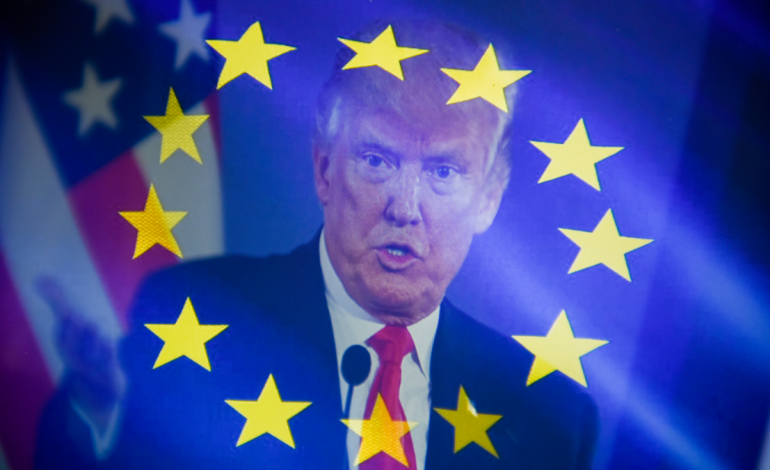

If you want to understand how badly the transatlantic relationship has frayed, start with this simple contrast.
On one side, the EU Council’s own numbers still describe the US–EU link as “the world’s most closely integrated economic relationship,” with €1.68 trillion in annual trade and over €5.3 trillion in mutual investment, supporting millions of jobs on both sides of the Atlantic.
On the other side, you now have a US president whose official National Security Strategy (NSS) basically says Europe’s main institutions are undermining liberty, erasing civilization, and need to be politically contained rather than courted.
This is the story of how we got from one to the other – and what Trump’s White House is trying to build in Europe instead.
For most of the post-war era, the US project in Europe was pretty straightforward: help Europeans integrate, trade more, fight less, and stand together against Moscow. NATO and what became the EU were the twin pillars of that vision.
Dr. Daniel S. Hamilton, Senior non-resident Fellow at the Brookings Institution and at Johns Hopkins University’s School of Advanced International Studies, whose recent articles include “The ‘Enemy Within’: How Partisan Cleavages are Redefining Transatlantic Relations” and “The Transatlantic Community and China in the Age of Disruption,” sums up that consensus neatly:
“Republican and Democratic presidents since the end of World War II encouraged European allies to build their security together, rather than against each other; to build down barriers across their economies; and to extend the space of democratic capitalism where war simply doesn’t happen. NATO and the European Union were the key vehicles for this. President Trump has upended this approach. He treats NATO as a protection racket, saying, ‘If they don’t pay, I’m not going to defend them.’ In his first term he called the EU a ‘foe’ and ‘worse than China, only smaller.’ Recently he asserted that ‘the European Union was formed to screw the United States.'”
That’s not just rude; it’s a frontal challenge to 70-plus years of US strategy.
The EU side still talks the old language. The center-right EPP Group in the European Parliament just released a position paper insisting that “a strong Europe can ensure a strong EU–US partnership” and calling the transatlantic bond “indispensable” for global stability. BusinessEurope, representing big European firms, warns that tit-for-tat tariffs “harm businesses and consumers on both sides” and urges a permanent high-level platform to stop trade spats from spiraling.
Trump’s Washington is playing a different game.
The first Trump term already damaged trust: tariffs on steel and aluminum, threats over European car exports, and the constant drumbeat that Europeans were freeloading on US defense.

By Trump 2.0, the fight has morphed from a narrow trade quarrel into a broader political struggle.
A TEPSA analysis puts it bluntly:
“Europe lost the trade war. Now Trump wants a political one.”
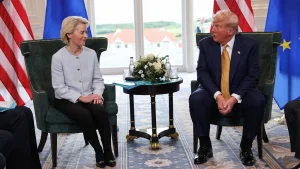
The piece describes how a Trump–von der Leyen deal to avoid even harsher tariffs left Europe facing 15% duties on most exports while US industrial goods enter tariff-free – a wildly asymmetric bargain that locked in US leverage.
Then comes the second move: weaponizing that leverage to reshape European politics, chiefly by empowering the far right. That’s not a conspiracy theory: it’s now openly discussed on both sides of the Atlantic.
If you want the Trump worldview on Europe in one document, the December 2025 NSS is it.
Beyond the usual language about China and Russia, the Europe section reads like an indictment. It argues:
“The larger issues facing Europe include activities of the EU and other transnational bodies that undermine political liberty and sovereignty, migration policies that are transforming the continent and creating strife, censorship of free speech and suppression of political opposition, cratering birthrates, and loss of national identities and self-confidence.”
That is not the vocabulary of an ally trying to manage disagreements. It’s the vocabulary of a culture war.
Dr. Hamilton again:
“In his second term he and his acolytes have adopted more of a “civilizational” than a “foreign policy” approach to Europe; his National Security Strategy calls for “cultivating resistance” to the European project and says Europe risks “civilizational erasure” for accepting so many immigrants.”
European analysts from ECFR and others were stunned not just by the policy shift but by the tone: a US strategy document that openly talks about backing forces inside Europe to push back against EU integration.
The European Parliament’s own “At a Glance” briefing describes the NSS as a “significant reorientation” of US foreign policy, particularly in how domestic concerns like border security and migration now dominate America’s view of Europe.
Meanwhile, US think tanks in Washington read the same text as a clear downgrading of Europe. War on the Rocks captured the mood with the headline “America First, Europe Fourth,” arguing that Trump’s team sees the Indo-Pacific, the Western Hemisphere, and even the Middle East as higher priorities than Brussels.
Put differently: the White House doesn’t just want Europe to spend more on defense; it wants a different Europe – less supranational, more nationalist, more culturally conservative – and is willing to engineer that outcome.
Steven Pifer, an affiliate of Stanford’s Center for International Security and Cooperation and a former US ambassador to Ukraine, spells out how radical that feels from the traditional US policy camp:
“The Trump administration’s approach toward the European Union treats it as a threat… indeed, a greater threat to US interests than that posed by a revisionist Russia that is conducting the largest war Europe has seen since 1945. That frankly bizarre assessment is a striking departure from how other US presidents have regarded the European Union. To be sure, there have been frustrations in the past with specific EU policies, but Europe remains America’s largest trade and investment partner. While the recently-released Trump National Security Strategy expressed concern that the EU’s anti-democratic forces could make Europe “unrecognizable in 20 years or less,” most European countries rank equal to or higher than the United States on freedom indexes. The Trump administration’s pivot toward Hungary and far-right, populist “patriotic” political parties such as Germany’s Alternative for Deutschland suggests an alarming turn toward embracing autocratic forces that threaten to divide and weaken Europe.”
From the Trump camp, of course, that’s the point: they don’t want a stronger EU as such. They want stronger nation-states that will cut bilateral deals with Washington, buy US energy and hardware, and align on migration and culture – and stop trying to regulate American tech giants or tell Israel, or the US, what to do.
You see this clash very clearly in the tech space. A Daily Sabah analysis notes how the EU’s Digital Services Act and Digital Markets Act – which led to a huge fine on Elon Musk’s X and a fresh probe into Google – have become a new flashpoint. Trump allies frame Brussels as a censorious “global regulator,” while the EU frames itself as the last line of defense against Big Tech abuse.
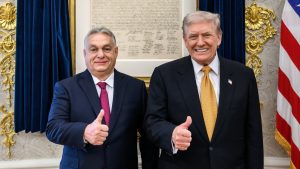
Hungarian Prime Minsiter Viktor Orbán and Donald Trump
(White House / X)
So if the EU institutions are the problem, who are Trump’s new European friends?
Answer: conservative governments in the former Eastern Bloc and a network of far-right and hard-right parties across the continent.
A Carnegie Europe paper calls this “the European radical right in the age of Trump 2.0,” arguing that many nationalist parties now see the White House as their external patron, not the centrist EU mainstream. Foreign Affairs talks about “Europe’s Trumpian right” feeding off American culture-war themes and amplifying them back into US politics.
Hungary is the poster child. A long piece in Hungarian Conservative describes Hungary–US ties as at a “historic high” after the Washington summit between Trump and Viktor Orbán. Officials brag about agreements on energy, nuclear cooperation, and culture, but the real language is ideological: sovereignty, family, and Christianity.
From the mainstream transatlantic perspective, that looks like Washington embracing “illiberal democracy.” Hamilton again:
“As part of his approach, Trump has forged alliances with far-right European parties who champion what Hungarian Prime Minister Viktor Orban calls “illiberal democracy.” Transatlantic illiberals exchange views, share tactics, and mimic each other’s rhetoric. They champion a “Europe of the Fatherlands”; they abhor the European Union.”
He goes further:
“They believe that the “true threat to Europe,” in the words of Vice President Vance, is not Russia or China, it is “the enemy within”: Europe’s mainstream establishment, whose leaders are seen as an extension of Trump’s opponents at home. Transatlantic illiberals believe that the collective West must revert to a civilizational ethos centered around national sovereignty, white supremacy, and a deeply conservative interpretation of Christianity.”
European commentators see the same dynamic from their side. TEPSA documents how US conservative networks like the Heritage Foundation are actively partnering with Polish and Hungarian nationalists, hosting workshops in Washington on dismantling EU institutions and promoting a “Make Europe Great Again” (MEGA) agenda. The European Policy Centre goes so far as to say Trump has “declared civilizational war on Europe.”
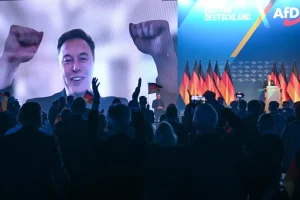
At the same time, parties like Germany’s AfD and France’s National Rally have welcomed the civilizational framing. Politico and DW report how AfD figures have been hosted in Washington, endorsed by high-profile US conservatives, and folded into the broader MAGA network.
For Trump, this isn’t a side effect; it’s a strategy. The NSS explicitly talks about building up “healthy nations” in Central and Eastern Europe and treating sympathetic governments there as “civilizational allies” against a supposedly decadent Brussels.
This is where the new coalition really emerges: Washington supplies the security umbrella, energy deals, and ideological messaging. Orbán, Polish ultraconservatives, and others supply the political machinery inside the EU. Far-right parties in big states (Germany, France, and Italy) become leverage against the EU’s core institutions.
James Goldgeier, Professor of International Relations and PhD program director at American University School of International Service, explores Trump’s underlying motives:
“When the Cold War ended, we hoped that the post-communist world, including Russia, would become more like us: democratic, market-oriented, and respecting the rule of law. Donald Trump seems to want the US to be more like Russia: authoritarian, transactional, and corrupt. The NSS suggests that what Trump most wants in Europe are leaders and parties who think like he does. For anyone who doesn’t want to live in a political, economic, and social system like the one in Russia, Trump’s desires to take us and Europe down that path are antithetical to the democratic, pluralistic, and law-abiding societies we have previously cherished.”
Trump, however, never paid much attention to the moral side of things. From his vantage point, the shift is ruthless but logical: if you believe the EU has become protectionist, over-regulated, and hostile to US culture and tech, why not work with forces trying to weaken it from within?
Step back, and you can see the Trump strategy as a three-part bet.
Bet 1: Europe will remain economically dependent anyway.
Despite all the politics, the raw numbers still scream interdependence. The EU Council notes that in 2024, EU–US trade in goods and services hit €1.68 trillion, with US exports to Europe supporting 2.3 million American jobs and European investment in the US worth around $2.4 trillion in economic activity.
BusinessEurope’s May 2025 paper calls the transatlantic economy “a strategic pillar of the global economy” and warns that escalating tariffs will only hurt growth and supply-chain resilience.
The Trump team seems to assume Europe will swallow this pain. Why? Because the US is still the more dynamic technology and energy power, and because China and Russia look even worse as alternatives.
Bet 2: A weaker EU makes for a stronger US negotiating position.
Here’s where critics like Pifer and Hamilton really worry. They argue that a deliberately weakened EU might make life easier for US negotiators in the short term, but it erodes a key partner just as Russia and China are testing the West.
Pifer warns:
“A weaker Europe would be a less capable partner for the United States in dealing with the challenges posed by Russia and China. Ultimately, that would weaken America.”
European think tanks go further. An EUISS “low trust” paper worries about a drift into mutual suspicion and fragmented defense planning, while a Finnish Institute report lays out four scenarios for transatlantic relations – including outright “strategic divorce” if US domestic politics stay polarized and EU states fail to coordinate.
Bet 3: The real game is elsewhere.
Finally, Trump’s people would say the quiet part out loud: in a world of China’s rise, a messy Middle East, and a still-armed Russia, Europe is no longer the main stage.
The Council on Foreign Relations talks about a “Trump twist” in US strategy – a turn toward a more transactional, hemispheric approach in which the US focuses on North America, the Indo-Pacific, and selected partners and treats Europe as just one file among many.
Carnegie’s “Can the EU meet the Trump moment?” asks whether Europe is capable of strategic autonomy if Washington really does drift away.
And in the background, Russia is still grinding away in Ukraine; China is still probing in the South China Sea and beyond.
Dr. Jeffrey Sachs, Professor and Director of the Center for Sustainable Development at Columbia University, coming from a very different angle than Hamilton or Pifer, is almost equally scathing about both sides:
“The relationship of the Trump Administration and the European Commission is what psychologists call a folie à deux. Both the US and Europe are delusional about their place in the world, with delusions of grandeur. They are fighting with each other over which specific wars to fight and who will pay for them, but neither is making much sense in their relations with Russia, China, and the rest of the world. Neither the US nor Europe has adjusted realistically to a multi-polar world. Both pushed NATO enlargement to the point of war with Russia. Currently, the US bullies its own neighbors while trying to settle the war in Ukraine, while the Europeans want to continue the war in Ukraine. Both the US and Europe are hostile towards China, rather than working with China. Both supported Israel in its murderous rampage in Gaza. NATO should have been disbanded back in 1990 when the Soviet Union ended the Warsaw Pact, or at least at the end of 1991, when the Soviet Union itself ended. Both the US and Europe squandered the historic chance for peace.”
You don’t have to buy all of that to recognize the core point: while Washington and Brussels argue over civilization, tariffs, and tech fines, the strategic environment keeps getting harsher.
If you strip away the drama, three realities remain:
- The economic bond is still huge and, for now, mutually beneficial. Neither side can casually walk away from €1.6+ trillion in annual trade and trillions in investment without serious self-harm.
- The political relationship is in free-fall. Trump’s NSS doesn’t just “reprioritize”; it recasts the EU itself as part of the problem. Key European voices now see the US administration not just as a difficult ally but as an active supporter of forces trying to roll back the Union from within.
- Neither side has a clear Plan B. Europe is talking up “strategic autonomy” and floating contingency scenarios but remains deeply tied to US markets, technology, and security guarantees. The US is looking to Asia and the Americas, but no other region offers the same combination of democratic legitimacy, capital, and military potential as Europe.
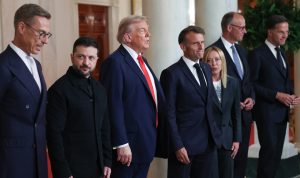
From a US perspective, the temptation is to see all this as cost-free leverage: squeeze the EU to buy more gas and weapons, hobble its regulatory reach, cultivate friendly governments in Budapest or Rome, and keep China in check without being bound by Brussels’ legalism.
But the deeper question is whether Washington is prepared for a world where, in the words of that BusinessEurope report, the “transatlantic relationship stands at a critical juncture” – and might not always be there to fall back on.
Right now, the Trump White House seems willing to run that experiment. Europe is scrambling to decide whether it can live with it or whether it finally has to grow into the strategic actor it has spent decades pretending to be.
Either way, the old comfortable story – “shared values, shared interests, inevitable partnership” – is over. What replaces it is still being written in Washington press rooms, Brussels bargaining sessions, and yes, in the backrooms of far-right parties that never used to matter in US foreign policy and suddenly matter a lot.
Comments by Prof. James Goldgeier were added.


The latest news in your social feeds
Subscribe to our social media platforms to stay tuned