
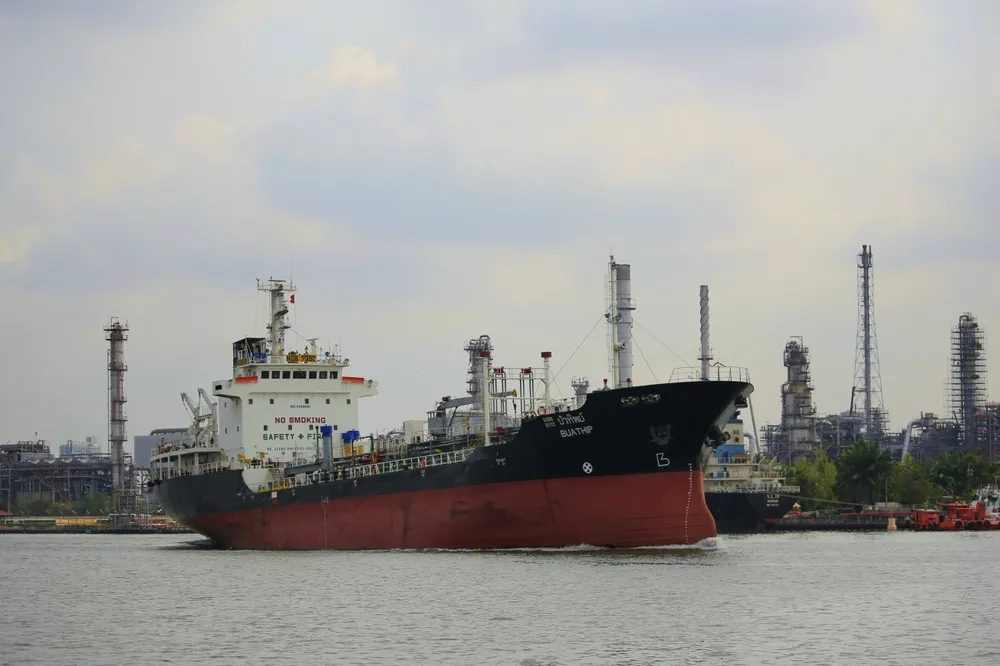

By the time US Coast Guard helicopters dropped ropes onto the deck of the oil tanker Skipper off Venezuela’s coast, the crisis between Washington and Caracas was already weeks into a dangerous new phase. The ship wasn’t just another sanctioned vessel slipping through the Caribbean. It was a floating symbol of where this standoff is headed: away from quiet sanctions and into a murky mix of naval raids, legal gambits, and regime-change politics.
The tanker is now under US control. Venezuela calls it piracy. Cuba calls it terrorism. Washington calls it law enforcement. Everyone else is trying to figure out whether this is the prelude to a wider war.
(picture alliance / ZUMAPRESS.com / Mc2 Tajh Payne /US Navy)
The US–Venezuelan relationship has been deteriorating for a quarter-century. What started as ideological friction between Washington and Hugo Chávez over oil policy and US interventions turned into open hostility after Caracas cozied up to Cuba, Russia, and Iran and expelled US anti-drug personnel.
By the mid-2010s, Washington had imposed targeted sanctions on officials accused of corruption and repression, then escalated to financial and oil sanctions after Nicolás Maduro’s contested 2018 reelection. In 2019, the US recognized opposition leader Juan Guaidó as interim president and tried to squeeze Caracas out of dollar markets.
There was a brief thaw. The Biden and early Trump years flirted with easing oil sanctions in exchange for elections and prisoner swaps. But Maduro’s crackdown around the 2024 vote, plus a renewed migrant surge, shifted the mood. The State Department’s Venezuela page once again reads like a sanctions manual, and the US Embassy travel advisory bluntly warns Americans not to go.
Then came the “drug war” phase.
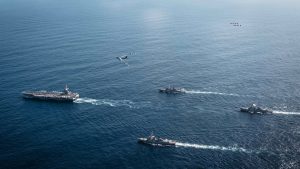
Over 2025, the US quietly assembled a serious force posture around Venezuela: guided-missile destroyers rotating through Caribbean waters, B-1B bombers flying “shows of force,” and a steady drumbeat of strikes on what Washington calls “narco-terrorist” boats linked to Venezuela’s Cartel de los Soles. ABC and the New York Times have tracked at least a dozen such strikes across the Caribbean and Pacific since late summer.
Our previous reporting from October and November described a build-up that looks a lot less like classic counter-narcotics and a lot more like a pressure campaign against the Maduro regime itself: naval task groups, Marines and special operations units rehearsing raids and evacuations, and Pentagon planners gaming out “limited strikes” on Venezuelan territory.
Democracy Now! and Al Jazeera have been blunter: the US is “already at war” with Venezuela, they argue, using drug interdiction as the legal fig leaf.
Into that context sailed the Skipper.
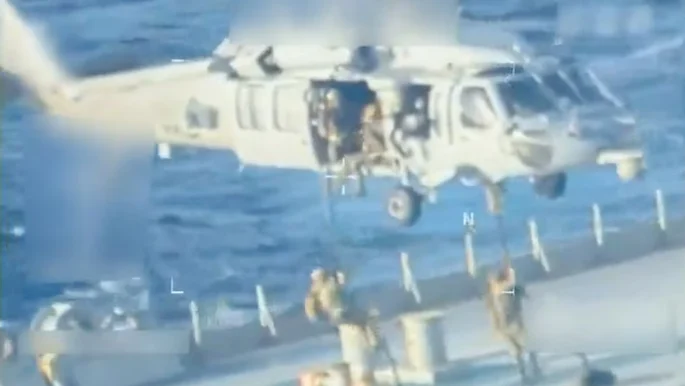
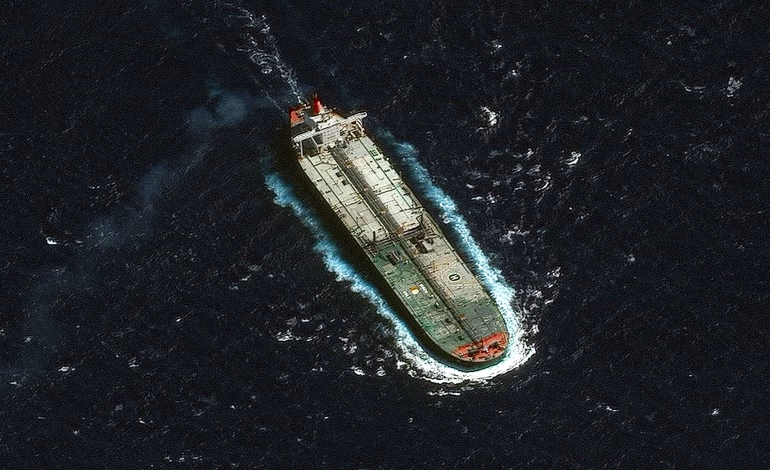
On December 10, US forces intercepted the crude oil tanker M/T Skipper off Venezuela’s coast, boarding it just as a federal warrant was about to expire. Court documents and shipping data suggest the ship had loaded about 1.8 million barrels of Merey heavy crude at Venezuela’s main export terminal and was headed toward Cuba in defiance of US sanctions.
The Justice Department says the vessel was part of a sanctions-busting network mixing Venezuelan and Iranian oil through shell companies and fake flags. Analysts at CSIS note that by itself, the cargo won’t move global oil markets, but it sends a powerful signal to traders: the US is now willing to physically seize Venezuelan crude at sea, not just blacklist companies on paper.
Cuba, which reportedly expected to receive part of the shipment, called the operation “piracy and maritime terrorism” and accused Washington of collective punishment. Venezuelan officials echoed that language and demanded the tanker’s immediate release.
For Dr. John Polga-Hecimovich, an Associate Professor of Political Science at the US Naval Academy, the symbolism is obvious:
“The seizure of the zombie oil tanker marks a further escalation in President Trump’s campaign to pressure Maduro and the Venezuelan government by cutting off access to oil revenues. It’s still too early to know if the US will impose a full blockade on Venezuelan oil – which could raise the price of gasoline here in the United States – but this event raises the cost of doing business with Venezuela and certainly hurts Maduro. Moreover, the seizure appears to be part of a broader strategy to hit Venezuelan government officials economically: the US also imposed sanctions on three nephews of Venezuela’s First Lady Cilia Flores, a businessman affiliated with Maduro, Ramón Carretero Napolitano, and six shipping companies operating in the oil sector. If this continues, it would represent a pretty significant pivot in the US approach. The seizure appears to have been done legally under US law and has engendered far less international pushback than the targeted strikes on suspected narco-trafficking boats. Maduro called the seizure an “act of international piracy,” and he and his inner circle have closed ranks while they attempt to wait out US threats. Economic pressure won’t make Maduro resign, but it’s possible it will push him into making real concessions to the US or the Venezuelan opposition.”
Those new sanctions are very real: the Treasury Department just blacklisted relatives of first lady Cilia Flores and several shipping firms, tightening the net on the elite’s access to oil income.
Venezuelan historian Dr. Miguel Tinker-Salas, Professor of Latin American History and Chicano/a Latino/a Studies at Pomona College in Claremont, California, zeroes in on the human fallout:
“Caracas views the seizure of the Skipper oil tanker as a dramatic escalation in the effort to remove Maduro from the presidency. The US is keenly aware of Venezuela’s dependence on oil sales to generate revenue with which to acquire needed imports. Though the Trump administration may be targeting Maduro, in the end, the real victims in this drama are the ordinary Venezuelans that will see the price of goods skyrocket as inflation worsens. If Trump wants to deter migration, this may be the wrong strategy.”
So far, this is an economic and legal escalation. But there’s a darker scenario lurking in the background: the idea that the “drug war” and tanker seizures could bleed into a direct shooting war with Venezuela itself.
Prof. Geoffrey S. Corn, the George R. Killam Jr. Chair of Criminal Law and Director of the Center for Military Law and Policy at Texas Tech University School of Law, Distinguished Fellow at JINSA Gemunder Center for Defense & Strategy, and Center for Ethics and the Rule of Law Advisory Council Member, lays out the legal minefield:
“I don’t think the likelihood of conflict expanding into Venezuela is significantly impacted by this seizure. I believe it was done to ratchet up the pressure on Maduro and those supporting him to persuade them to step aside. The risk of military escalation is focused more on the dubious, if not invalid, claim the US is engaged in an armed conflict against TdA. I say invalid because there is insufficient support for the conclusion that TdA amounts to an ‘organized armed group’ that has and/or is engaging in hostilities against the US. The analogy to al Qaeda is invalid, because unlike al Qaeda, nothing has indicated this group is intentionally directing violence against the US, the key aspect of something amounting to an ‘attack’ and ‘hostilities.’ However, by invoking this theory and the accordant right of self-defense, the administration has laid the foundation for invoking a doctrine called ‘unable or unwilling’ to justify strikes against TdA assets inside Venezuela. This is an aspect of national self-defense relied on by the US in the past to attack non-state organized armed groups engaged in hostilities against the US inside the territory of another state when we determine that state is ‘unable or unwilling’ to prevent its use by the group. Examples include the raid into Pakistan that killed bin Laden and US operations against ISIS in Syria. The problem is that Venezuela is not likely to agree to our projection of combat power into its territory and may resist with force, claiming its own right of self-defense. At that point we have direct hostilities between the US and Venezuelan armed forces, which would then be used to justify expanding the campaign to destroy those armed forces. All of this derives from this overboard theory that we are in a ‘war’ against TdA.”
In other words, the tanker itself doesn’t trigger war. The legal theory behind the drug-boat strikes might.
So what is the US actually trying to achieve?
If you read the recent coverage and think-tank reports together, you get a three-layered strategy.
- Economic strangulation. The tanker seizure, new sanctions on Maduro’s relatives and six oil carriers, and warnings to traders are all designed to make it radically more expensive and risky to move Venezuelan crude. Analysts note that several other tankers turned around after word of the Skipper operation broke, suggesting the chilling effect is already real.
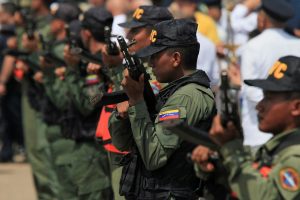
- Calibrated military pressure. The US has been waging what Al Jazeera calls a “low-grade naval and air war” against suspected drug boats while running war games and planning cells that openly model scenarios for Maduro’s fall. A Guardian investigation into US simulations found that most scenarios for regime collapse ended with massive refugee flows and chaotic violence – a warning to planners even as they rehearse the options.
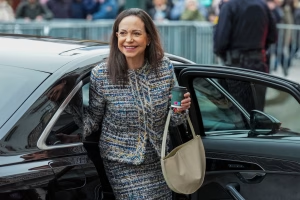
- Political engineering. Washington is also betting on Venezuela’s opposition, particularly María Corina Machado, now in exile after a dramatic escape. TIME and other outlets report that Trump-aligned advisers are coordinating with opposition figures on a “day after Maduro” roadmap: emergency stabilization measures, debt restructuring, and a security deal that would keep parts of the current military intact.
ECFR’s “MAGA goes south” essay describes an internal split in the administration: some favor slow-burn pressure and negotiated transition, others are pushing for a decisive “win” via military force or a naval blockade. Real Instituto Elcano’s analysis of Trump’s Venezuela policy calls it a mix of ideological crusade, domestic politics (immigration and Florida voters), and classic oil geopolitics.
The Guardian’s columnists warn that this looks a lot like replaying the old US regime-change script in Latin America – only this time with drones, sanctions, and cyber operations instead of Marines storming the presidential palace.
The question is whether this mix of pressure points is enough to crack the regime – or just enough to deepen Venezuela’s agony.
If the US plan is pressure leading to some kind of negotiated or forced exit, Maduro’s plan is simpler: survive.
Los Angeles Times reporting paints a regime built on a brutal but effective mix of reward and punishment – allowing loyal officers, judges, and politicians to enrich themselves while harshly punishing defectors. That pattern is backed up by a recent UN fact-finding mission, which found crimes against humanity by security forces over more than a decade.
International Crisis Group and CFR both caution that abruptly toppling that system could easily produce something worse: fragmented security forces, armed colectivos and disillusioned Chavistas morphing into insurgents, plus spillover into Colombia’s still-fragile peace process.
Against that backdrop, Jose Enrique Arrioja, managing editor of Americas Quarterly, sketches out Maduro’s near-term play:
“Maduro will likely ramp up his anti-US rhetoric and narrative, aiming to prevent further escalation and protect Venezuela’s vital oil exports. (It’s important to note that crude exports hit 1 million bpd in September, the highest since 2020, but dropped slightly to 967,000 in November.) To stay in power, Maduro is betting on keeping the population distracted with holiday celebrations and, at the same time, increasing repression across the board, planning to push for a constitutional reform in January with the help of the soon-to-be-inaugurated National Assembly elected months ago. He’ll use every possible means to stay in power, hoping that with Maria Corina Machado now out of the country, the internal opposition will weaken, opening the door to a darker, more dictatorial period. Still, this conflict is fluid and open, and its potential outcome remains as dynamic as ever.”
That lines up with CNN reporting: a leader who looks weaker on the surface – hemorrhaging legitimacy, facing new sanctions – but whose control over the security apparatus and courts remains tight.
Tinker-Salas’s comment is crucial here. Maduro has already outlasted protests, “interim” governments, coup plots, and one failed mercenary landing. From his perspective, this is just one more wave to ride out:
“Maduro is playing the long game. The country has already endured one of the worst economic crises in the modern era. He hopes that with time, Trump will move on to another issue or will accept a negotiated solution. As he has done in the past, Maduro will try to pin the hardships on the country’s opposition that, until now, has supported Trump’s military actions. The reality is that a great number of people are disenchanted with both sides, this includes the government as well as the opposition. Are there any 3rd parties he can somewhat rely on for help if the situation deteriorates further? At different moments, Brazil, Colombia, and Qatar have offered to mediate between the US and Venezuela, though the Trump administration has not shown any interest in talks. Making this more difficult, Trump has repeatedly indicated that Brazil and Colombia are also in his sights.”
If that last line is right, even potential mediators are being dragged into the confrontation. Brazilian officials have already warned that an all-out US attack could trigger a “Vietnam-style” regional conflict and massive refugee flows.
So can Caracas survive this kind of pressure?
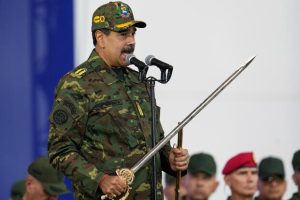
In the short term, probably yes. The regime still controls the guns, the courts, the electoral machinery, and the remaining cash flow from oil and gold. It has external lifelines – Russia, Iran, and some Chinese entities – that can help it dodge sanctions, even if at a discount.
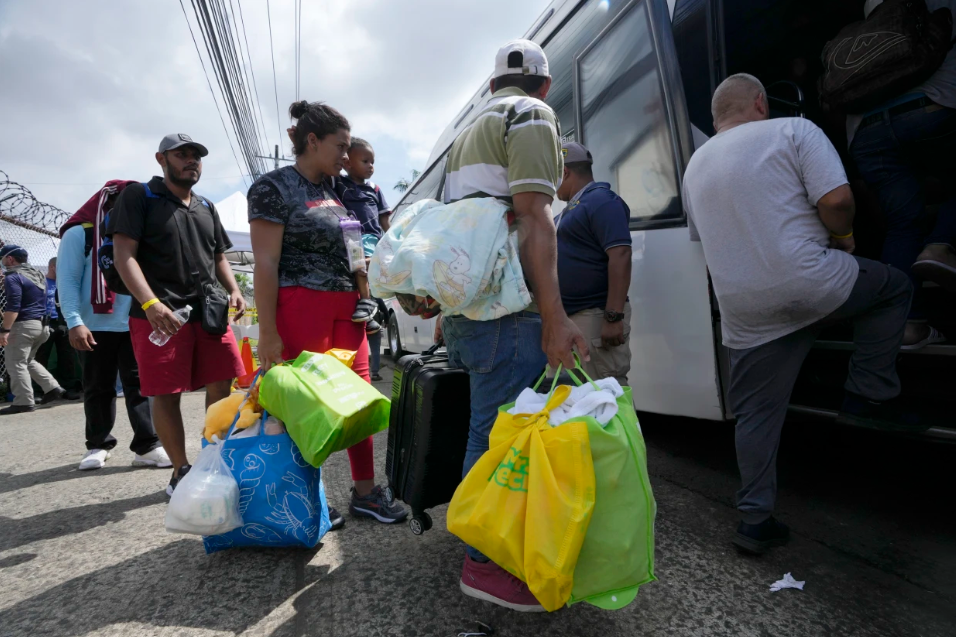
In the medium term, the picture is uglier. Every tanker seized or turned back shrinks the pie that keeps elites loyal. Every new sanction nudges more Venezuelans toward leaving, adding to an exodus that already rivals Syria’s. Every war game that ends in chaos fuels the argument – inside Venezuela and abroad – that there are no good options left.
And yet, as Polga-Hecimovich notes, economic pressure alone won’t make Maduro simply walk away. It might push him to bargain. It might harden his inner circle. It might fracture it. All three outcomes are on the table.
The Skipper seizure is a snapshot of a conflict that has quietly transformed over the last year. What began as sanctions and diplomatic isolation is now a hybrid campaign: legal seizures, targeted strikes on “drug boats,” a visible military build-up and open talk – on both sides – about regime change and war.
For the Trump administration, the tanker operation was low-risk, high-signal: a chance to show resolve, punish sanction-busting networks, and reassure domestic hawks that Washington is “doing something” about Maduro. For Caracas, it is proof that the US will go after the country’s last viable source of hard currency, no matter the humanitarian cost.
Whether this story ends with a negotiated transition, a grinding stalemate, or a disastrous miscalculation may depend less on the next tanker intercepted and more on the choices made in backchannels — between US officials, Venezuelan power brokers, and the few countries still willing to pick up the phone from both sides.
For now, the only safe bet is that the conflict is far from over, the pressure on ordinary Venezuelans will get worse, and both Maduro and Trump believe they still have time to play their respective long games.


The latest news in your social feeds
Subscribe to our social media platforms to stay tuned