
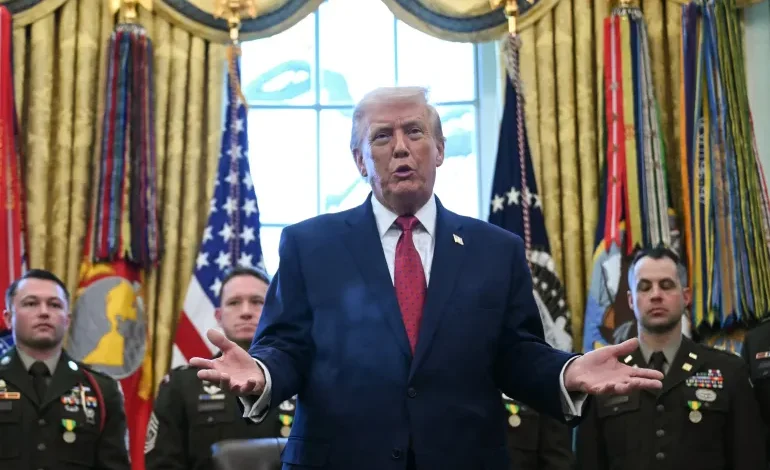

US President Donald Trump says he will sign an executive order formally classifying fentanyl and its key precursor chemicals as a “weapon of mass destruction”, marking a sharp rhetorical escalation in his administration’s campaign against drug cartels and smugglers.
The announcement on Monday fits a broader pattern in which the Trump administration has increasingly framed drug trafficking as a national security threat rather than a criminal issue, repeatedly referring to smugglers as “narco-terrorists” and designating several Latin American cartels as “foreign terrorist organisations”.
“There’s no doubt that America’s adversaries are trafficking fentanyl into the United States, in part because they want to kill Americans,” Trump said during a White House event. “That’s why today, I’m taking one more step to protect Americans from the scourge of deadly fentanyl flooding into our country.”
“With this historic executive order I will sign today, we’re formally classifying fentanyl as a weapon of mass destruction,” he added.
What the label actually changes remains unclear. The order directs the heads of federal agencies to take steps to “eliminate the threat of illicit fentanyl and its core precursor chemicals to the United States”, but does not spell out new legal authorities or enforcement mechanisms. It also leaves unanswered how the designation would interact with fentanyl’s legitimate medical use.
Under existing US law, which the president cannot rewrite by executive order, a weapon of mass destruction is defined as any weapon designed to cause death or serious injury through toxic chemicals or their precursors, biological agents, radiation, or explosive devices such as bombs and missiles.
Whether fentanyl trafficking fits that framework in a practical or prosecutorial sense is likely to be contested.
Still, the symbolic shift matters. The administration has already leaned on the fentanyl crisis to justify higher tariffs on Mexico and China, accusing both of failing to curb the flow of drugs and precursor chemicals. It has also pointed to the drug trade to defend an expanded military posture in the Caribbean and eastern Pacific, including air and naval strikes on alleged smuggling boats, operations that rights groups say may amount to extrajudicial killings.
The same logic has been used to rationalise a growing US military presence near Venezuela, with Trump repeatedly threatening to extend anti-drug operations onto land.
“We’re going to start hitting them on land, which is a lot easier to do, frankly,” he said again on Monday.


The latest news in your social feeds
Subscribe to our social media platforms to stay tuned