


Barrasso Wants “Next-gen 911” in the Parks — and in Wyoming, that Hits a Nerve

The original story by for WyoFile.
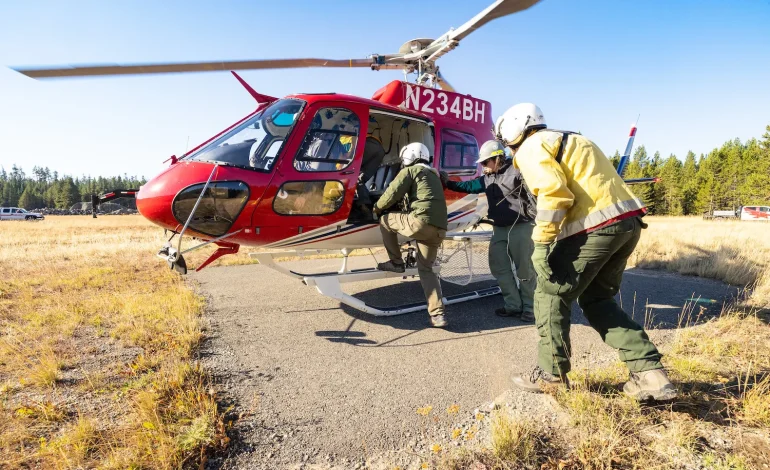
If you’ve ever tried to get help in the backcountry — or even on a long stretch of two-lane highway — you already know the uncomfortable truth: in a lot of Wyoming, help can be a long way off.
That’s the backdrop for a new bill from US Sen. John Barrasso, who’s pushing legislation aimed at tightening up emergency communications in national parks like Yellowstone and Grand Teton. His pitch is simple: when something goes sideways in a place that’s huge, remote and crowded with visitors, the difference between a good outcome and a bad one can come down to minutes — and to whether dispatchers can figure out exactly where you are.
“This bill improves the speed and accuracy of emergency responders in locating and assisting callers in need of emergency assistance,” Barrasso told the Senate’s National Parks Subcommittee during a hearing last week. “These moments make a difference between visitors being able to receive quick care and continue their trip or facing more serious medical complications.”
Barrasso’s proposal — the Making Parks Safer Act — directs the US Department of the Interior to come up with a plan to modernize National Park Service 911 call centers using next-generation 911 technology.
In plain English: it’s an upgrade that would let park dispatchers receive texts, photos and videos, not just phone calls. If you’re stuck on a cliff band, trying to describe a location you don’t have words for, or dealing with a medical emergency where visuals matter, that extra information could be a big deal.
That matters in Wyoming’s parks, which cover a combined 2.5 million acres and rack up everything from routine mishaps to worst-day-of-your-life scenarios — lost hikers, car wrecks, and yes, the kind of wildlife incidents that make headlines.
Barrasso also pointed out the sheer scale of visitation: more than 8 million recreation visits to Wyoming’s national parks in 2024, part of the hundreds of millions of people who hit national parks nationwide each year.
“Folks travel from across the world to enjoy the great American outdoors,” he said. “This is a bipartisan bill that ensures visitors who may need assistance can be reached in an accurate and timely manner.”
Barrasso introduced the bill with a pretty broad coalition: Sen. Angus King (I-Maine), Sen. Cindy Hyde-Smith (R-Miss.), and Sen. John Hickenlooper (D-Colo.).
And in a hearing packed with other park-related proposals — including debates over international visitor fees, wild horses, off-highway vehicles, and even the official name of North America’s highest mountain — Barrasso’s 911 upgrade bill landed as one of the least controversial items on the menu.
Even the National Park Service gave it a thumbs-up.
Mike Caldwell, the Park Service’s associate director for park planning, facilities and lands, told lawmakers the agency supports the legislation and framed it as consistent with Executive Order 14314, titled “Making America Beautiful Again by Improving our National Parks.”
“These improvements are largely invisible to visitors,” Caldwell said, “so they strengthen the emergency response without deterring the park’s natural beauty or history.”
Here’s the thing, though: Wyoming doesn’t just struggle with emergency response inside park boundaries.
Outside Yellowstone and Grand Teton, plenty of the state has the same problem — big distances, small populations, and emergency systems that have to make the math work. Ground ambulance services, in particular, face challenges around financial viability, while many residents in frontier areas deal with longer response times and uneven coverage.
That issue is big enough that improving access to ground ambulance response is a major priority in Wyoming’s recent application for federal Rural Health Transformation Project funding.
Barrasso’s office didn’t respond to a request for comment about Wyoming’s broader EMS challenges by publication time — but the contrast is hard to miss: modernizing park dispatch is popular and relatively straightforward, while fixing rural EMS statewide is messier, more expensive, and politically harder.
Even a mostly noncontroversial bill like this one is happening in a moment when national parks are politically radioactive.
Since early 2025, parks have been caught up in the Trump-era churn — including DOGE-related efforts, debates over federal land policy, and controversies around how history is presented on public lands. Add in the 43-day government shutdown, and “How are we managing the parks?” has turned into a recurring fight.
That tension showed up in the same subcommittee hearing through another flashpoint: the fee-free days schedule for 2026.
Under the new plan, Martin Luther King Jr. Day and Juneteenth would no longer be fee-free days. In their place: Flag Day (June 14) — which happens to be Trump’s birthday — and Oct. 27, Theodore Roosevelt’s birthday.
Critics called the changes regressive. Sen. Martin Heinrich (D-NM) promised a reversal down the road, telling the room that “when this president is in the past,” MLK Day and Juneteenth will again take their “places of pride” in the national story.
Interior Department leadership defended the shift as a fairness and access argument. In a department announcement, Interior Secretary Doug Burgum said the updated fee approach is meant to keep parks affordable for Americans while asking international visitors to contribute more toward upkeep.
Barrasso’s bill is basically the legislative version of upgrading from a flip phone to a smartphone — and in giant, rugged parks where “I’m near a tree and a rock” isn’t helpful location data, that upgrade could save time, money, and maybe lives.
But it also highlights a bigger Wyoming reality: even if the parks get sharper tools, much of the rest of the state still has the same old problem — long miles, limited resources, and emergencies that don’t wait for perfect coverage.


The latest news in your social feeds
Subscribe to our social media platforms to stay tuned