



Wyoming vs. Cheatgrass: the Weed that’s Turning Sagebrush Country into Tinder

The original story by
Wyoming is throwing the kitchen sink at cheatgrass — and still watching it creep.
There’s real money on the table (tens of millions), an all-hands-on-deck coalition of weed crews and wildlife biologists, and a new “breakthrough” herbicide that actually works better than anything we’ve had before. But if you’re looking for a clean victory story, you won’t find it here. What Wyoming has right now is a slowing action, not a stop.
Brian Mealor, a University of Wyoming professor who leads the Institute for Managing Annual Grasses Invading Natural Ecosystems, knows exactly what “losing” looks like. He saw it up close this summer in northern Nevada — and it stuck with him.
He was walking the burn scar of the Roosters Comb Fire, more than 220,000 acres northwest of Elko, when the landscape hit him like a punch.
“Literally everything you see is cheatgrass,” Mealor said. “I just stood there, depressed.”
No native grasses. Barely a shrub. Hardly a wildflower. Not even other weeds competing for space. Just cheatgrass, wall to wall — a monoculture so complete Nevada managers have started planting another nonnative plant, forage kochia, because at least it beats starving wildlife on a cheatgrass diet.
“They’ll just die, because there’s nothing there,” Mealor said of animals trying to live in that kind of burn scar. “That’s why we have to do stuff. Because we could turn into that.”
Cheatgrass is already spreading across Wyoming. That’s scary not because Wyoming has never dealt with invasive plants, but because Wyoming is the cornerstone of what’s left of the sagebrush-steppe biome — the sprawling 13-state ecosystem that’s disappearing at a pace of more than a million acres a year.
“Half of the best of the best is in Wyoming,” said Corinna Riginos, who directs The Nature Conservancy’s Wyoming science program.
And she’s not talking about average sagebrush. She means the last big, unbroken, high-quality stretches — places like the “Golden Triangle” southwest of the Wind River Range. These landscapes don’t just look pretty; they power some of the West’s most famous wildlife stories, including massive sage grouse leks and epic mule deer migrations.
Riginos doesn’t mince words about what cheatgrass represents.
“I feel that this is the most existential, sweeping threat to our western ecosystems,” she said.
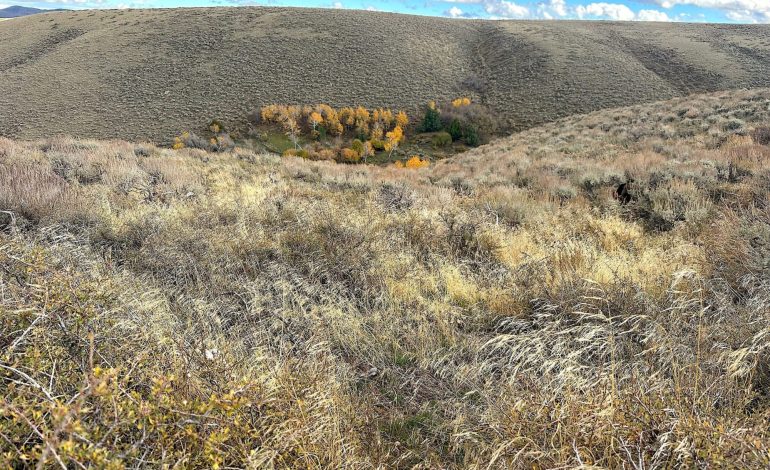
Cheatgrass is a cheat in the most literal sense. It germinates in fall, grows in cold weather, overwinters, then bolts early in spring — soaking up moisture and nutrients before native grasses and wildflowers even get going. By midsummer it’s dead, leaving behind dry, flashy fuel that burns fast and hot.
That’s where the feedback loop kicks in: cheatgrass helps fires happen, fires kill native plants, and the aftermath is prime real estate for… more cheatgrass.
Wyoming used to think much of the state was too cold and too high for cheatgrass to dominate. Jeanne Chambers, an emeritus US Forest Service research ecologist who has studied the plant for decades, says that old assumption isn’t holding up.
“Cooler temperatures, especially those cold nighttime temperatures, used to keep cheatgrass at bay,” Chambers said. “But now that things are warming up… the propagules — the seeds — are getting everywhere.”
Lower-elevation Wyoming is especially vulnerable: the Bighorn Basin, the transition zones in the southwest, and disturbed areas where roads, livestock, recreation and development help spread seed.
Sweetwater County Weed and Pest Supervisor Dan Madson said the invasion is no longer a “down south” problem.
“There are hot spots throughout the county invading mule deer, antelope and elk habitats, as well as sage grouse core areas,” he said.
If Nevada is the nightmare, Wyoming’s House Draw Fire is the warning sign.
Before Aug. 21, 2024, the landscape east of Buffalo was considered some of the best remaining sagebrush in northeast Wyoming. Then lightning sparked the House Draw Fire, which ripped a 10-mile-wide, nearly 60-mile-long scar through the Powder River Basin in two days, causing more than $25 million in damage.
In an instant, native sagebrush — and with it prime sage grouse habitat — was largely erased across roughly 100,000 acres. The fire eliminated 18 active leks.
Now the burn scar is turning golden. Some native grasses are coming back, sure. But big pockets are filling with cheatgrass and Japanese brome. Mealor calls it a lag phase — it doesn’t go full Nevada overnight.
“It’s not like you have a fire and all of a sudden you’re just completely covered with cheatgrass,” he said. “There’s a lag.”
That lag is the window Wyoming is trying to exploit.
The most talked-about tool right now is Indaziflam — often referred to by its trade name, Rejuvra — a herbicide cleared for rangeland use in 2020. Unlike older treatments that need to be reapplied constantly, Indaziflam targets the cheatgrass seedbank and shallow roots while leaving deeper-rooted native perennials a better chance.
Sublette County Weed and Pest District Supervisor Julie Kraft says it’s been a game-changer.
“It depletes it down until there won’t be a seedbank of cheatgrass anymore,” she said. “Year one… you can grab handfuls of cheatgrass seed. Year two, you can’t find those handfuls anymore. By year three, you can’t dig [seeds] out of the bottoms of sagebrush.”
That’s the dream: not just knock cheatgrass down for a season, but starve it out over time.
But there’s a catch. It’s expensive. In some places, the product alone runs around $42–$43 per acre — and that’s before you pay for helicopters.
Wyoming weed crews are therefore making tough choices: defend clean or lightly infested areas first, and accept that some places may never return to what they were.
“I think you have to kind of accept that we’re going to have cheatgrass forever,” said Aaron Foster, Fremont County’s weed and pest supervisor. “And areas like that are going to be impacted by it most severely forever, too.”
Wyoming isn’t ignoring the problem. After the state’s massive 2024 fire year (about half a million acres burned in northeast Wyoming alone), lawmakers set aside $49 million for wildfire recovery grants statewide — though that was less than half of what Gov. Mark Gordon requested.
Gordon, a rancher, has said flat out the state is “losing the battle” against invasive annual grasses. He asked for $20 million in cheatgrass spraying funds; lawmakers approved $9 million.
Mealor’s view is basically: appreciate the money, but don’t pretend it matches the scale.
“If you think about it from a statewide level, it’s not a lot,” he said.
Wyoming is 62 million acres. Cheatgrass is spreading in a state-sized pattern.
Bob Budd, executive director of the Wyoming Wildlife and Natural Resource Trust, put the funding reality in even starker terms:
“The magnitude of the need is utterly staggering,” Budd said. “We’re talking hundreds of millions of dollars over the next decade. That’s daunting.”
And the stakes aren’t abstract. A study co-authored by Mealor found cheatgrass could wipe out roughly half of northeast Wyoming’s mule deer habitat over the next couple decades, because the plant is only edible in spring and becomes low-nutrition straw the rest of the year.
Even if Wyoming somehow held cheatgrass at bay, sagebrush recovery is painfully slow. Individual plants take decades to mature, and research suggests Wyoming big sagebrush can take 200 to 350 years to return to dense, mature stands after wildfire.
That’s not a typo. Centuries.
So when Wyoming tries something new — like aerial sagebrush seeding in the House Draw Fire scar — it’s basically betting on the long game. Early monitoring has been rough: about one seedling per acre.
“This whole thing was an experiment,” said Wyoming Game and Fish biologist Todd Caltrider.
The most honest takeaway might be this: Wyoming can’t “fix” every burned acre. It can’t spray its way out of a statewide invasion. What it can do is defend the core — the best remaining sagebrush on Earth — and slow the cheatgrass tide enough to keep today’s iconic landscapes from turning into Nevada’s silent, flammable monocultures.
Mealor’s fear isn’t that Wyoming will change. It’s how far, and how fast.
Standing in the Powder River Basin scar of what used to be prime sagebrush, he’s staring at a future that could be grassland for the rest of his life. The hope — the urgent, expensive, all-hands hope — is that it won’t become a sea of cheatgrass.



The latest news in your social feeds
Subscribe to our social media platforms to stay tuned