
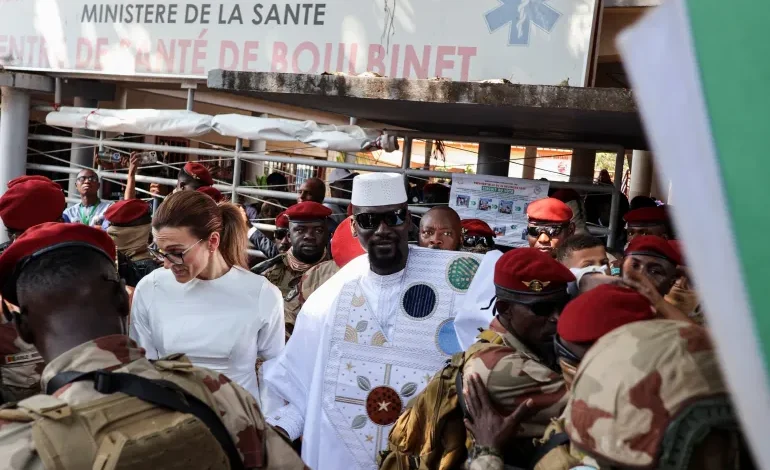

Mamady Doumbouya has been elected president of Guinea with an overwhelming 86.72 percent of the vote, according to provisional results announced on Tuesday, cementing his hold on power more than four years after the 2021 military coup.
The December 28 election delivered Doumbouya an outright majority, sparing him a runoff and marking the country’s first national vote since he ousted longtime president Alpha Condé. The Supreme Court now has eight days to validate the results should any legal challenges be filed.
The vote was widely viewed as an attempt to formalise Doumbouya’s rule after a tightly managed transition period that critics say hollowed out political competition. Both Condé and veteran opposition leader Cellou Dalein Diallo remain in exile, while dissent at home has been heavily curtailed.
Yero Baldé, a former education minister under Condé, placed a distant second with 6.51 percent. Election authorities said turnout reached 80.95 percent among the country’s 6.7 million registered voters.
Doumbouya reverses earlier pledge
After seizing power, Doumbouya had publicly promised that neither he nor other military officers would run for office. That position shifted after a constitutional referendum in September cleared the way for officers to contest elections and extended presidential terms from five to seven years.
Guinea’s vast mineral wealth has been central to Doumbouya’s pitch. The country holds the world’s largest bauxite reserves and one of the biggest untapped iron ore deposits at Simandou, a long-delayed project that was officially launched last month. Doumbouya has framed progress on Simandou as proof that his leadership is delivering tangible gains.
His government has also embraced a harder line on resource control, revoking the licence of Emirates Global Aluminium’s Guinea Alumina Corporation amid a dispute over refinery development and transferring its assets to a state-owned firm. Similar turns toward resource nationalism in Mali, Burkina Faso and Niger have helped boost popular support for military-led governments across the Sahel.
Restrictions and allegations
Political space in Guinea remains narrow. Civil society groups accuse the authorities of banning protests, restricting opposition organising and tightening pressure on the media. UN human rights chief Volker Turk said the campaign was “severely restricted, marked by intimidation of opposition actors, apparently politically motivated enforced disappearances, and constraints on media freedom”.
On Monday, opposition candidate Faya Lansana Millimono alleged “systematic fraudulent practices” and said observers were blocked from monitoring voting and ballot counting. The government has not responded publicly to those claims.

The latest news in your social feeds
Subscribe to our social media platforms to stay tuned