



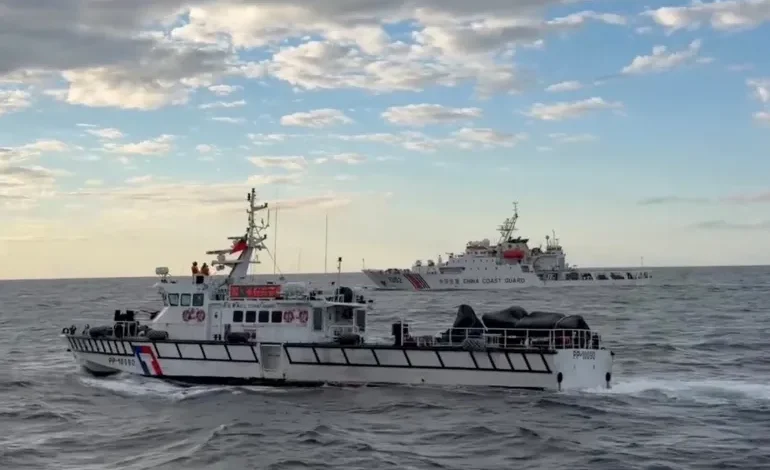

The United States has called on China to show “restraint” after Beijing staged a fresh round of military exercises around Taiwan, including drills simulating a blockade of the self-governed island.
In a statement on Thursday, the US State Department said China’s rhetoric and manoeuvres were driving “unnecessary” tension in the region, echoing sharp criticism already voiced by authorities in Taipei.
“China’s military activities and rhetoric toward Taiwan and others in the region increase tensions unnecessarily. We urge Beijing to exercise restraint, cease its military pressure against Taiwan, and instead engage in meaningful dialogue,” said State Department spokesman Tommy Pigott. “The United States supports peace and stability across the Taiwan Strait and opposes unilateral changes to the status quo, including by force or coercion,” he added.
The comments came days after China fired missiles and deployed aircraft and naval vessels in exercises designed to encircle Taiwan, which Beijing claims as part of its sovereign territory and has vowed to bring under its control.
Chinese war games around the island have become increasingly routine in recent years and have caused little disruption to daily life in Taiwan. But the drills have drawn growing anger from Taiwanese officials and reinforced public scepticism toward Beijing, particularly after China’s crackdown on freedoms in Hong Kong.
“As president, my stance has always been clear: to resolutely defend national sovereignty and strengthen national defence,” Taiwan’s President Lai Ching-te said on Thursday.
Lai has proposed a $40bn increase in defence spending, though the plan remains stuck in parliament, where opposition parties hold a majority.
“The coming year, 2026, will be a crucial one for Taiwan,” he said, adding that the island must “make plans for the worst, but hope for the best”.
US policy on Taiwan has long been defined by strategic ambiguity. While Washington frequently voices political support for Taipei, it has stopped short of explicitly guaranteeing military intervention in the event of a Chinese attack.
The US recently approved an $11bn arms package for Taiwan, even as Donald Trump played down the likelihood of an imminent conflict.
“I have a great relationship with [Chinese] President Xi Jinping. And he hasn’t told me anything about it,” Trump told reporters earlier this week. “They’ve been doing naval exercises for 20 years in that area. Now people take it a little bit differently,” he said.


The latest news in your social feeds
Subscribe to our social media platforms to stay tuned