



US ‘law enforcement’ in Venezuela is neither law nor order, it’s vandalism
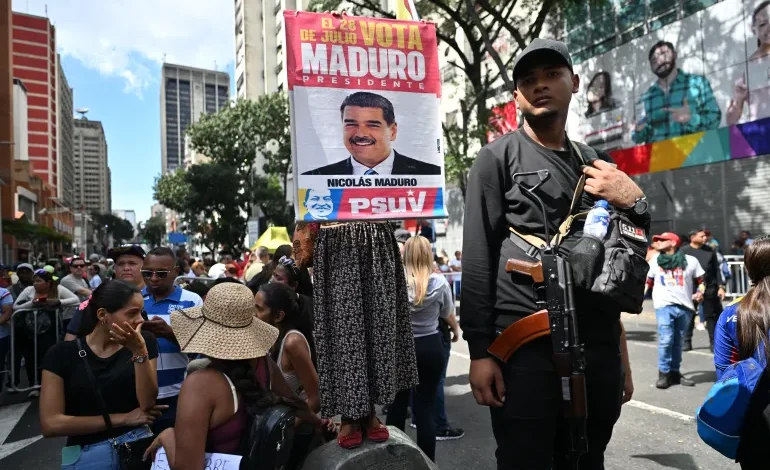

The United States’ seizure of Venezuela’s president is not a bold extension of justice across border but rather international vandalism, plain and unadorned, a raw exercise of power dressed up as principle, and a quiet execution of the very legal order Washington claims to defend.
By abducting a sitting head of state and calling it law enforcement, the US has inverted the meaning of international law. Power has displaced law. Preference has replaced principle. Force is presented as virtue. When a state kidnaps the law to justify kidnapping a leader, it does not uphold order, it advertises contempt for it.
There is no foothold for this action in international law. None. It is not self-defence under Article 51 of the UN Charter. It was not authorised by the UN Security Council. International law may be imperfect, but it is not a roving moral warrant that allows great powers to carry out regime change by abduction.
The argument that alleged human rights abuses or narcotics trafficking justify removing a foreign president is especially corrosive. There is no such rule: not in treaty law, not in customary law, not in any serious jurisprudence. Human rights law binds states to standards of conduct; it does not license unilateral military seizures by self-appointed global sheriffs. If it did, the world would exist in a permanent state of sanctioned chaos.
And if Washington were serious about this principle, consistency would demand action far closer to home. By the logic now advanced, there would be a stronger legal and moral case to seize Israeli Prime Minister Benjamin Netanyahu, given extensive documentation of mass civilian harm and credible allegations of genocide linked to Israel’s conduct in Gaza. No such logic is entertained, of course. This is not law at work. It is power choosing its targets.
Regime change is not an aberration in US foreign policy. It is a habit with a long paper trail, from Iran in 1953 to Guatemala in 1954, Chile in 1973 and Iraq in 2003. But the kidnapping of a sitting president marks a new low. This is precisely the conduct the post-1945 legal order was designed to prohibit.
The ban on the use of force is not a technicality. It is the central nervous system of international law. To violate it without authorisation is to announce that rules bind only the weak. The US understands this perfectly, and is acting anyway, conducting what amounts to an autopsy of the UN Charter system itself.
The erosion does not stop with Venezuela. Washington has repeatedly violated its obligations under the UN Charter and the UN Headquarters Agreement, denying entry to officials it disfavors. Preventing the Palestinian president from addressing the UN General Assembly in person last year was not a diplomatic faux pas; it was a treaty breach by the host state of the world’s principal multilateral institution.
The message was unmistakable: access to the international system, and adherence to its rules, is conditional on American approval.
The United Nations was designed to constrain power, not flatter it. Today, it increasingly fails to restrain serious violations of international law. Paralysed by vetoes, bullied by its host and ignored by those most capable of breaching its charter, the UN has drifted from guardian of legality to stage prop for its erosion.
At some point, denial becomes self-deception. The system has failed in its core promise because its most powerful beneficiary has decided it is optional.
The latest news in your social feeds
Subscribe to our social media platforms to stay tuned