



EXCLUSIVE: “Operation Absolute Resolve.” How Maduro’s Capture Became the Climax of the US-Venezuela Crisis.

For months, the US–Venezuela story felt like it was stuck in a tense loop: threats, sanctions, “drug war” rhetoric, a growing military footprint in the Caribbean, and a steady drumbeat of “something bigger is coming.”
Then it happened.
The capture of Venezuelan President Nicolás Maduro – the political “end boss” of Chavismo – in the predawn hours of Jan. 3, 2026, wasn’t just another escalation. It was the kind of move that takes a long-running crisis and slams it into a new category: not diplomacy-with-teeth, not covert pressure, not even “limited strikes.” This was a decapitating strike in the most literal sense, designed to yank the leadership question out of Caracas and drop it onto Washington’s desk.
And now that the shock value has landed, the real question is painfully basic: what exactly is the United States trying to accomplish next – and how?
Zooming out far enough, US–Venezuela relations have been rocky for decades, but the modern era is basically a loop: Washington condemns democratic backsliding and corruption; Caracas calls it imperial meddling; sanctions tighten; migration grows; oil becomes both leverage and liability.
Our previous reporting described the relationship as moving from “hostile stalemate” to something closer to a war planning problem – not necessarily a declared war, but the kind of slow-motion escalation where every move is also a rehearsal.
A key feature of the run-up was how the confrontation was marketed: less “regime change,” more “narco-state,” “cartels,” “interdiction,” and “regional security.” That framing matters because it’s politically easier to sell “law enforcement plus precision force” than another Iraq-sized occupation.
In that telling, the Caribbean becomes a chessboard: naval deployments, interdictions, intelligence-sharing, and constant talk of “quarantines” and “blockades” – all of it presented as targeted, temporary, justified.
Another strand in our coverage was the idea that even if Washington swore it didn’t want an invasion, its planning increasingly resembled the early phases of one: contingency scenarios, assessments of Venezuelan capabilities, and speculation about what happens if the regime fractures, or if it doesn’t.
By mid-December, the “Seizing the Skipper” piece was basically asking the question out loud: if the US wanted a decisive move without a long war, would the cleanest “win” be grabbing Maduro himself?
That question aged fast.
The Trump administration’s public version of events is blunt: Maduro was captured by US forces in an operation the government framed as a precision action – and it warned further strikes were possible.
A lot of operational detail is still contested, and some of it is inevitably propaganda from all sides. But a few core points show up repeatedly across reporting and official messaging:
Al Jazeera’s reporting described a night of explosions and coordinated activity that looked like more than one target set – consistent with diversion strikes, suppression of defenses, and the kind of confusion you’d want if your main goal is a quick snatch-and-grab near the capital.
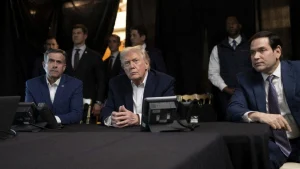
The Guardian’s account leaned into the psychological dimension: Venezuelan leaders had talked for years about a US invasion like it was a fantasy and a threat – and then the reality landed in a form that wasn’t an amphibious assault but felt like a sovereignty violation all the same.
The Department of War presented the operation as a US military success and centered Trump’s announcement of Maduro’s capture, emphasizing operational control and decisiveness. Reuters
Reuters, meanwhile, reported the administration’s posture after the fact: Maduro set to appear in US court, and Trump signaling that follow-on strikes are still on the table. That combination – courtroom plus threat of more bombs – is basically coercive diplomacy with a battering ram.
In his recent piece for the Conversation Dr. Robert Evan Ellis, Senior Associate with the Center for Strategic and International Studies Americas Program, described the seizure as “operationally, a resounding success” and emphasized how the US military buildup and intelligence preparation likely shaped the window for action. He also highlighted the importance of timing, cyber disruption, and air defense suppression to keep the raid short and survivable.
Dr. Ellis’s article contains a comprehensive description of the operation:
“We know the US launched aircraft from multiple sites – the operation involved at least 20 different launch sites for 150 planes and helicopters. These would have involved aircraft for jamming operations, some surveillance, fighter jets to strike targets, and some to provide an escort for the helicopters bringing in a special forces unit and members of the FBI. As an integral part of the operation, the US carried out a series of cyber activities that may have played a role in undermining not only Venezuela’s defense systems, but also its understanding of what was going on… There was also, according to Trump, a US-generated interruption to some part of the power grid. In addition, it appears that there may have been diversionary strikes in other parts of the country to give a false impression to the Venezuelan military that US military activity was directed toward some other, lesser land target, as had recently been the case. US aircraft then basically disabled Venezuelan air defenses… It would be logical if elite members of the US 160th Special Operations Aviation Regiment were used in the approach to the compound in Caracas… Once the team landed, it would have taken a matter of minutes to infiltrate the compound where Maduro was.”
This wasn’t a spontaneous strike. It was the endpoint of months of posture-building and signaling – with the strike serving as the punctuation mark.

(Jane Rosenberg / Reuters)
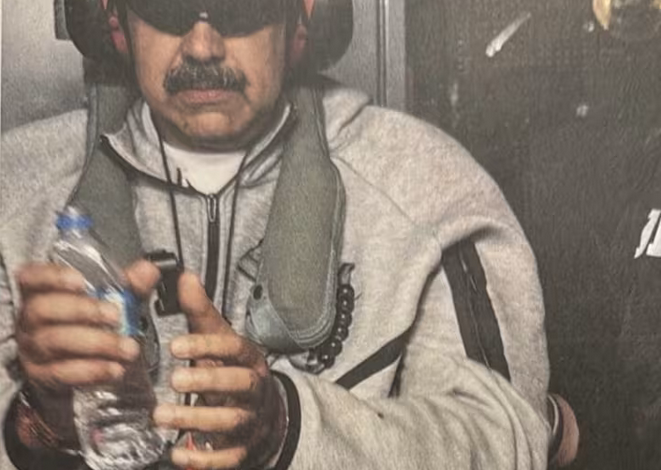
From aboard the USS Iwo Jima to the Westside Heliport in Manhattan, New York City, Nicolás Maduro now finds himself indicted in the Southern District of New York on charges of narco-terrorism conspiracy, cocaine importation conspiracy, possession of machine guns and destructive devices, and conspiracy to possess machine guns and destructive devices.
AP’s coverage described US officials briefing lawmakers for nearly two hours, as the administration tried to justify the operation and explain next steps – a sign that even inside Washington, the “what now?” problem immediately overtook the “we got him” headline.
CBS’ updates tracked the immediate legal and political storm around charges and process, framing the event as both a national-security operation and a justice-system spectacle unfolding in real time.
So what is the plan now – regime change, managed transition, or a forced deal?
Here’s the uncomfortable truth: capturing Maduro is the easy part compared to what comes next. Removing a leader does not automatically remove the system that kept him in power – especially in a state where security services, patronage networks, and armed actors have learned how to survive shocks.
Henry Ziemer, Associate Fellow with the CSIS Americas Program, who runs a blog focusing on security policy in the Americas, put it this way:
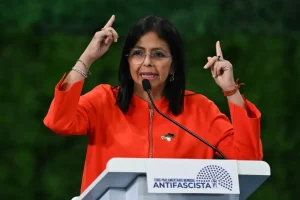
“The capture of Nicolás Maduro has left more questions than answers in its wake, namely over how the United States plans to accomplish what President Trump deemed a “safe, proper and judicious transition.” While Trump indicated the United States was set to “run” Venezuela, it seems unlikely that a major troop presence is envisioned at this time. More likely, it seems to be an effort to work with now-interim Venezuelan president Delcy Rodríguez to strike a deal on key issues like narcotrafficking and oil concessions. The United States seems to be trying to use the threat of force, including potential follow-up strikes on Venezuela, to coerce Rodríguez and the rest of the still-intact Venezuelan government to adhere to US demands. While this may not rule out future US boots on the ground, a large-scale troop commitment along the lines of Iraq or Afghanistan would likely be viewed as a strategic failure in Washington, which hopes to achieve its policy aims with minimal risk to US personnel… The current US strategy appears to be directed towards collaboration with Delcy and the remaining government, rather than pushing for full regime change. This seems to be based on a lack of confidence in the United States that the Venezuelan opposition could credibly control the armed forces in the event of a complete transfer of authority. While this does not rule out the possibility of further change, especially if Delcy Rodriguez proves not to be an acceptable partner, it seems as though the prospect of María Corina Machado or another opposition figure taking the reins is light at the moment. Key developments to watch for in this regard will be whether large-scale protests in support of the opposition break out within Venezuela and whether any splits emerge within the governing Chavista inner circle. For the time being it seems neither of these have happened yet, but the situation remains highly fraught and subject to rapid development.”
Drop Site News warned that “regime change” logic tends to mutate into broader violence and sustained coercion, even when it’s sold as limited.
Working with whoever holds the levers now, forcing concessions on drugs and oil, and keeping the threat of more strikes as the enforcement mechanism seems to be the ideal scenario for Washington right now.
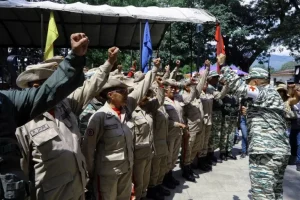
However, CFR’s analysis of the aftermath emphasized uncertainty and the regional implications. Local commanders, armed groups, opportunistic politicians – plus foreign states trying to protect interests without directly confronting US forces – may ruin the day.
The US declaring mission accomplished can easily end up in months of improvising as Venezuela’s internal and external factions fight, the economy jolts, and migration surges.
Ziemer also makes a sharp point about “fair-weather” great-power friendships: Russia and China can condemn, but they’re unlikely to physically shield Venezuela against US military dominance if Washington is willing to use it:
“As with Syria and Iran before, Venezuela finds itself abandoned by its erstwhile friends in its hour of need.”
That’s not moral commentary. It’s a strategic reality – and it shapes how isolated Caracas can become once deterrence fails.
A decapitation strike always comes with two battles: the kinetic one and the narrative one.
Al Jazeera’s UN coverage showed multiple Security Council members slamming the US operation – using language centered on sovereignty and the danger of normalizing cross-border seizures.
Dr. Jeffrey Sachs, Professor and Director of the Center for Sustainable Development at Columbia University, in his statement to the United Nations Security Council on January 5, anchors the legal critique in the UN Charter’s Article 2(4): the prohibition on the use of force against another state’s territorial integrity or political independence. His broader warning is that once major powers treat regime change as a routine tool, international law becomes optional – and the “optional” era is where escalation thrives.
To keep this grounded and readable, here’s the heart of Dr. Sachs’ argument:
“Members of the Council are not called upon to judge Nicolás Maduro. They are not called upon to assess whether the recent United States attack and ongoing naval quarantine of Venezuela result in freedom or in subjugation. Members of the Council are called upon to defend international law, and specifically the United Nations Charter… Peace and the survival of humanity depend on whether the United Nations Charter remains a living instrument of international law or is allowed to wither into irrelevance.”
Whether the international law still means anything now depends on the Security Council. Dr. Sachs’s statement contains a list of clear steps towards resolving the US-Venezuela crisis:
“1) The United States shall immediately cease and desist from all explicit and implicit threats or use of force against Venezuela.
2) The United States shall terminate its naval quarantine and all related coercive military measures undertaken in the absence of authorization by the Security Council.
3) The United States shall immediately withdraw its military forces from within and along the perimeter of Venezuela, including intelligence, naval, air, and other forward-deployed assets positioned for coercive purposes.
4) Venezuela shall adhere to the UN Charter and to the human rights protected in the Universal Declaration of Human Rights.
5) The Secretary-General shall immediately appoint a Special Envoy, mandated to engage relevant Venezuelan and international stakeholders and to report back to the Security Council within fourteen days with recommendations consistent with the Charter of the United Nations, and the Security Council shall remain urgently seized of this matter.
6) All Member States shall refrain from unilateral threats, coercive measures, or armed actions undertaken outside the authority of the Security Council, in strict conformity with the Charter.”
Le Monde compiled global reactions, capturing the broad pattern: condemnation from some governments, caution from others, and a lot of anxious hedging by states that don’t want to be the next precedent.
Reuters also cataloged international reactions in a more diplomatic register, underlining how quickly the operation became a global argument about legitimacy and escalation rather than just Venezuela.
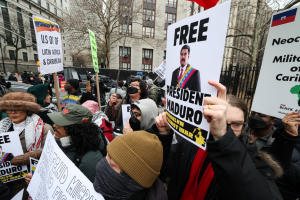
(Timothy A. Clary / AFP via Getty Images)
Al Jazeera reported Americans were roughly evenly split on the abduction, a sign the administration is operating in a polarized environment where half the country will treat the operation as justice, and the other half will treat it as a dangerous breach of norms.
AP’s coverage of the closed-door congressional briefing underscores that even lawmakers who might support a hard line still want answers about the endgame – the part decapitation strategies often struggle to provide.
There’s also a social reality here: Venezuelan diaspora communities – particularly those shaped by exile politics – are highly influential in US media ecosystems and domestic lobbying. That doesn’t require a secret plot. It’s how diaspora politics works: intense personal stakes, concentrated networks, and an ability to keep an issue alive long after the wider public moves on.
Drop Site News argued the administration’s public justification and media strategy function to normalize escalating coercion (sanctions, naval pressure, strikes) as an almost administrative process – a “pressure ladder” that always has one more rung.
Meanwhile, the Guardian editorial position treated the seizure as a moral and strategic self-own – the US acting like the kind of “rogue state” it claims to restrain.
Those frames matter because they shape what Washington can do next without losing allied cooperation.
Even if you accept the Trump administration’s premise – that Maduro is a criminal leader whose removal helps Venezuela – the post-capture phase is where outcomes diverge wildly.
Here are the dynamics that will decide whether this ends in a deal, a new civil conflict, or a long, grinding international crisis:
1) Who controls the guns inside Venezuela
If the security services stay cohesive, they can bargain. If they fracture, you get militia politics, localized fiefdoms, and a state that exists mainly as a flag. Our earlier “boots on the ground” analysis warned that capabilities and loyalties matter more than headlines.
2) Oil as leverage, oil as accelerant
Venezuela’s oil sector isn’t just economic – it’s political oxygen. Any US plan that includes “concessions” or “reopening” is also a plan that rearranges who gets paid, who gets starved, and who can buy loyalty. CFR flagged this as one of the big regional stakes, because oil policy changes will ripple across allies, rivals, and energy markets.
3) Migration pressure
If violence rises or the economy jolts again, migration becomes the fastest-moving consequence – and that hits neighbors first, then the US border politics machine shortly after.
4) Whether Washington escalates… or uses escalation as a bargaining chip
Reuters’ reporting that Trump left the door open to further strikes is a classic coercion move: keep the target uncertain and off-balance.
But coercion strategies are notoriously hard to stop once launched – because backing down starts to look like weakness, and pushing forward starts to look like mission creep.
5) The “great power” variable is mostly rhetorical
Ziemer’s observation – that Russia and China may condemn but likely won’t materially intervene – points to a harsh asymmetry: Venezuela can be geopolitically important without being geopolitically protected. That increases the odds that Venezuela’s future is decided primarily by internal power struggles and US pressure, not by an external balancing coalition.
Operation Absolute Resolve, as described by US officials and widely reported, looks like a tactical success wrapped around a strategic gamble: that capturing Maduro creates a controllable transition rather than an uncontrollable spiral.
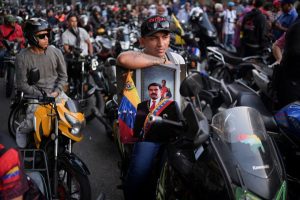
The strongest pro-operation argument is simple: Maduro gone means space for change. The strongest anti-operation argument is also simple: when great powers normalize kidnapping leaders, “space for change” becomes “space for chaos.”
If you want the clearest scoreboard for the next few weeks, it’s this:
- Do we see mass protests – and if so, who controls them?
- Do we see splits in the inner circle – or consolidation around a successor?
- Do we see immediate bargaining on oil and narcotrafficking – or escalation and retaliation?
- And does Washington act like it’s chasing “transition” or like it’s chasing “control”?
Because decapitation isn’t an ending. It’s an accelerator. And Venezuela – along with the region – is about to find out what direction the accelerator is pointed.


The latest news in your social feeds
Subscribe to our social media platforms to stay tuned