

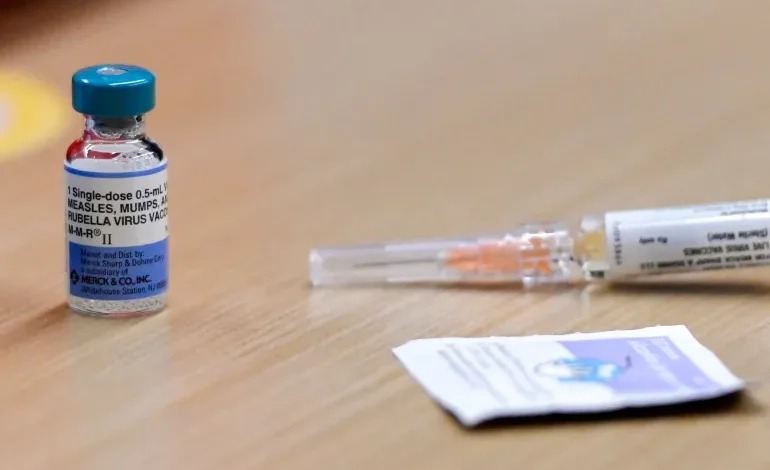

Health officials in the United States say a measles outbreak in South Carolina continues to expand, with confirmed cases rising to 185, nine more than earlier this week.
In a Friday update, state authorities said 172 of those infected had not received the measles, mumps and rubella (MMR) vaccine. Four cases involved people who were partially vaccinated, four had an unknown vaccination status, and another four remain under investigation. Only one case involved a fully vaccinated individual.
Measles, a highly contagious and sometimes deadly virus, was declared eliminated in the US more than 25 years ago. That status, however, is increasingly under pressure.
Elimination does not mean zero cases. Rather, it refers to the absence of sustained local transmission, with occasional cases still “imported” from abroad. The US’s success in reaching that benchmark has long been credited to widespread use of the MMR vaccine.
The first measles vaccine was licensed in 1963. By 1971, a combined MMR vaccine was introduced, protecting against three diseases at once. Two doses are typically required for full immunity.
The Centers for Disease Control and Prevention initially set a goal of eliminating measles by 1982, a target it missed by nearly two decades. The US finally achieved elimination status in 2000.
But vaccine hesitancy has allowed the virus to regain ground.
While measles has a relatively low fatality rate, it spreads with alarming efficiency. The CDC estimates that one infected person can transmit the virus to nine out of every 10 unprotected people nearby.
The World Health Organization estimates that for every 1,000 reported measles cases, two to three people die. Children face the highest risk, with possible complications including high fever, hearing or vision loss, and encephalitis, a dangerous inflammation of the brain.
Doctors generally recommend children receive their first MMR dose before 15 months of age, with a second by age six. The vaccine is widely considered safe.
Still, vaccine scepticism has been rising across the US, with critics pointing in part to rhetoric and policies associated with President Donald Trump.
CDC data shows MMR vaccination coverage among US kindergarteners stood at 95.2 percent during the 2019–2020 school year. By 2023–2024, that figure had fallen to 92.7 percent, a drop representing roughly 280,000 children.
The resurgence peaked in 2025. The CDC reported 2,065 measles cases nationwide last year, the highest number since 1991 and more than seven times the total recorded in 2024.
One of the largest outbreaks occurred in Texas, where three people died, beginning with a fatal case reported last February. Before that, the US had not recorded a measles death since 2015.
After that death, Trump’s Health and Human Services secretary, Robert F Kennedy Jr, publicly encouraged vaccination, writing on social media, “The most effective way to prevent the spread of measles is the MMR vaccine.”
But Kennedy has also made statements that appeared to undermine confidence in the vaccine.
In late April, he told NewsNation:
“The MMR vaccine contains a lot of aborted fetus debris and DNA particles.”
Medical experts have repeatedly denounced that claim as false. While the rubella component of the vaccine was developed using a cell line derived from an elective abortion in the 1960s, no fetal tissue has been used since, and no fetal tissue is present in the vaccine.
Kennedy has also promoted debunked claims linking vaccines to autism, drawing widespread condemnation from the medical community.
In South Carolina, the current outbreak is concentrated in the northwest of the state. The South Carolina Department of Public Health says most infections involve children under the age of 17.
The outbreak has also entered the political arena. One Democratic candidate in the state’s 2026 midterm elections, paediatrician Annie Andrews, has made fighting measles a central theme of her campaign. She is seeking to unseat Republican Senator Lindsey Graham.
“If you told me back in medical school that someday I would be running for the Senate and my campaign slogan would be ‘It’s me or the measles’ I WOULD DEFINITELY NOT HAVE BELIEVED YOU,” Andrews wrote on social media on Friday.

The latest news in your social feeds
Subscribe to our social media platforms to stay tuned