



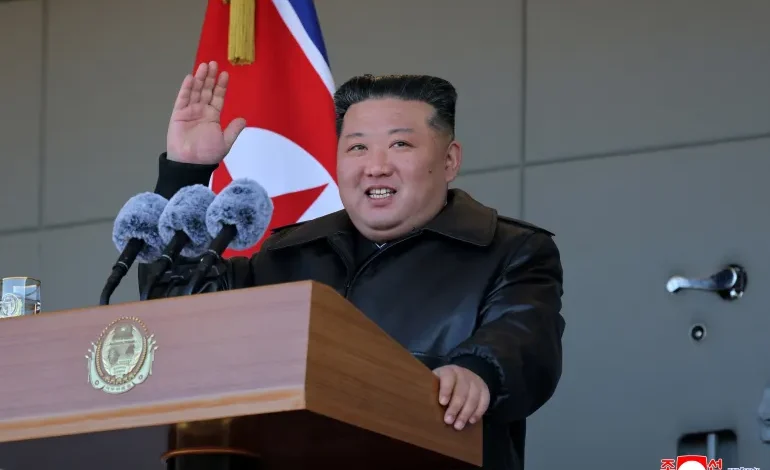

North Korean leader Kim Jong Un has overseen test flights of hypersonic missiles, signalling Pyongyang’s intent to strengthen its nuclear deterrent amid what it calls mounting global instability and “complicated international events”.
State media said the drills were confirmed on Monday by the Korean Central News Agency (KCNA), a day after South Korea and Japan reported detecting multiple ballistic missile launches by the North.
The tests took place just hours before South Korean President Lee Jae Myung departed for China for a summit with Chinese President Xi Jinping, adding a layer of regional sensitivity to the timing.
According to KCNA, Sunday’s launch involved a hypersonic weapon system and was aimed at assessing combat readiness, sharpening missile troops’ operational skills and evaluating the performance of North Korea’s overall war deterrent.
“Through today’s launching drill, we can confirm that a very important technology task for national defence has been carried out,” Kim was quoted as saying. “We must continuously upgrade the military means, especially offensive weapon systems.”
KCNA said the missiles struck targets about 1,000km (621 miles) away, over waters east of the Korean Peninsula.
Kim framed the test in explicitly strategic terms, saying it was “a very important strategy to maintain or expand the strong and reliable nuclear deterrent” in light of “the recent geopolitical crisis and various international circumstances”.
The launch followed a sharp statement from Pyongyang on Sunday condemning US actions in Venezuela, including Washington’s abduction of Venezuelan President Nicolás Maduro.
North Korea denounced the operation as a “serious encroachment of sovereignty” and said it once again exposed “the rogue and brutal nature” of the United States, language that fits a long-standing narrative used by Pyongyang to justify its nuclear and missile programmes as protection against regime-change threats.
Hong Min, a North Korea expert at the Korea Institute for National Unification in Seoul, said the timing of the test appeared deliberate. In a note on Monday, he wrote that the launch was likely a response to US strikes on Venezuela.
Based on images released by state media, Hong said the missile appeared to be the Hwasong-11, a system unveiled at a military parade in October. He added that the Kim government was emphasising its ability to launch such weapons at will, an effort to complicate US and South Korean missile defence planning and reduce the chances of preemptive interception.
If fully operational, a hypersonic missile would significantly enhance North Korea’s ability to penetrate US and South Korean missile defence shields. While Pyongyang has conducted multiple tests in pursuit of such capabilities, many foreign experts remain sceptical about whether its missiles have consistently achieved the speed and manoeuvrability associated with true hypersonic weapons.
The latest test fits a broader pattern of intensified weapons development. In recent weeks, North Korea has test-fired what it described as long-range strategic cruise missiles and new anti-air systems, and has released images suggesting progress on its first nuclear-powered submarine.
Analysts say Pyongyang is likely showcasing or reviewing these advances ahead of the upcoming Workers’ Party Congress, the first in five years. Attention is focused on whether Kim might use the gathering to outline a new approach to relations with the United States or signal openness to reviving long-stalled talks.



The latest news in your social feeds
Subscribe to our social media platforms to stay tuned