

EXCLUSIVE: Trump, Greenland, unravelling of multilateral restraint
- Published January 12, 2026

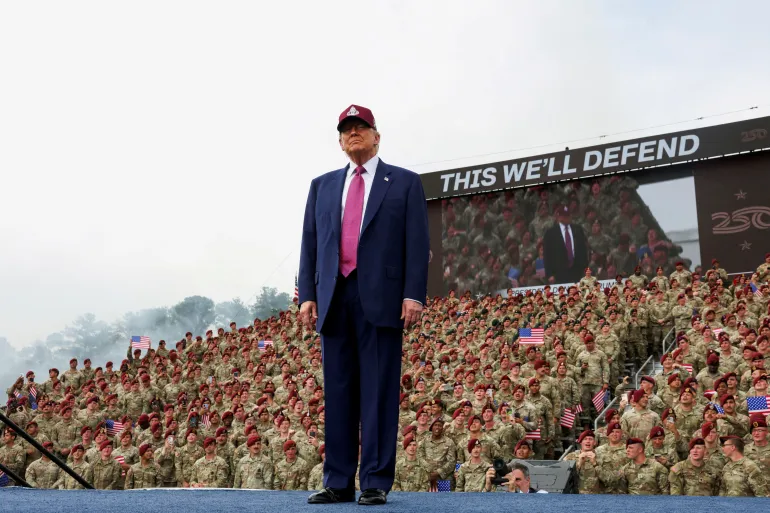
When United States President Donald Trump says he does not “need international law”, it is no longer just rhetorical provocation, it is becoming an organising principle of US foreign policy.
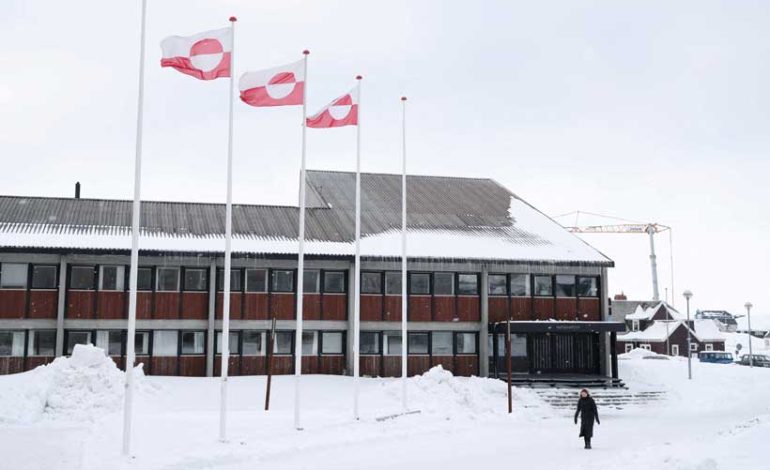
That principle is now colliding head-on with Greenland.
On Sunday, Trump argued that taking over Greenland is necessary to stop Russia or China from gaining control of the strategically vital Arctic territory, which belongs to Denmark.
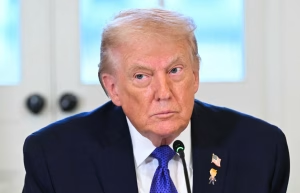
“If we don’t take Greenland, Russia or China will take Greenland, and I am not going to let that happen … but one way or the other, we’re going to have Greenland,” Trump told reporters aboard Air Force One.
He was explicit that this would not be a temporary arrangement.
“We’re talking about acquiring, not leasing, not having it short-term. We’re talking about acquiring,” he said. “You really need ownership. You really need title.”
The comments come as the Trump administration disengages en masse from multilateral institutions while simultaneously asserting unilateral control over other states, from Venezuela to Greenland. For many international law scholars, the combination is unprecedented in the post-war era.
Asked by The Wyoming Star to comment on the situation, Rosemary Foot, a British international political scholar, placed the current moment in historical context.
“The twentieth century is marked by a strong period of multilateral international organisational creation, with the UN system and the Bretton Woods institutions playing a major role in shaping the post-war order,” she said. “It is most unusual for a major state to disengage in this way, as Trump has chosen to do, especially surprising where that major state has exerted considerable direct influence over the ways these institutions have operated up to this point.”
What makes the moment particularly stark, Foot argues, is not just withdrawal, but selective domination. Washington is stepping away from formal commitments while continuing to pressure, sanction, threaten or override outcomes.
“Withdrawal reduces an ability to influence institutions from the inside as they deal with the collective challenges that we face in a globalised world,” she said.
Legally, the situation is even more fraught. Many international agreements contain explicit procedures governing withdrawal, including timelines, consultations and notice requirements.
“Withdrawal without following designated procedures for how withdrawal is required to be effected in itself is illegal,” Foot said.
The broader consequences, she added, extend well beyond any single treaty or organisation.
“The systemic consequences are further damage to the idea of a shared collective interest,” Foot said, describing an “anti-universalist stand” that replaces multilateralism with ad hoc arrangements.
The likely outcome, she warned, is a world where cooperation becomes “more likely bilateral than multilateral”, with only “a minimalist underpinning of coexistence for states and peoples in our global system”.
Supporters of Trump often argue that the international order was already fraying long before his return to office. That much is true. The language of international law has been repeatedly strained, ignored or selectively applied in recent years.
“Changes have been underway prior to this move on 7 January 2026,” Foot said, pointing to multiple stress points in the system, from the erosion of trade rules to failures to prevent mass atrocities.
Western leaders routinely cite Russia’s war in Ukraine as proof that the norm against the use of force is collapsing. Yet the contrast is now uncomfortable. The same governments invoking international law in Europe have largely struggled to respond when the United States abducts a sitting president in Venezuela, openly claims it will “run” the country, controls its oil revenues, and threatens military action against a NATO ally’s territory.
“This is a further acceleration of a breakdown in key areas,” Foot said.
She argues the Trump administration has weakened several foundational post-1945 norms, including the non-use of force except in self-defence, the defence of human rights, and the idea of collective security.
For Harri Mikkola, programme director at the Finnish Foreign Policy, Northern European Security and NATO research programme, Greenland exposes how far this worldview has already travelled.
“In a recent newspaper interview, Trump said that he does not care about the constraints imposed by international law and that we may have to choose between Greenland and NATO,” Mikkola told the Wyoming Star.
“In his actions, Trump relies on a very narrowly defined national interest, and in his worldview, world politics is framed by strength and power, not ideological or legal commitments.”
Mikkola warned that even US promises are now provisional.
“We have reason to assume that even international commitments made by Trump himself have only instrumental value, and he can break them at any time.”
The damage, he said, is already visible.
“Trust in the United States as a guarantor of security and in the commitments of the United States have been eroded, and at the same time the credibility of NATO’s deterrence has suffered significantly.”
Asked what precedent this sets if sovereignty becomes negotiable through pressure rather than consent, Mikkola was blunt.
“Trump is openly an imperialist, as is evident in his administration’s security strategy. I think we overestimate his transactional side, and we underestimate his ideology. He is an ill-liberal, radical, revisionist imperialist who believes in the right of the great powers to spheres of influence,” Mikkola said.
“Through his actions, he is creating a world in which the international rules-based order is increasingly losing its significance and where there are fewer and fewer restraints on the actions of the great powers.”
That framing resonates uncomfortably in Europe, particularly in Nordic countries that border the Arctic and have long relied on NATO’s collective guarantees.
Yet Greenland’s status also raises a more basic question: whose consent actually matters.
“Greenland is an autonomous territory whose leaders have repeatedly rejected US control,” Mikkola noted.
“Greenland is an autonomous territory of Denmark, but whose foreign policy is handled by Denmark. Greenland can become independent if it so wishes, after which it would be up to the Greenlanders themselves to define their own status.”
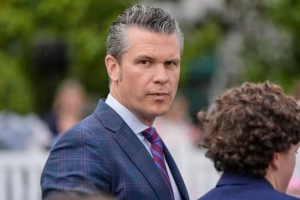
Trump has withdrawn the US from the UN Human Rights Council. His defence secretary, Peter Hegseth, has framed US strategy in explicitly imperial terms, invoking the Monroe Doctrine to justify projecting American power across the hemisphere.
As Hegseth put it, the doctrine means the administration “can project our will, anywhere, anytime”.
Greenland now sits squarely inside that worldview. Trump’s argument that Denmark cannot protect the island, and that US ownership is therefore necessary, echoes a much older logic: that power confers entitlement, and that security justifies acquisition.
For critics, the danger is not only what Washington does next, but what others learn from it. If international law becomes optional for the most powerful state in the system, it becomes optional for everyone else.
And if “ownership” replaces consent as the currency of security, then the post-war promise that borders are not up for grabs begins to look increasingly hollow.
The latest news in your social feeds
Subscribe to our social media platforms to stay tuned