


China and Canada Look to Reset Ties as Global Pressures Mount

After years of strained relations, China and Canada are signalling a cautious reset, driven less by enthusiasm than by shifting global realities.
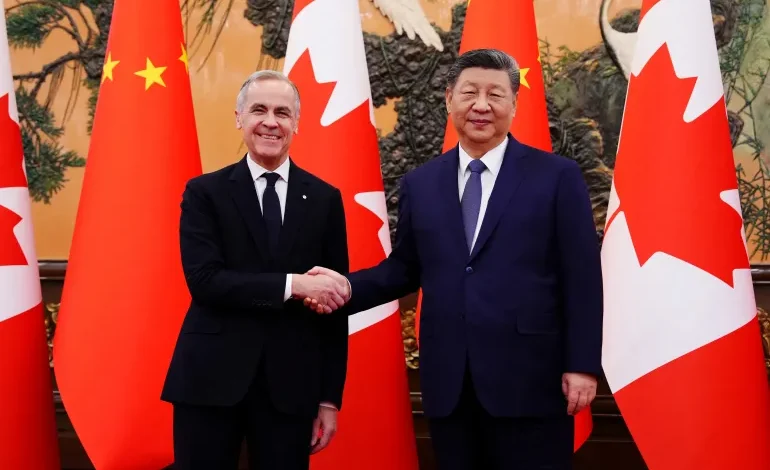
Meeting in Beijing on Friday, Chinese President Xi Jinping told visiting Canadian Prime Minister Mark Carney that he was willing to continue working to improve bilateral ties. Xi pointed to ongoing talks aimed at restoring cooperation, which began after the two leaders held an initial meeting last October on the sidelines of a regional economic forum in South Korea.
“It can be said that our meeting last year opened a new chapter in turning China–Canada relations towards improvement,” Xi said.
Carney, making the first visit to China by a Canadian prime minister in eight years, framed the outreach in broader, systemic terms. Speaking at the Great Hall of the People, he argued that improved relations between Beijing and Ottawa could help stabilise a global governance system he said was “under great strain”.
Addressing Xi directly, Carney said that “together we can build on the best of what this relationship has been in the past to create a new one adapted to new global realities”.
Engagement and cooperation, he added, would be “the foundation of our new strategic partnership”.
“Agriculture, energy, finance, that’s where we can make the most immediate progress.”
Those “new global realities” are widely understood to include the economic shockwaves generated by the “America First” trade agenda of US President Donald Trump. His tariff-heavy approach has hit both Canadian and Chinese economies, forcing allies and rivals alike to reassess long-standing dependencies.
Carney, who met with several major Chinese companies during his visit, said ahead of the trip that Canada is trying to build an economy less reliant on the United States at what he described as “a time of global trade disruption”.
Despite the warmer tone, key points of friction remain unresolved. No announcements were made on tariffs between China and Canada, one of the most contentious issues in the relationship.
Under former prime minister Justin Trudeau, Canada followed Washington in imposing tariffs of 100 percent on Chinese electric vehicles and 25 percent on steel and aluminium. Beijing responded with its own sweeping measures, slapping 100 percent duties on Canadian canola oil and meal, 25 percent tariffs on pork and seafood, and a 75.8 percent levy on canola seeds last August.
Together, those measures effectively shut Canadian canola out of the Chinese market, according to industry groups, dealing a heavy blow to one of Canada’s most important agricultural exports.
For Beijing, the diplomatic opening with Ottawa fits into a broader strategy. Chinese officials have made little secret of their hope that pressure from Trump on traditional allies like Canada will push them toward foreign policies less tightly aligned with Washington.
Trump has repeatedly inflamed sensitivities north of the border by suggesting that Canada could one day become the United States’ 51st state, remarks that have hardened public opinion while underscoring the uncertainty facing US partners.


The latest news in your social feeds
Subscribe to our social media platforms to stay tuned