




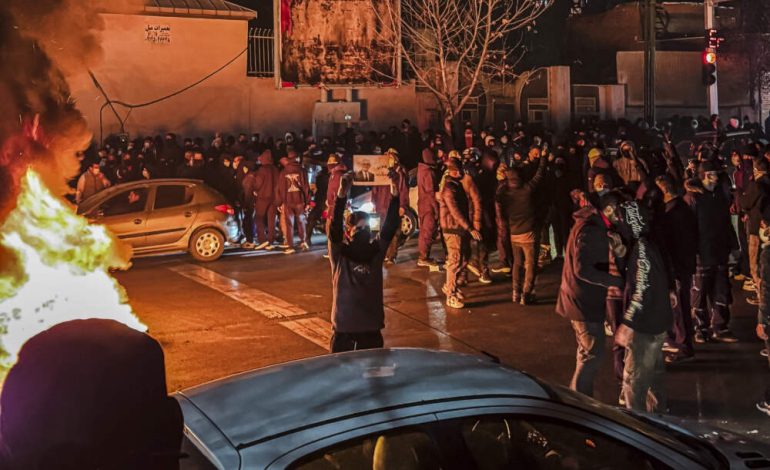

Will the ongoing turmoil in Iran, coupled with President Trump’s promised support for protestors, threats of US and Israeli military intervention, and the imposition of a 25 percent tariff on countries that trade with Iran soften the Iranian government’s crackdown, result in regime change, or, most importantly, benefit protestors?
First, essential background. Iran has been in an economic freefall ever since the Revolution of 1979, with hardships that have been exacerbated in recent years. Why such economic hardship for a country of educated people and blessed with abundant resources? Observers focus on US and international economic sanctions limiting Iran’s oil and natural gas and non-energy exports, increasing the cost and availability of imports, choking off foreign investment in Iran and also limiting domestic investment, restricting access to technology, and more, all of which have combined to impair economic growth. While sanctions have been a very important factor, there have been other deleterious factors – inconsistent and harmful economic policies, endemic corruption, the 8-year war with Iraq, regional conflicts, expenditures on defense and regional proxies, and the heavy cost of a nuclear enrichment initiative. All along, the Iranian currency has been under pressure and has crashed in the New Year. A dramatic statistic on how badly Iran has fared is Iran’s progress in comparison to South Korea’s – before the Revolution of 1979, Iran’s GDP was about 200% of Korea’s but in 2024, it was about 25% of Korea’s!
Economic hardships have ballooned, and the most recent demonstrations that have paralyzed the country mushroomed in the Grand Bazaar, a commercial center. Protests have been met with harsh repression. Thousands of protestors, along with hundreds of security officials, have been killed. President Trump and Benjamin Netanyahu have encouraged and fueled continued protests. Reza Pahlavi, the son of the late Shah, has echoed Trump’s call to action and has been promoted by Israel as Iran’s savior; while there is a lot of nostalgia for the late Shah, his son has little legitimacy in the eyes of most Iranians, especially since he has warmed up to Netanyahu.
Will more sanctions, American and Israeli intervention, and the promotion of Reza Pahlavi change Iran for the better and help average Iranians?
In the first place, given that Iran is sanctioned to the hilt, Iran has been good at getting around sanctions – smuggling, rerouting through third countries, and everything in between. Countries that trade with Iran do the same – any country that already trades with Iran is quite fleet-footed. Still, Trump’s proposed 25% tariff may have a marginal effect in raising prices in Iran and leading to shortages. But the question is, will this affect the regime’s policies so as to improve daily lives? Clearly not, but it will increase the hardship on all Iranians. The only thing that would bring immediate relief for Iranians is a lifting of all sanctions. But the United States is unlikely to contemplate such a move unless the regime is gone and buried or if there is a real rapprochement.
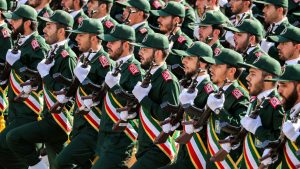
Will the additional tariff and even more economic pressure topple the regime? No. The regime loyalists – the Revolutionary Guards, the security forces, and the hundreds of thousands of clerics – are all in with the regime. The Guards will not lay down their guns. They would lose economically if the regime fell and they had no escape routes. Promises of benefits and pardons from Trump would be worthless, as the majority of Iranians remember the CIA coup of 1953, US support for Iraq during the Iran-Iraq War, the Trump-ordered assassination of an Iranian nationalist, General Ghassem Soleimani, and Trump’s recent promise of negotiations that was instead preempted by the bombing of Iran’s nuclear facilities. If threatened, the Guards will fight to the bitter end this time. They will release missiles as never before at US military bases in the region and at Israel, fully cognizant that Iran will be bombed by Israel and the US. But they have nothing more to lose, and they now regret that they agreed to the ceasefire with Israel, as their missiles were getting through and Israel was running out of interceptors. They see that weakness as a historic blunder. Never again!
Iranians are being used as pawns by the US and Israel to soften the regime for an attack. Thousands of innocent Iranians are dying. But all for naught. The situation is tragic beyond words. Neither Israel nor the United States has Iran’s interest at heart. Instead, they are looking for their own advantage as Iranians shed their blood.
The United States and the West keep repeating the same strategic mistake. They assess all conflicts in their own mindset and from their own perspective. They rarely get inside the head of their adversary and ask how he will react under the ongoing circumstances. Regime change, inspired by outsiders, might have been possible in the early days of the Revolution but not now. Sanctions, more sanctions, and economic hardship will only hurt average Iranians and make eventual rapprochement ever more difficult.
The only positive road is for Iran and the US to hold all-inclusive talks, sometimes referred to as a “grand bargain,” without the interference of other countries muddying the waters, to arrive at a normalized relationship between the two.

The latest news in your social feeds
Subscribe to our social media platforms to stay tuned