


The original story by Mark Heinz for Cowboy State Daily.
Gerald Gay once thought his days of real backcountry hunting were over. After decades spent roaming Wyoming’s wild places, a medical setback in 2015 left the Casper man partially paralyzed and facing a future that, at best, meant hunting from the side of a road.
Today, thanks to a rugged all-terrain electric buggy, Gay is once again heading off-road, picking his shots, and packing out game on his own. And he believes this kind of technology could change everything for disabled hunters.
Gay was 59 when complications from spinal surgery temporarily paralyzed him from the waist down. Through months of physical therapy, he regained the ability to stand and walk short distances with the help of leg braces and a cane.
“The first thing I asked them to teach me was how to stand up and say the Pledge of Allegiance,” Gay said.
Still, reality set in fast. Wyoming law doesn’t allow able-bodied hunters to shoot big game from vehicles, and while disabled hunters can apply for special permits, that usually meant staying close to roads. For years, Gay’s hunting was limited to sitting in friends’ pickups, glassing from pullouts.
“It was better than nothing,” he said, “but it wasn’t really hunting the way I knew it.”
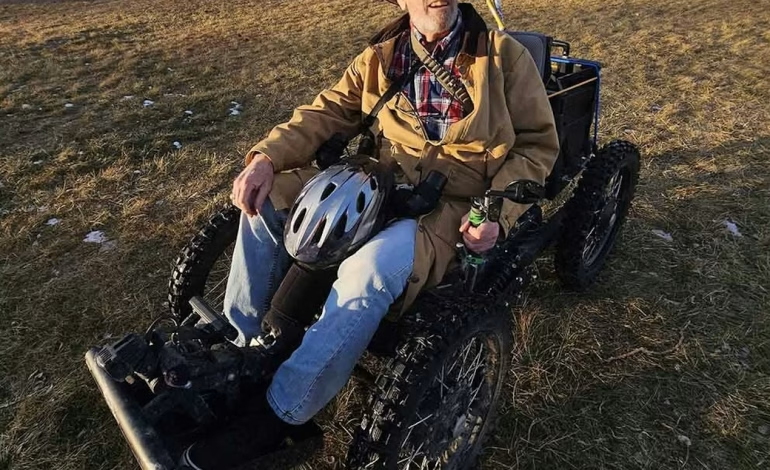
That changed in 2024, when Gay got his hands on a Coyote, a single-person, all-terrain electric vehicle built by Outrider, a company based in North Carolina. Technically, it’s classified as an electric wheelchair. In practice, it’s more like a compact off-road buggy.
It has four wheels, aggressive tires, high clearance, and enough stability to handle rough terrain well beyond the shoulder of any road.
This past fall, Gay took it deep into hunting country. On the third day of his hunt, he spotted the mule deer buck he wanted.
“I shot a beautiful five-by-five,” he said.
Then he did something that would’ve seemed impossible just a few years earlier: he quartered the deer and hauled all the meat out himself using the Coyote.
“Everything you do if you’re fully physically capable, I can do with this thing,” he said.
Gay isn’t the only one pushing boundaries. Across Wyoming and the region, disabled hunters are finding ways back into the field.
Randy Svalina of Laramie, who recently lost most of one leg, started hunting on crutches while adapting to a prosthetic. He and his doctor are even working on redesigning the prosthetic to double as a rifle rest.
Idaho hunter Tj Cartwright, who lost his sight in a bowhunting accident, once thought hunting was over for good. Instead, he learned to hunt waterfowl by sound and, in 2024, successfully harvested a whitetail buck in Park County with the help of specialized aiming devices.
“Just because you do things differently doesn’t mean you can’t do it,” Cartwright said. “Everybody deserves to be out there.”
Gay has customized his Coyote with a rifle rest and a hitch. He caps the speed at about 10 mph, fast enough to cover ground but slow enough to stay safe on tight turns.
In town, the rifle rest doubles as a hands-free leash hook when he walks his dog. In winter, he hooks up a sled and gives neighborhood kids rides after a snowfall. During hunting season, a small trailer hauls meat.
“It’s handy in ways I didn’t even expect,” he said.
With new mobility comes new goals. Gay wants to try upland bird hunting with a dog, picturing a scenario where the dog goes on point and he flushes birds on his own terms.
Even bigger is his long-standing dream of completing the “grand slam” of North American bighorn sheep. He already took three species decades ago. The final one, desert bighorns, lives in terrain where the Coyote might actually work.
He’s already prepared for it, filling the tires with sealant to handle cactus spines and thorns.
Gay says technology is only part of the equation. Access to public land remains a challenge, especially where fences block routes across land that’s supposed to be open.
He believes some barriers may violate long-standing laws protecting access to public land, and possibly even the Americans With Disabilities Act.
“Times are changing as the technology is changing,” he said. “And access needs to keep up.”
Friends say Gay hasn’t lost his edge. Decades ago, he was a bodybuilder training for Mr. Wyoming, known for hauling oversized rifles on prairie dog hunts and later chasing brown bears in Alaska.
His body may not be what it once was, but his drive hasn’t faded.
The Coyote didn’t just get Gerald Gay back into the field. It gave him back a future in the wild – and opened the door for a lot of other hunters who were told, one way or another, that their time was up.

The latest news in your social feeds
Subscribe to our social media platforms to stay tuned