




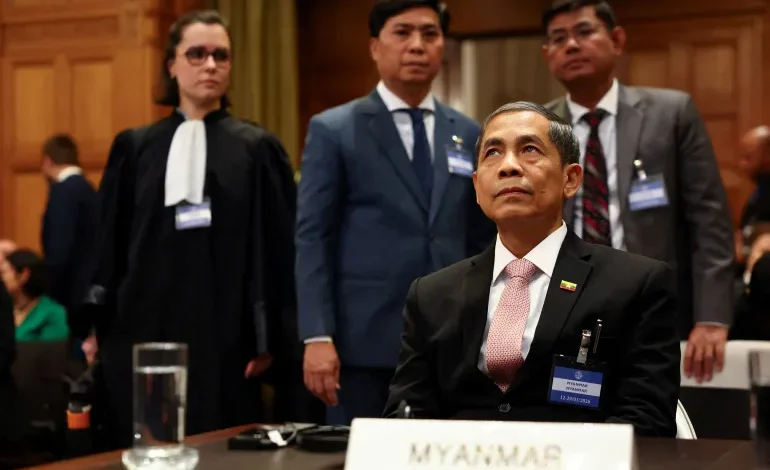

Myanmar’s military government has pushed back hard against an international court case accusing it of genocide against the country’s mostly Muslim Rohingya minority, calling the allegations “flawed and unfounded”.
In a statement carried by state media on Wednesday, the Ministry of Foreign Affairs rejected the case brought by The Gambia at the International Court of Justice (ICJ) in The Hague, saying it was based on “biased reports” and “unreliable evidence”.
“The allegations made by The Gambia are flawed and unfounded in fact and law,” the ministry said. “Biased reports, based on unreliable evidence, cannot make up for truth.”
The statement added that Myanmar’s military rulers, who seized power in a 2021 coup, were cooperating with the proceedings “in good faith” and out of respect for international law.
The case dates back to 2019, when The Gambia filed suit at the ICJ over Myanmar’s 2017 military campaign in Rakhine state. That operation forced about 750,000 Rohingya to flee their homes, mostly into neighbouring Bangladesh, amid widespread reports of mass killings, rape and the burning of entire villages.
Today, around 1.17 million Rohingya are living in overcrowded refugee camps in Cox’s Bazar, Bangladesh.
On Monday, as hearings formally opened, Gambian Justice Minister Dawda Jallow told the court that the Rohingya “have been targeted for destruction” by Myanmar’s authorities.
Myanmar’s legal team is due to begin presenting its response on Friday. The trial is the first genocide case the ICJ has taken up in full in more than a decade, and its implications extend well beyond Myanmar. Legal experts say the outcome could influence other cases, including South Africa’s petition accusing Israel of genocide in Gaza.
The hearings are expected to run for three weeks.
International scrutiny of Myanmar’s actions is not new. The UN human rights chief at the time of the 2017 crackdown described it as a “textbook example of ethnic cleansing”, while a UN fact-finding mission concluded that the military campaign had included “genocidal acts”.
Myanmar’s authorities have consistently rejected those findings, arguing the operation was a legitimate counterterrorism response to attacks by Rohingya armed groups.
Notably, Wednesday’s Foreign Ministry statement did not use the term “Rohingya”, instead referring to “persons from Rakhine state,” reflecting the state’s long-standing refusal to recognise the Rohingya as an official ethnic minority or grant them citizenship, despite generations-long ties to the country.
A final ICJ ruling could take months or even years. While the court has no enforcement mechanism, a decision in favour of The Gambia would likely intensify diplomatic and political pressure on Myanmar.


The latest news in your social feeds
Subscribe to our social media platforms to stay tuned