






With input from Oil City News and Gillette News Record.
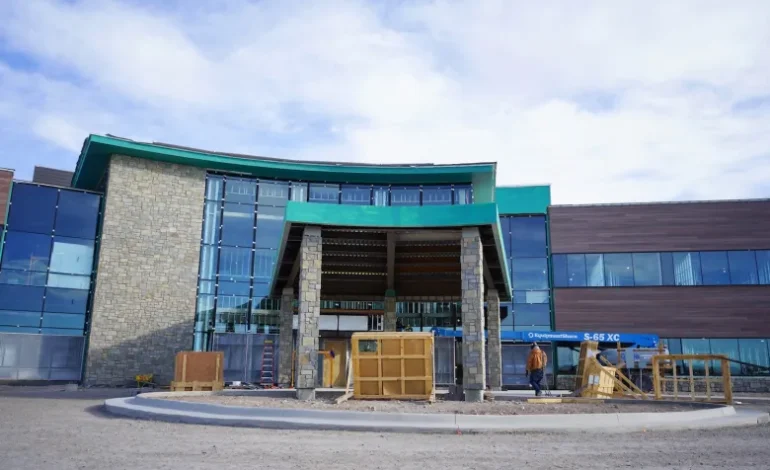
Wearing a hard hat and neon safety vest, Corte McGuffey weaves through drywall dust and half-finished hallways, gesturing toward the future. Radiology will go here. Exam rooms there. A walk-up pharmacy in the back. Upstairs, hospital beds – and yes, labor and delivery rooms.
McGuffey is giving a tour of Riverton’s new community-owned hospital, the product of nearly eight years of fundraising, planning and persistence in a town of about 11,000 people. After breaking ground in late 2024, the 70,000-square-foot facility has quickly taken shape on Riverton’s north side. Exterior walls and most windows are in, and the goal is to wrap construction by September and start seeing patients before the end of the year.
The project grew out of local frustration with health care consolidation and the loss of services under SageWest, which operates its own Riverton hospital. At a time when Wyoming has seen hospitals close departments and struggle to stay afloat, Riverton’s new facility stands out as rare growth.
There’s still plenty to do. The medical district must finish construction, hire staff, install billing and record systems – and ideally raise more money. And once the doors open, the hospital will face the same tough math as other Wyoming facilities: low patient volume and high fixed costs.
That’s where a massive influx of federal money could change the equation.
Wyoming is set to receive $205 million in federal Rural Health Transformation Funds in 2026, with the potential for up to $800 million more over the following five years. State leaders are now sketching out how that money could help stabilize hospitals, clinics and providers across Wyoming – including brand-new facilities like Riverton’s.
The Riverton Medical District Board worked with other Billings Clinic affiliates around the state to submit recommendations to the Wyoming Department of Health and has been closely tracking the rollout. While specifics are still sparse, hospital leaders see real opportunity.
“Wyoming has a real chance to use these funds not as a one-time fix,” said McGuffey, who chairs the board, speaking over the noise of construction. “Hopefully this becomes something that works long term.”
The Rural Health Transformation Program was created under President Donald Trump’s One Big Beautiful Bill Act, setting aside $50 billion nationwide over five years to shore up rural health care.
Wyoming’s application process moved quickly. Health Department staff started gathering public input last September through town halls, conferences and an online survey that drew 1,300 responses. By early November, the state had submitted an 84-page application outlining how it would spend the money.
The proposal includes incentives for small rural hospitals to focus on core services, grants to train and retain health care workers, expanded telehealth, stronger EMS systems, wellness programs and even a permanent investment fund to generate ongoing revenue for health care. Wyoming applied for $200 million – and was awarded $205 million, landing the second-highest per-capita award in the nation behind Alaska.
Now comes the hard part: setting up programs, hiring staff, drafting contracts and passing legislation to make it all work.
Last week, the Joint Appropriations Committee took its first look at a draft bill that would establish major pieces of Wyoming’s rural health plan, including a perpetuity investment fund and an advisory panel.
Even among a Legislature known for its small-government instincts, the reception was largely positive – a key signal that Wyoming intends to accept and deploy the federal dollars. One proposal didn’t make the cut: a state-run insurance plan for catastrophic health events, which lawmakers had previously criticized.
Health Department Director Stefan Johansson told lawmakers the state has some flexibility to tweak its plans, but warned that going beyond what was approved could put the funding at risk.
“I don’t want it to be a situation where we color outside the lines,” said Rep. Jeremy Haroldson, R-Wheatland, “to the point where we find ourselves without lines and maybe without a fund.”
Johansson called the funding a rare opportunity.
“This is a generational chance to make smart, conservative and practical investments in rural and frontier health care,” he said.
The committee tabled the bill until February.
For McGuffey, the policy discussions feel a world away from the day-to-day grind of building a hospital. The project has already required a $37.1 million USDA Rural Development loan, $15 million in federal grants and a partnership with Billings Clinic. At times, he said, just getting to this point felt overwhelming.
“The amount of work it takes to pull something like this off is crazy,” he said, standing on a second-floor balcony overlooking the construction.
Once open, the hospital is expected to create more than 100 local jobs and restore services that have disappeared elsewhere – including limited labor and delivery, which many Wyoming hospitals have dropped in recent years.
Gov. Mark Gordon said last week the federal funding will help facilities like Riverton’s survive and grow.
“This program will protect hospitals, strengthen emergency care, grow our rural health care workforce and bring care closer to home,” Gordon said, also crediting lawmakers for helping secure the funding.
As Riverton’s hospital inches closer to completion, state leaders, providers and communities across Wyoming are watching closely – hopeful that this wave of rural health dollars might finally give struggling hospitals a fighting chance.

The latest news in your social feeds
Subscribe to our social media platforms to stay tuned