






When United States President Donald Trump returned to office a year ago, he made cutting the US trade deficit a centrepiece of his economic reset. The gap had ballooned to roughly $918.4bn in 2024, about 3.1 percent of GDP, and Trump vowed to reverse what he called decades of failed trade policy.
To do it, he reached for emergency powers. Using the International Emergency Economic Powers Act, the White House rolled out sweeping “reciprocal tariffs” on April 2, arguing they were needed to correct unfair trade practices that had “hollowed out” American manufacturing.
On paper, the strategy has delivered part of what Trump promised. Preliminary data show the overall US trade deficit narrowed in 2025. But look closer, and the story is less about reshoring and more about rerouting.
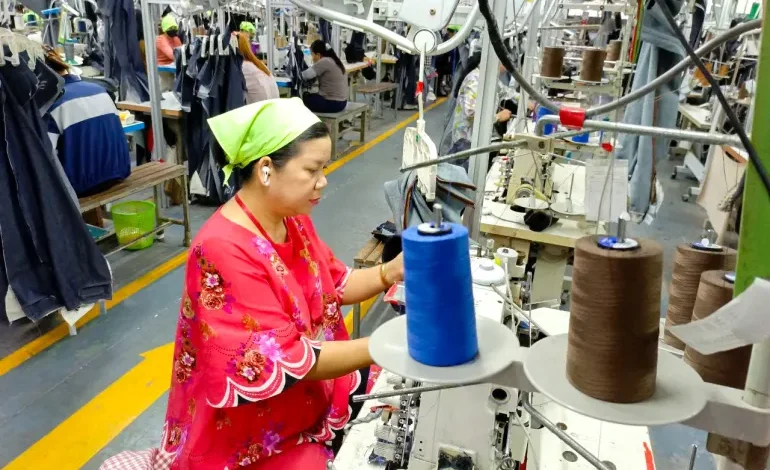
Rather than breaking US dependence on Asian manufacturing, the tariffs have largely reshuffled supply chains, especially away from China and deeper into Southeast Asia.
China was always the main target. After months of tit-for-tat escalation, US tariffs on Chinese goods averaged 47.5 percent by November 2025, according to the Peterson Institute for International Economics.
The impact was immediate. Chinese exports to the US fell by about 20 percent in 2025, Chinese customs data show. US figures tell a similar story: imports of Chinese goods dropped from $438.7bn in 2024 to $266.3bn in 2025.
As a result, the US goods trade deficit with China shrank sharply, contributing to an overall fall in the US goods deficit from $245.5bn to $175.4bn year-on-year.
That is the headline Trump wanted. But it is not the whole picture.
While China’s exports fell, Southeast Asia’s manufacturing economies picked up the slack.
Countries such as Vietnam, Thailand, Indonesia and the Philippines were also hit with “Liberation Day” tariffs, initially ranging from 17 to 49 percent. Those were later negotiated down to around 19–20 percent through bilateral deals, still well below the effective rate imposed on China.
The result: US trade with much of Southeast Asia increased in 2025.
The US goods deficit rose 11 percent with Indonesia, 23 percent with Thailand, and 38 percent with the Philippines, according to US Census Bureau data. Trade with Cambodia and Malaysia stayed broadly flat despite the new tariffs.
Vietnam stands out. The US goods deficit with Hanoi jumped by more than $20bn, climbing from $123.4bn in 2024 to $145.7bn in 2025, even with a 20 percent tariff in place.
Southeast Asia, long positioned as part of the “China Plus One” supply chain strategy, has emerged as one of the main beneficiaries of Trump’s trade war.
Some of the shift reflects Chinese firms rerouting exports through neighbouring countries, a practice known as transshipment. But economists say that is only part of the story.


The latest news in your social feeds
Subscribe to our social media platforms to stay tuned