





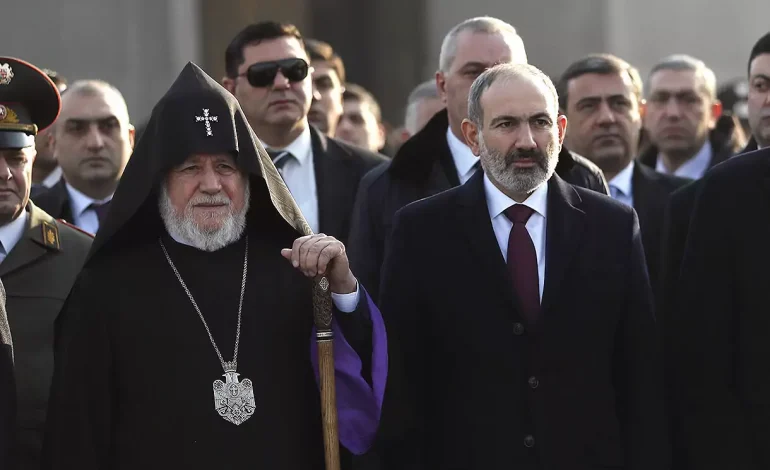

Armenian Prime Minister Nikol Pashinyan has drawn a hard line between church and state, and then immediately stepped across it.
Speaking during a government question hour on January 21, Pashinyan pushed back against accusations that his government is interfering in the affairs of the Armenian Apostolic Church (AAC). Responding to opposition MP Garnik Danielyan, who accused him of overreach and even played an old recording of one of his speeches, Pashinyan flipped the argument on its head.
The church, he said, should not interfere in state affairs either.
That line might have sounded like a standard secularist defence, until he went much further.
According to Pashinyan, it is now becoming clear that churches are being used for “anti-state propaganda” and that there are plans to activate political activity during elections. Then came the remark that detonated the room.
“We never assumed that the church should be led by KGB agents,” Pashinyan said. “The interests of Armenia are involved here.”
The message was blunt: the prime minister believes elements inside the Armenian Apostolic Church are acting not just politically, but as instruments of hostile influence — implicitly Russian.
But here’s the problem. This isn’t really about the KGB. And it’s not really about theology either.
It’s about power.
Pashinyan has spent years trying to dismantle what he sees as Armenia’s old elite networks: oligarchic, clerical, security-linked, and historically aligned with Moscow. The church, one of the most trusted institutions in Armenian society, sits uncomfortably outside his control. When clerics criticise the government, especially over national identity, war, or relations with Russia, Pashinyan doesn’t hear dissent, he hears subversion.
By framing church leaders as potential “agents”, he shifts the debate from legitimacy to loyalty. Once that move is made, everything becomes a matter of national security.
And that’s where the argument starts to wobble.
Because if the charge is foreign influence, critics will say Pashinyan is being selective. He doesn’t want KGB agents, fair enough. But what he wants instead, they argue, is ideological alignment with his own geopolitical pivot: away from Moscow and toward the West.
In that reading, it’s not that Pashinyan opposes agents. It’s that he opposes the wrong ones.
The Armenian Apostolic Church has historically functioned as more than a religious body. It has been a guardian of identity, especially in moments when the state was weak or absent. Trying to discipline it through the language of espionage risks backfiring badly, particularly in a society already traumatised by war, territorial loss, and geopolitical drift.
Accusing the church of preparing political activity may or may not be true. But accusing it of being run by shadowy intelligence forces is a far more explosive claim — and one that demands evidence, not insinuation.
For now, Pashinyan appears to be escalating a confrontation he claims to want to avoid. He says the church should stay out of politics. Yet by invoking the KGB, elections, and national security in the same breath, he is pulling the church deeper into a political fight it cannot escape.



The latest news in your social feeds
Subscribe to our social media platforms to stay tuned