



Short Staffed and Falling Apart: Forest Service Insiders Warn Trails Are on the Brink

The original story by for WyoFile.
A quiet but troubling warning has been making the rounds inside the US Forest Service: America’s trails, campgrounds and recreation sites are slipping into disrepair – and fast.
That warning, spelled out in a federal Trails Program Status Report that surfaced in December, comes as no surprise to longtime Wyoming Forest Service veterans Del Nelson and Bill Lee. After spending last summer volunteering on the Shoshone National Forest, the retired Lander residents say the situation on the ground already feels dire – and likely to get worse.
Nelson and Lee followed similar paths long before DOGE became a household acronym. Both built careers in public education – Nelson as a teacher, Lee as a school counselor – jobs that conveniently freed up their summers. And both shared a deep love for the mountains.
That combination sent them into the woods year after year, signing on as seasonal Forest Service workers. Over decades, they became rangers, forestry techs, campground hosts and fire crew members, mostly on the 2.5-million-acre Shoshone National Forest, which sprawls from Montana to Wyoming’s Red Desert.
They built bridges, cleared trails, drove fire engines, cleaned campgrounds and fixed whatever broke.
“I’d say my job was ‘T to T’ – tickets to toilets,” Nelson joked.
“We had the best job,” Lee said. “Good times.”
Even after retiring from education, both men kept coming back to seasonal Forest Service work. Between them, they logged roughly 90 years of service. But that era ended abruptly. Lee’s seasonal recreation position was cut in 2024. Nelson’s followed soon after, both eliminated due to funding shortages – before President Donald Trump and Elon Musk rolled out the Department of Government Efficiency, or DOGE, in 2025.
“And then DOGE came in and just did a hatchet job,” Lee said. “We haven’t recovered, and it doesn’t look like we’re going to anytime soon.”
In a state like Wyoming, where nearly half the land is federally managed, those cuts hit hard. District offices across the state were hollowed out by layoffs, hiring freezes and policy shifts. Staffers have largely stayed quiet, declining to speak publicly since Trump took office.
The internal Forest Service report fills in the silence – and it’s blunt.
Districts reported losing up to 100% of their trail staff, along with decades of institutional knowledge. Burnout is widespread. Vacant positions, unfunded contracts and muddled communication from leadership are grinding recreation programs to a halt.
Without major changes, the report warns, public access and visitor satisfaction will continue to decline beyond 2026, putting decades of investment in trail infrastructure at risk.
Nelson and Lee say that assessment matches exactly what they saw in 2025, when both volunteered on the Shoshone. They fixed signs, repaired picnic tables, patched docks and took note of eroding trails – all while watching staff struggle to keep up.
“We got through last year,” Lee said. “But it’s not sustainable. Stuff is going to build up.”
What worries him most is the near-wipeout of seasonal workers – the people who actually swing tools, clear downfall and maintain trails.
“They’re gone,” Lee said. “That leaves specialists with no crews and guarantees the backlog just keeps growing.”
The impact became painfully clear last February, when job cuts gutted the Shoshone’s Washakie District office in Lander. The office closed temporarily, citing too few staff to stay open.
Lee stopped by often, checking in with former coworkers. One conversation stuck with him: a trails crew that once had nearly a dozen people was down to two.
“I thought, how’s this going to work?” he said. “It ain’t feasible.”
So he volunteered. Nelson did too, serving as a campground host. Another retired employee, Barb Gustin, filled in at the front desk all summer.
Lee admits he worried that doing too much unpaid work might send the wrong message. But concern for the land won out. Together, the men cleaned bathrooms, fixed docks, stabilized signs and talked with campers about fire rules.
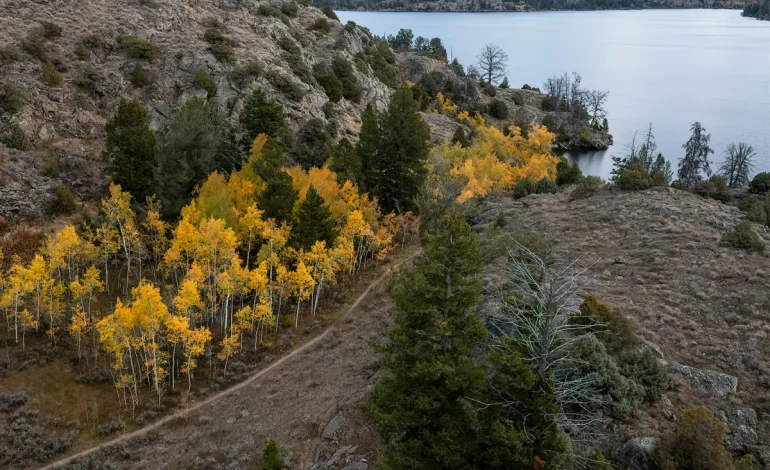
What they couldn’t reach – and what worries them most – are the roughly 1,300 miles of trails threading through the forest. Without crews, trees don’t get cleared, erosion worsens, water bars fail and maintenance snowballs into bigger, more expensive problems.
The Washington Office trails report echoes those fears. Based on input from nearly 300 district-level employees, it describes unpassable trails, unsafe bridges and environmental damage tied directly to staffing losses and stalled projects. Critical wilderness positions sit vacant. Millions in grant funding went unused and had to be returned.
Trail maintenance dropped 22%. Only 19% of trails met standard – the lowest mark in 15 years.
One staffer summed up the mood:
“It feels like we are on the verge of not passing anything on for the future.”
Forest Service Chief Tom Schultz has struck a more upbeat tone publicly, promising a leaner agency focused on core work, improved visitor experience and modernized recreation infrastructure.
But on the ground, that message rings hollow.
One Wyoming Forest Service employee, speaking anonymously, described a workplace consumed by uncertainty, shifting directives and fear. Their team has been slashed, and the fallout reaches far beyond recreation – affecting grazing, watershed protection, habitat restoration and cultural resources.
“It’s not just recreation,” the employee said. “All Forest Service staff are suffering.”
Nelson sees a deeper disconnect, too. He says fewer decision-makers have real, on-the-ground experience anymore – fewer people who’ve slept outside, worked trails or truly know the land.
That experience matters, both men say. They’ve watched public lands change lives, including their own. Nelson returned to teaching each fall refreshed by summers outside. Lee calls time in the forest spiritual.
“It’s good for the soul,” he said.
The internal report offers a roadmap: speed up seasonal hiring, extend key positions, support partnerships and – perhaps most importantly – deliver clear, consistent leadership messages.
Lee says hiring seasonal workers is the single most urgent fix. Volunteers help, but they can’t replace trained, paid crews.
As for the two old rangers? Lee plans to volunteer again – and keep speaking out.
“It’s my way of pushing back,” he said. “This is wrong.”
Nelson isn’t sure yet. At 81, he hesitates.
But Lee didn’t miss a beat.
“We’ve gotta fix the dock,” he said, thinking of Louise Lake. “That table’s busted. We’ve got to fix it.”



The latest news in your social feeds
Subscribe to our social media platforms to stay tuned