

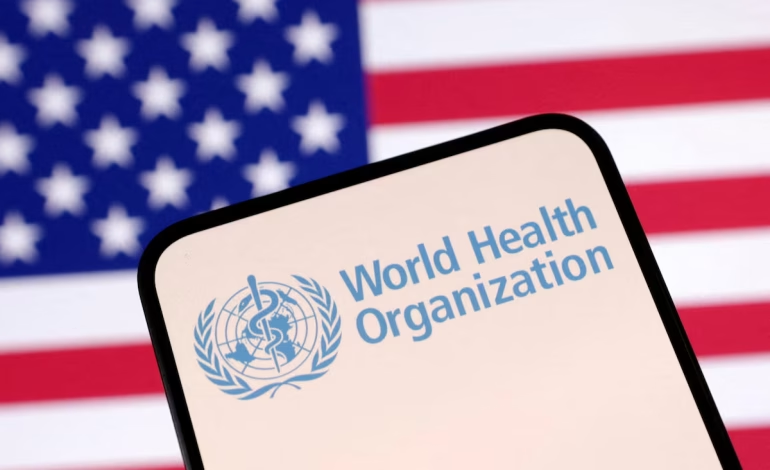

The United States has formally completed its withdrawal from the World Health Organization, closing a chapter that began with threats during Donald Trump’s first term and is now being carried through to the end by his second.
The announcement came Thursday in a joint statement from US Health Secretary Robert F Kennedy Jr and Secretary of State Marco Rubio, who declared that Washington’s exit from the World Health Organization is now complete. It marks the first time since 1948 that the US is no longer a member of the Geneva-based body it once helped found.
The pair laid the blame squarely on the WHO’s handling of COVID-19.
“Going forward, US engagement with the WHO will be limited strictly to effectuate our withdrawal and to safeguard the health and safety of the American people,” Rubio and Kennedy said, confirming that all US funding to the organisation has stopped.
The move follows through on a decision announced by Donald Trump on January 20, 2025, his first day back in office. A technical delay written into US law meant the withdrawal only took legal effect this week.
From Washington’s perspective, the break is final. From the UN’s, it is already a fact on the ground.
“For all intents and purposes” the US is “no longer participating in the work of the World Health Organization,” UN spokesperson Stéphane Dujarric told reporters, adding that some legal loose ends still need sorting out.
“It is clear we would love to see the United States be a full participant in the work of the World Health Organization, like we want to see every country,” Dujarric said. “If there’s an issue that is clearly, that knows no border, that doesn’t respect territorial integrity, so to speak, are health issues.”
WHO chief Tedros Adhanom Ghebreyesus has already acknowledged the fallout. Earlier this month, he said the organisation had begun making cuts to cope with the funding gap left by the US exit.
Behind the scenes, the legal architecture of the withdrawal has been unusually messy. The WHO’s chief legal officer has noted that the organisation’s founders never imagined a member would leave, seeing it as a “truly universal organisation that would make the world safer”. The US later carved out its own escape hatch, allowing withdrawal after one year’s notice and full payment of outstanding dues — a condition complicated by the fact that Washington remains in arrears for 2024 and 2025.
Public health advocates have been blunt about the consequences. Lucky Tran, a global health policy expert, warned that the decision weakens everyone.
“The WHO has played a huge role in bringing countries together to reduce death and disease at an unprecedented scale,” he wrote. “It is by no means perfect, but we can only improve it by continuing to participate. Withdrawal is reckless and makes us all more vulnerable.”
Before the US departure, the WHO counted 194 members, encompassing nearly every UN state. Its work ranges from coordinating responses to outbreaks like Ebola and tuberculosis to deploying medical teams in humanitarian disasters, including Gaza.

The latest news in your social feeds
Subscribe to our social media platforms to stay tuned