





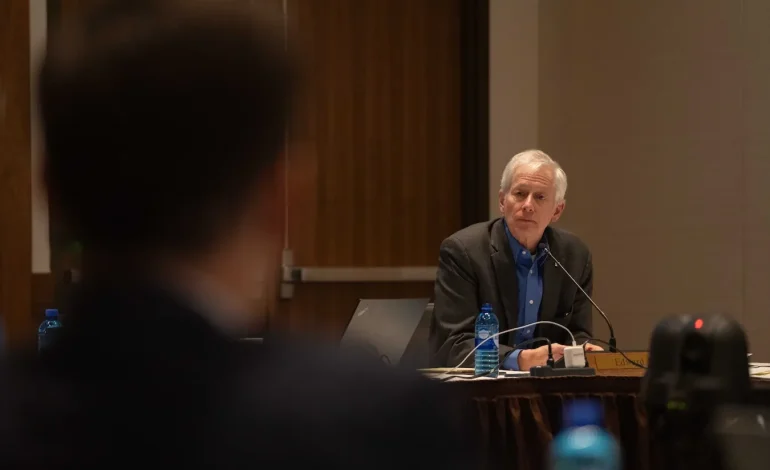

University of Wyoming President Ed Seidel isn’t usually one to jump into the day-to-day grind of the Wyoming Legislature. Even as lawmakers have increasingly scrutinized the state’s only four-year public university – from DEI programs to courses they see as too “woke” – Seidel has mostly stayed quiet in public.
That changed last week.
A proposal from lawmakers to cut $40 million from UW’s recommended state block grant was enough to push the president out of his usual behind-the-scenes role and into the spotlight. The reason is simple: cuts of that size could mean job losses and major changes to the university.
“This was such a major proposal that I thought we should make sure our community understood what was at stake,” Seidel said in a phone interview.
Seidel has long said that part of the reason he avoids public commentary on legislative proposals is that the process is unpredictable. Bills can appear one day and disappear the next, and many discussions happen quietly between university officials and lawmakers.
But the Legislature’s Joint Appropriations Committee voting to slash UW’s block grant by $40 million crossed a line.
In a campus-wide email sent Jan. 15, Seidel addressed the proposal head-on, assuring faculty, staff and students that university leaders were closely tracking the budget process and actively lobbying lawmakers.
He warned that the proposed cut – nearly 11% of UW’s state block grant for the biennium – would be “harmful and unnecessary,” especially since Wyoming isn’t facing a broader state budget crisis.
The proposed reduction comes on top of several other funding rejections:
- A $12.5 million request for matching funds;
- A $6 million ask for the athletics department;
- Full defunding of Wyoming Public Media, which is housed at UW;
- Rejection of Gov. Mark Gordon’s plan to fund salary increases for state employees, including nearly $28 million for UW staff who last received raises in 2023.
Overall, lawmakers pared Gov. Gordon’s recommended $374 million block grant for 2027–28 down to about $334 million, then added restrictions that reduce truly flexible funding to roughly $322 million.
For context, UW’s unrestricted operating budget in 2026 was nearly $410 million, with state aid making up more than $164 million of that total.
Seidel has been blunt about what a cut of this magnitude could mean.
Roughly 77% of UW’s unrestricted budget goes to salaries, wages and benefits, according to university spokesperson Chad Baldwin. That leaves little room to absorb cuts without trimming staff.
“Most of that funding does go for people,” Seidel said. “That would mean we’d have to have fewer people.”
While he stressed that it’s still speculative until final budget language is approved, the message was clear: layoffs are a real possibility.
The budget fight doesn’t stop with jobs. Seidel also raised concerns about the future of UW athletics. The Legislature rejected a $6 million request tied to a new NCAA settlement that allows colleges to pay student-athletes for name, image and likeness rights.
If that funding doesn’t materialize, Seidel said UW’s Division I status could be at risk – a move that would ripple through Laramie, especially on game days.
Another two-year budget cycle without raises could also hurt UW’s ability to keep faculty.
“We will certainly lose faculty through people finding better opportunities if we aren’t able to keep up,” Seidel said.
Laramie Democratic Rep. Ken Chestek, a professor emeritus at UW, worries the university could slide into being a “feeder school,” where students start their degrees in Wyoming but leave to finish elsewhere.
UW has weathered major cuts before, including during downturns under former governors Dave Freudenthal and Matt Mead, and a $30 million cut during the pandemic in 2020 – right as Seidel took office.
The difference this time? There’s no statewide revenue collapse.
“We’ve already gone through the deep pruning exercises,” Seidel said. “This time, I don’t see how we can do that without damaging the university.”
Supporters of the cuts, led by members of the Wyoming Freedom Caucus, say the goal is to rein in administrative growth and what they view as ideological drift at the university.
Rep. John Bear, a Gillette Republican and former caucus leader, said lawmakers are responding to concerns that UW has turned away from a “Wyoming way of life.” He also said he’d rather see more funding go to community colleges – while keeping UW tuition low for those who attend.
The budget fight is part of a longer battle. In recent years, lawmakers have barred state funds from being used for DEI programs, pushed to eliminate UW’s DEI office, and repeatedly targeted gender studies courses.
The budget process is far from over. The Freedom Caucus holds more sway in the House than the Senate, and the final numbers could change before the session ends. Lawmakers are also expected to propose more “footnotes” that restrict how UW can spend its money – potentially forcing deeper cuts in some areas while shielding others.
Seidel, for his part, has acknowledged that some lawmakers’ concerns deserve discussion. He points to UW’s move toward institutional neutrality and its early efforts to review DEI programming as evidence the university is responding.
Still, the timing is awkward. Seidel plans to step down as president in June, leaving his successor to inherit whatever budget – and political baggage – emerges.
“My main goal right now is to put the university in the best possible position for the next president,” he said.
Who that will be, and whether the current turmoil scares off potential candidates, remains an open question. What’s clear is that UW is heading into uncertain territory – and this time, its president isn’t staying quiet about it.



The latest news in your social feeds
Subscribe to our social media platforms to stay tuned