





Boise’s Rat Boom Is a Warning Sign. Wyoming Could Be Next.

The original story by Mark Heinz for Cowboy State Daily.
What one Idaho exterminator memorably called a “nuclear bomb of rats” in the Boise area isn’t just a local nightmare – it could be a preview of problems Wyoming might face if conditions line up just right.
The rat explosion unfolding across Idaho’s Treasure Valley started small. A couple of years ago, a single invasive Norway rat appears to have hitched a ride into a Boise suburb, likely tucked inside a moving pod brought by a newcomer from out of state. From there, things spiraled fast.
“Within a year, it was like a nuclear bomb of rats went off,” said Scott Springer, owner of ProGuard Pest Control in Eagle, Idaho. These days, he jokes grimly that he’s become the area’s “local rat expert.”
The situation worsened when a second invasive species – roof rats – joined the party. Known for their climbing skills and ability to squeeze into homes through tiny openings, roof rats are especially destructive.
“Roof rats are the pinnacle of rats,” Springer said. “They can climb trees and bushes, get onto roofs, and once they’re inside, they can cause massive damage in a very short time.”
According to John Koprowski, a University of Wyoming zoology professor and dean of the Haub School of Environment & Natural Resources, the answer is yes.
“The non-native rats can be found throughout Wyoming,” Koprowski said. “If any of the factors that favor rapid population growth kick in, then irruptions in rat populations can occur here in Wyoming or anywhere else.”
Those factors include mild winters, easy access to food, and shelter close to people. Rats thrive alongside humans – and have for centuries.
“The fact that these non-native species have been successful for so long tells us they aren’t going away anytime soon,” Koprowski added.
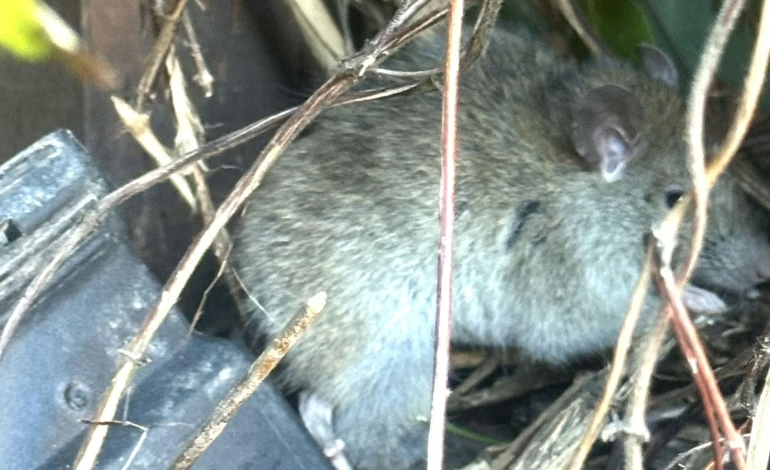
Springer said the Treasure Valley had always dealt with mice, but rats were another story. His first call came from a hunter who noticed unusual activity in his backyard. A trail camera confirmed it: a Norway rat running along a fence line.
That single rat, believed to be a pregnant female, quickly established a nest. From there, populations exploded – especially once roof rats arrived.
Rats reproduce at an astonishing pace. Roof rats can have four to five litters a year, while Norway rats can produce up to eight. Once established, exterminators say total eradication is no longer realistic.
“At this point, we’re just managing numbers and trying to limit damage,” said Tim Hall, a technician with Vertex Pest Control in Meridian, Idaho.
Older neighborhoods with do-it-yourself home repairs proved ideal for rats to move in. Springer said rats only need an opening about the size of a thumb.
“If they can get their skull through, they can get the rest of their body through,” he said.
From there, rats spread outward – into barns, sheds, chicken coops, and feed storage areas, where grain and hay offer an endless buffet.
Hall said winter makes things worse.
“When the cold hits, you just see that flood of rats coming into people’s homes,” he said.
Springer said rats are frustratingly smart. In one case, bait and traps failed because the rats were sneaking next door at night to raid bird feeders – stockpiling real food instead.
In another incident, rats chewed through a homeowner’s water line, HVAC system, and insulation, causing thousands of dollars in damage.
“I could hear the desperation in his voice,” Springer said of the homeowner. “It was overwhelming.”
Beyond property damage, rats pose serious health risks. Koprowski warned they can carry diseases like hantavirus and parasites that spread illnesses such as plague. Exposure can happen through droppings, bites, or even cleaning contaminated areas improperly.
Springer says exterminators are doing what they can, but prevention is the real key – especially for places like Wyoming that haven’t yet seen a full-blown invasion.
His advice is blunt: stop making your property inviting.
“Don’t feed the birds. Don’t feed the squirrels,” he said. “Trim trees and bushes back from your roof. Check door seals, window screens, and any gaps around your house.”
The Boise rat boom, he said, should be taken as a warning.
“This didn’t happen overnight,” Springer said. “But once it started, there was no stopping it.”
For Wyoming residents, the lesson is simple: stay proactive – or risk finding out just how fast a “nuclear bomb of rats” can go off.



The latest news in your social feeds
Subscribe to our social media platforms to stay tuned