


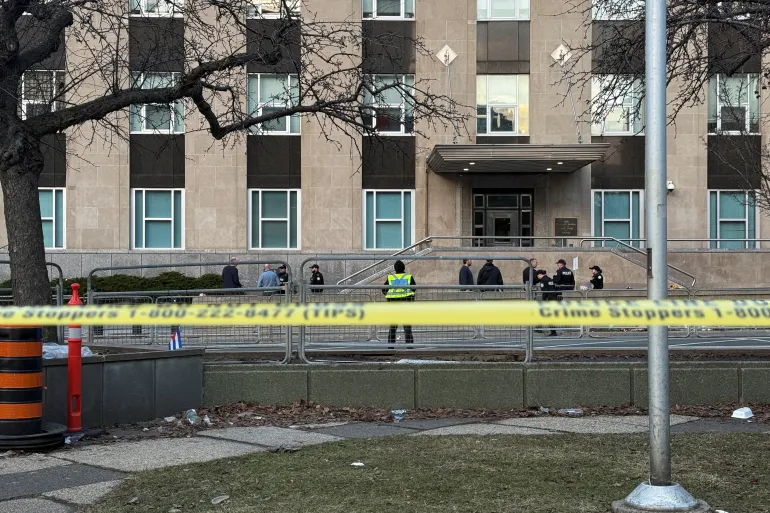


Advocates say the killing of a US citizen by an immigration agent in Minnesota may have pushed President Donald Trump’s aggressive deportation agenda into dangerous new territory, and opened a rare political window for Congress to act.
At a news conference on Wednesday, immigration experts and civil liberties advocates argued that public opinion is turning sharply against Trump’s mass enforcement drive, once a cornerstone of his 2024 election victory. They say lawmakers now face mounting pressure to rein in an immigration system that has grown bigger, bolder and far less accountable.
“I think we are really at an inflection point here,” said Kate Voigt, senior policy counsel at the American Civil Liberties Union.
“We’ve seen a swell of grassroots actions over the past few weeks. More and more people are seeing that ICE is dangerous, violent, operating with impunity. More and more people are angry, scared, motivated, and more and more people are looking to their members of Congress for action.”
That shift, advocates argue, is being driven not by abstract policy debates but by images and videos that have ricocheted across the country, most notably the January 7 killing of 37-year-old Renee Nicole Good in a Minneapolis suburb.
The footage, which spread rapidly online, raised serious questions about the Trump administration’s claim that Good was attempting to run over an immigration officer when she was shot. Within minutes of the incident, federal officials labelled her a “domestic terrorist”, blocked local authorities from investigating and rejected calls for a civil rights probe.
For critics, the response became as alarming as the shooting itself.
Any course correction would be difficult. Trump’s sweeping tax and spending package, which he proudly dubbed the “Big Beautiful Bill”, delivered an unprecedented funding surge to the US Department of Homeland Security.
Of the $170bn windfall, roughly $75bn was earmarked for the Immigration and Customs Enforcement over four years, $45bn to expand detention capacity and $30bn to intensify enforcement. That comes on top of ICE’s regular budget of about $10bn a year.
Critics describe the extra funding as a slush fund with minimal oversight. The Brennan Center for Justice has warned it is fueling a sprawling “deportation industrial complex”, making ICE the most heavily funded federal law enforcement agency in the country by a wide margin.
Under Trump’s second term, ICE has rapidly expanded, with the agency now topping 22,000 agents. Daily detention targets have surged to 100,000 people, nearly triple historical levels, while the administration is openly chasing one million deportations a year, far beyond the 605,000 reported in Trump’s first year back in office.
Advocates say Minnesota has become a case study in what unchecked enforcement looks like in practice.
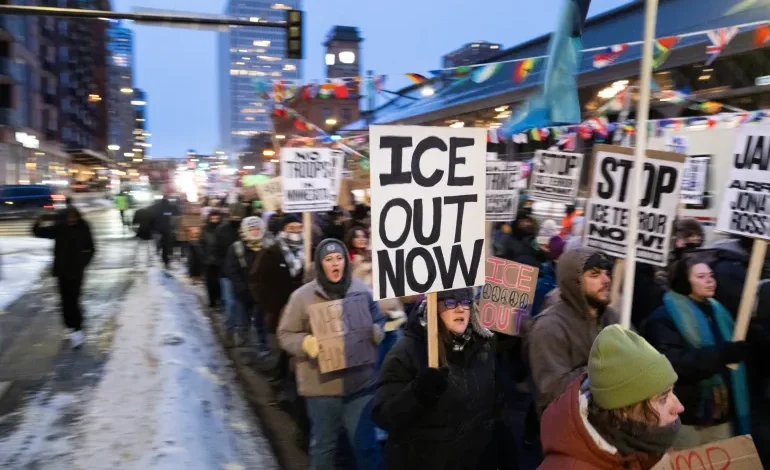
After Good’s killing, the administration flooded the state with additional federal agents, pushing the total to nearly 3,000. Protests erupted across Minneapolis, St Paul and hundreds of other US cities. Trump officials dismissed the demonstrations as the work of “agitators” and “insurrectionists”.
The Justice Department has since opened investigations into Minneapolis Mayor Jacob Frey and Minnesota Governor Tim Walz, accusing them of conspiring to obstruct federal immigration enforcement, a move critics see as intimidation.
Minnesota, along with Minneapolis and St Paul, has filed a lawsuit alleging ICE agents repeatedly violated residents’ civil liberties. Videos showing confrontations between agents and civilians have continued to circulate, further eroding trust in federal enforcement.
Advocates argue that the backlash is no longer confined to immigrant communities.
“What people are seeing now is that this isn’t just about immigration status,” one organizer said privately. “It’s about state violence, lack of accountability, and what happens when a federal agency is told it can do whatever it wants.”

The latest news in your social feeds
Subscribe to our social media platforms to stay tuned