




The original story by David Madison for Cowboy State Daily.
When Ethan Pretsch was working in the world of massive temporary industrial buildings – think data centers, factories and aircraft hangars – he kept slamming into the same problem: fire suppression that felt wildly outdated.
Sprinkler systems were expensive, slow to kick on and, in many cases, caused almost as much damage as the fire itself.
“I went down this rabbit hole and found out there was absolutely nothing out there,” Pretsch said. “I even called one of the biggest sprinkler companies in the country, and they basically said, ‘Nope – but if you build something, let us know.'”
So Pretsch did.
In 2024, the Jackson-based entrepreneur launched WatchDog Robotics, a startup building autonomous fire suppression systems that rely on robotic water turrets and infrared sensors instead of century-old sprinkler technology. The company says its system can detect and extinguish a fire in about 12 seconds, compared to the two to four minutes it can take for traditional sprinklers to activate.
And in a fire, seconds matter.
“A fire grows exponentially,” Pretsch said. “Every second it’s getting bigger and more dangerous. Being able to knock it down within 12 seconds of ignition is a massive game changer.”
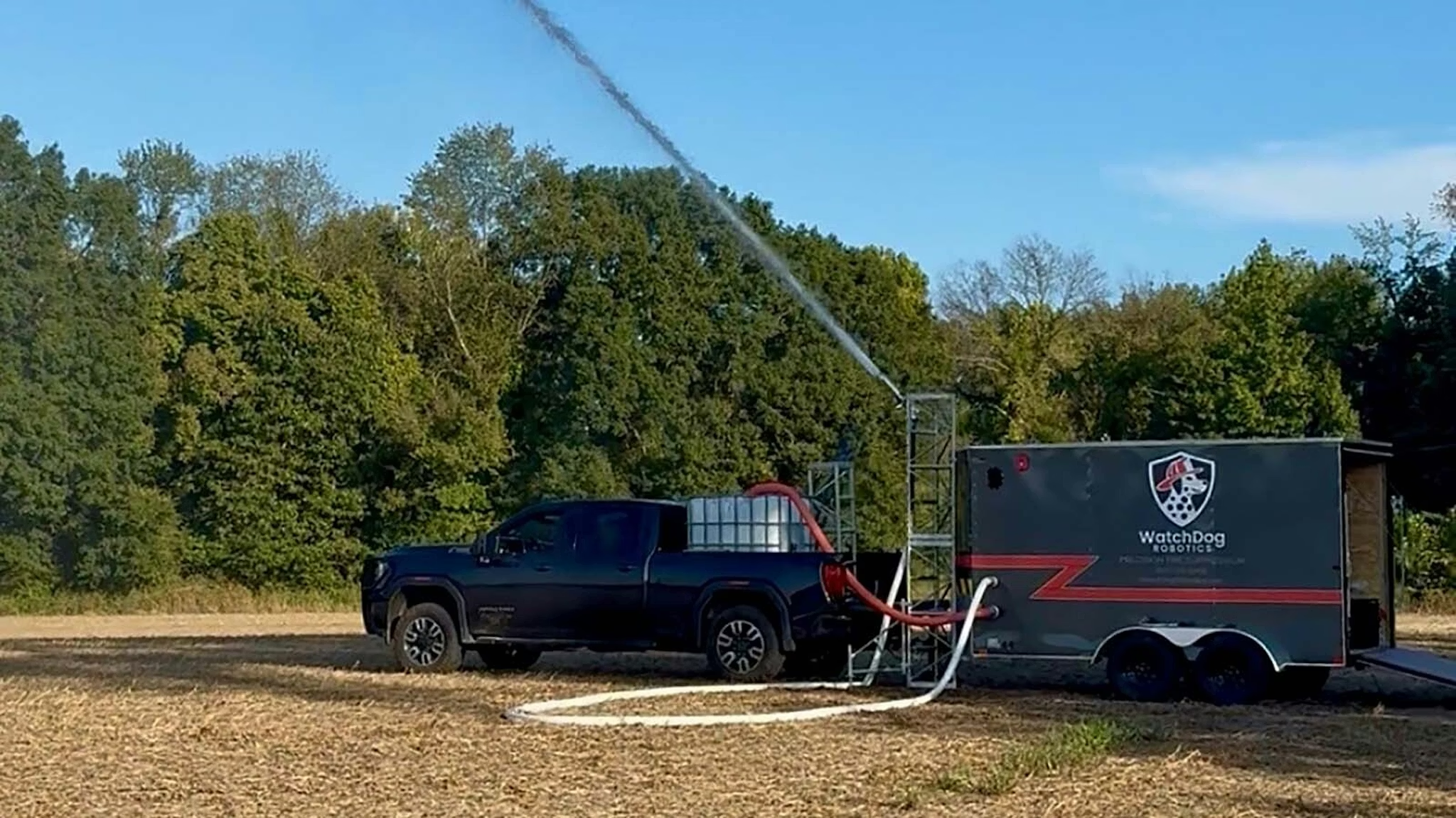
WatchDog’s flagship system, called the NozzleBot, uses triple-infrared sensors to detect the unique wavelengths emitted by flames. Once a fire is detected – typically within two to four seconds – a motorized water turret locks on and starts spraying within another eight or nine seconds.
A typical wood fire can be fully extinguished in about 12 to 15 seconds, Pretsch said.
The turret can rotate 360 degrees, reach targets up to 212 feet away, and spray nearly 600 gallons of water per minute. One unit can cover as much as 140,000 square feet, and the system automatically shuts off once the flames disappear.
That’s a big departure from sprinklers, which were first introduced in the late 1800s and still operate largely the same way today.
“Sprinklers are a last line of defense,” Pretsch said. “They’re great at keeping a building from burning to the ground, but by the time they activate, a lot of damage has already happened. And then they just keep running until firefighters shut them off.”
In places like paper mills, manufacturing plants or data centers, that water damage alone can shut down operations for months.
Pretsch’s idea grew out of his time at Mahaffey USA, a company that built temporary facilities for huge industrial projects. Fire protection was always a challenge, said George Smith, Mahaffey’s former CEO and Pretsch’s uncle.
“These buildings still need sprinkler protection, but it’s extremely expensive to run pumps and water mains for something that’s only semi-permanent,” Smith said.
Smith pointed Pretsch toward autonomous fire vehicles, but they didn’t quite fit the need. So Pretsch started researching alternatives, eventually traveling to Australia and Europe to find partners who could help him build a portable, fast-acting system.
“There’s nobody really doing what he’s doing,” Smith said. “He’s getting there first.”
While WatchDog’s early demand has come from industrial workplaces and remote facilities, Pretsch sees huge potential in wildfire protection, especially in Wyoming and across the Mountain West.
The mobile version of the NozzleBot is mounted on a trailer and includes its own pump, power supply and solar panels. It can pull water from ponds, lakes or other nearby sources.
For homes in the wildland-urban interface, Pretsch imagines multiple trailers positioned around a property during fire season.
“If a wildfire is detected on the perimeter, the system could start soaking the structure immediately,” he said. “Then, as the fire approaches, it transitions into actively fighting it.”
Pretsch said Jackson Hole Fire/EMS officials have been receptive to the idea, particularly as a way to free up firefighters during major wildfire events.
“If you’re stretched thin, instead of putting two firefighters at a substation or historic cabin, you could deploy a couple trailers and move on,” he said.
WatchDog Robotics is headquartered in Jackson, though much of the testing currently happens at a warehouse in Tennessee. Pretsch said he hopes to eventually move more operations back to Wyoming, possibly to Alpine, where space is easier to find.
The company is still in startup mode. Pretsch’s wife, Tori, a pharmacist in Jackson, has been helping support the business while he builds it. WatchDog now has a small team, including a chief operating officer, and is actively bidding on projects.
The company’s name is a nod to the Dalmatian – the classic firehouse dog that once guarded equipment and helped clear streets for horse-drawn fire engines.
And while robotic fire turrets may sound futuristic, Pretsch says the need is already here.
“After big wildfires, you hear about homeowners trying to hire private firefighters,” Smith said. “That doesn’t really exist at scale. This is a niche that needs innovation.”
As fire seasons grow longer and more intense, WatchDog Robotics is betting that faster, smarter fire suppression – not 19th-century sprinklers – is the future.



The latest news in your social feeds
Subscribe to our social media platforms to stay tuned