




India and the European Union have agreed on a sweeping free trade deal creating a market spanning two billion people, marking one of the largest trade agreements in the world after nearly two decades of intermittent negotiations.
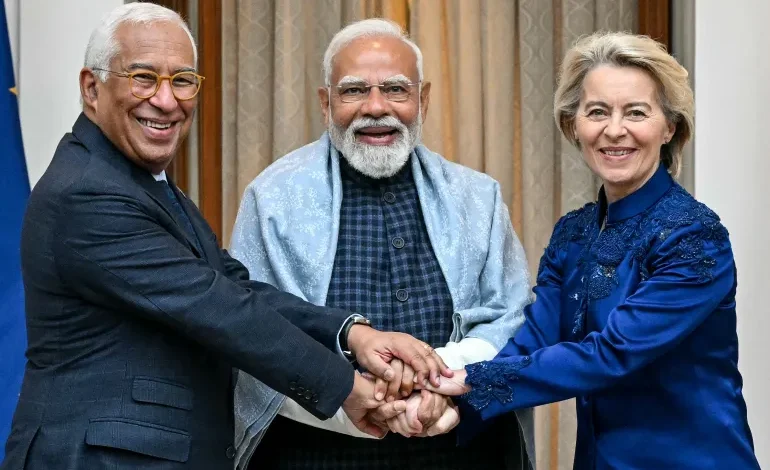
European Commission President Ursula von der Leyen announced the breakthrough during a visit to New Delhi on Tuesday, calling the agreement historic.
“We have concluded the mother of all deals. We have created a free trade zone of two billion people, with both sides set to benefit,” von der Leyen wrote in a post on X, adding that the partners were “making history today”.
Indian Prime Minister Narendra Modi confirmed the agreement ahead of meetings with von der Leyen and European Council President António Costa, describing it as a milestone for both economies.
“This deal will bring many opportunities for India’s 1.4 billion and many millions of people of the EU,” Modi said.
The agreement will cover roughly 25 percent of global gross domestic product, Modi added, with India expected to gain across sectors such as textiles, gems and jewellery, and leather goods.
The pact comes as both Brussels and New Delhi look to diversify trade and open new markets amid rising global protectionism, including tariffs imposed by the United States and tighter Chinese export controls. For India, the deal opens access to freer trade with the 27-nation EU, its largest trading partner, while Europe sees India as a key long-term growth market and a source of future demand for technology and investment.
Formal signing will follow a legal review expected to take five to six months, according to Reuters, citing an Indian government official. Implementation is anticipated within a year.
EU officials said the agreement could double European exports to India by 2032. Trade in goods between the two sides has already grown by nearly 90 percent over the past decade, reaching 120 billion euros ($139bn) in 2024, with services adding another 60 billion euros ($69bn).
Under the deal, tariffs on 96.6 percent of EU goods exported to India would be eliminated or reduced, saving European companies up to 4 billion euros ($4.74bn) annually in duties. Machinery, chemicals and pharmaceuticals are among the sectors seeing the most significant tariff cuts.
Car tariffs would be gradually lowered to 10 percent, subject to a quota of 250,000 vehicles per year. EU service providers would gain preferential access in areas including financial and maritime services, while tariffs on most EU aircraft and spacecraft would be eliminated. Duties would also fall on wine, spirits and beer, while tariffs on fruit juices and processed foods would be removed entirely.
“The EU stands to gain the highest level of access ever granted to a trade partner in the traditionally protected Indian market,” von der Leyen said earlier this week. “We will gain a significant competitive advantage in key industrial and agri-good sectors.”
Negotiators had raced to resolve final sticking points on Monday, including concerns over the EU’s carbon border tax on steel, according to sources cited by AFP.
Talks on an India–EU trade deal began in 2007 but stalled for years. Momentum returned in 2022 after Russia’s full-scale invasion of Ukraine reshaped global trade and security priorities, while US President Donald Trump’s aggressive tariff policies accelerated progress.
Alongside the trade agreement, India and the EU announced a new security and defence partnership, similar to EU arrangements with Japan and South Korea. The move reflects parallel efforts by both sides to reduce reliance on traditional partners — India on Russia for defence equipment, and Europe on the United States — by diversifying supply chains and strategic ties.
The India–EU deal follows a series of recent trade pacts. Brussels has signed agreements with Mercosur, Indonesia, Mexico and Switzerland, while New Delhi has concluded deals with the United Kingdom, New Zealand and Oman.

The latest news in your social feeds
Subscribe to our social media platforms to stay tuned