



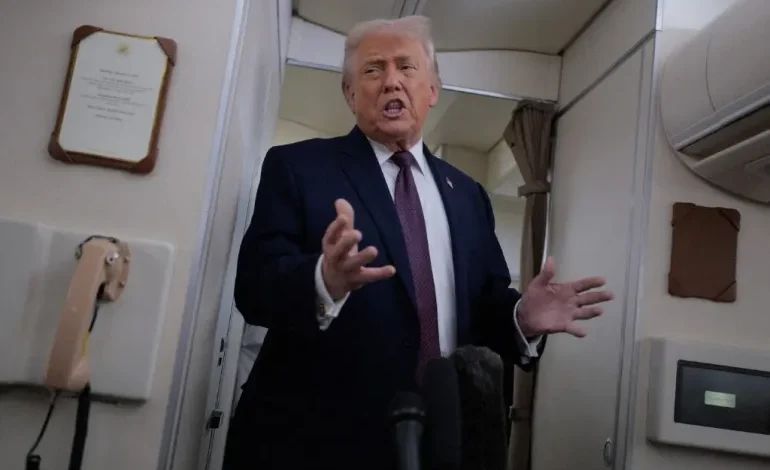

United States President Donald Trump has announced a sharp increase in tariffs on South Korean exports, accusing the East Asian ally of dragging its feet on ratifying a trade agreement with Washington.
In a post on Truth Social on Monday, Trump said he was “hereby increasing” tariffs from 15 percent to 25 percent, blaming South Korea’s legislature for failing to approve the pact reached between the two countries last year.
“South Korea’s Legislature is not living up to its Deal with the United States,” Trump wrote. “Why hasn’t the Korean Legislature approved it?” he added.
According to Trump, the higher tariff rate would apply to automobiles, lumber and pharmaceutical products, as well as goods covered under his baseline “reciprocal” tariff regime. As of Monday night, however, the White House had not issued an executive order formally enacting the increase.
South Korea’s presidential office, Cheong Wa Dae, said it had received no official notification from Washington. In a statement, it said Kim Yong-beom, director of national policy, would convene an emergency meeting on Tuesday to assess Trump’s announcement.
The office also said South Korean Trade Minister Kim Jung-Kwan, currently in Canada, would travel to the United States immediately to hold talks with US Secretary of Commerce Howard Lutnick.
The tariff threat puts renewed strain on a trade framework announced in July, under which Trump agreed to cut his reciprocal tariff on South Korean goods from 25 percent to 15 percent. The lower rate was later extended to South Korean automobile exports following Trump’s summit with South Korean President Lee Jae Myung on the sidelines of the APEC forum in Gyeongju in October.
As part of that deal, Seoul committed to investing $350bn in key US industries, including semiconductors and shipbuilding. Legislation linked to the agreement, drafted by Lee’s Democratic Party, has been sitting in South Korea’s National Assembly since November.
Trump’s latest move underscores how trade has become a persistent pressure point for South Korea, whose economy is heavily export-dependent and has struggled with weak growth. The economy expanded by just 1 percent in 2025 after contracting 0.3 percent in the final quarter, marking its weakest performance since 2020, when the COVID-19 pandemic disrupted global commerce.
Exports accounted for roughly 44 percent of South Korea’s GDP in 2024, far above the OECD average of 30 percent. While tariffs have dented demand for South Korean cars and machinery, the United States remains Seoul’s largest export destination after China.
South Korean exports to the US totalled $122.9bn in 2025, about 17 percent of overall exports, though that figure represented a year-on-year decline of 3.8 percent, a reminder of how exposed the country remains to shifts in US trade policy.

The latest news in your social feeds
Subscribe to our social media platforms to stay tuned