




CNBC, Investor’s Business Daily, the Wall Street Journal, the Financial Times, and Market Watch contributed to this report.
Boeing’s turnaround picked up speed in the fourth quarter: the plane-maker hauled in $23.9 billion in revenue in the final three months of 2025 – a 57% jump from a year earlier – and delivered the most jets since 2018. Still, executives warned there’s plenty left to do before the company can fully put a decade of troubles behind it.
The headline numbers were solid. Adjusted earnings came in at about $9.92 a share, a surprise after analysts were penciling in a loss, and Boeing reported fourth-quarter revenue of $23.95 billion versus roughly $22.6 billion expected. Free cash flow for the quarter was roughly $400 million, about double market expectations. Net income for the quarter was $8.22 billion, or $10.23 a share, compared with a loss a year earlier. Executives will take questions on an earnings call at 10:30 a.m. ET.
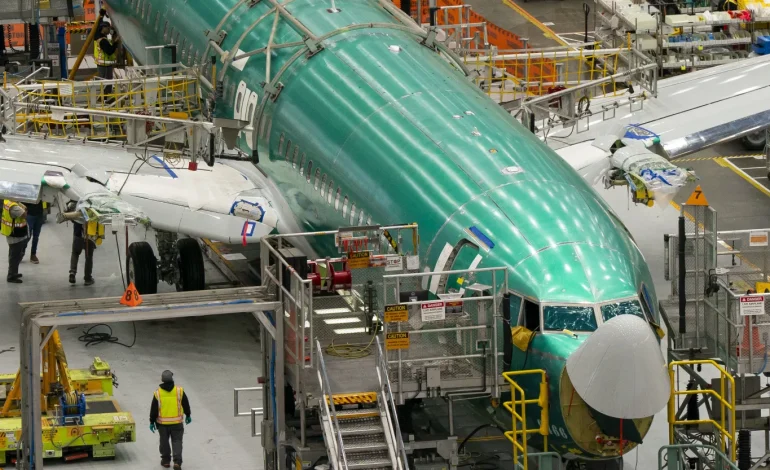
A big reason for the bump: deliveries. Boeing handed over 600 airplanes in 2025, up from 348 the year before and the highest annual total since 2018. The company delivered 63 jetliners in December alone, 44 of them 737 Max models. Commercial airplane revenue surged, too – management reported $11.38 billion for the quarter in that unit, well above Street estimates and nearly a 140% gain from the prior year. Its defense division also grew, with revenue rising 37% year-over-year to about $7.42 billion.
“Our progress is real,” CEO Kelly Ortberg told staff, adding there’s “a lot to be optimistic about” heading into 2026.
He told CNBC the company expects positive free cash flow of $1 billion to $3 billion this year, and reiterated a longer-term goal of getting to $10 billion in free cash flow – a target Ortberg said will take time and steady execution.
That optimism has a grain of realism baked in. Boeing has burned through roughly $40 billion since the second 737 Max crash in 2019 sent the company into crisis, followed by pandemic shocks, supply-chain headaches and a string of manufacturing and quality problems. Management has said the company still needs to win regulatory approvals, boost production without sacrificing safety, and finish work on long-delayed jet programs.
Investors cheered the beat but still want clarity. Boeing’s stock has bounced around this week as traders ask hard questions: how fast can production ramp, and when will the FAA sign off on higher 737 Max production rates beyond the current 42 a month? Regulators tightened that cap after a near-catastrophic midair panel blowout in January 2024, and any further increases hinge on FAA approvals. Shareholders are also pressing for concrete timelines on certification for the 737 Max 7 and Max 10, and for the 777X – Boeing’s next big wide-body that has slipped repeatedly.
There’s another wrinkle: despite the delivery surge, Airbus still delivered more aircraft in 2025, handing over 793 jets versus Boeing’s 600. But Boeing won the order race on net bookings, logging 1,173 net orders for the year versus Airbus’s 889, a sign that airlines are already planning for growth and fleet renewal into the 2030s.
Ortberg and other execs stressed that deliveries matter because airlines pay the bulk of a plane’s price on handover – ramping deliveries drives revenue and, eventually, cash. But turning that revenue into steady, predictable cash flow will require ironing out production kinks and navigating the regulatory process.
Boeing also flagged one-time items in the quarter. Adjusted earnings included the impact of the sale of its Jeppesen navigation unit, and the company has been absorbing costs tied to restructuring and other fallout from past issues. Management says those are part of a necessary cleanup to simplify operations and get margins back on track.
On the customer front, Boeing continues to lock in long-term commitments: recent wins include order activity from carriers such as Alaska and Delta for deliveries stretching into the next decade. Airlines appear focused on fuel-efficient next-generation jets as they plot growth and retire older, thirstier models.
But the road ahead isn’t smooth. Regulators, delivery backlogs, and lingering production challenges all leave room for disappointment. Analysts will be watching whether Boeing can translate its delivery momentum into sustained free-cash growth this year and whether the FAA clears higher Max production rates and certifications for the delayed models.
For now, Boeing can tout a clear rebound: revenue and deliveries are moving the right way, the company beat expectations on profit, and management is promising more cash in 2026. As Ortberg put it, progress brings higher expectations: “our customers and stakeholders are going to expect more from us this year.” Investors will want to hear the specifics of how Boeing plans to meet those expectations when executives take questions on the earnings call.



The latest news in your social feeds
Subscribe to our social media platforms to stay tuned