



The original story by for WyoFile.
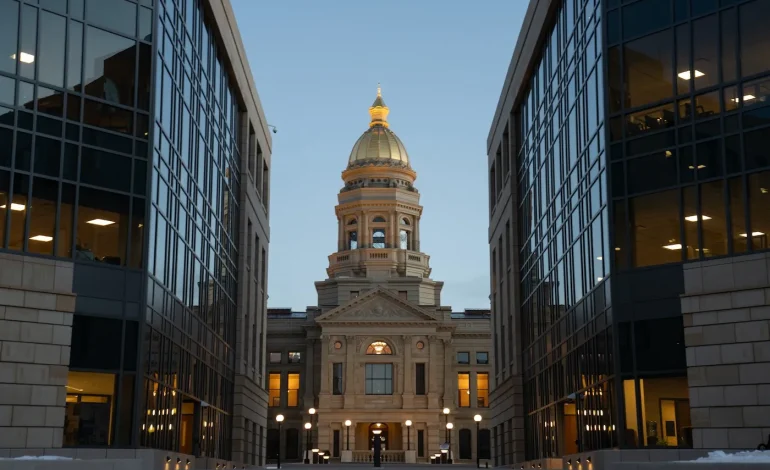
Lawmakers in Cheyenne are focused on the budget – as always – but the 2026 session also has a clutch of public-safety and justice tweaks worth watching. Expect debates on everything from where mentally ill inmates wait for treatment to how the state pays for its creaky 911 network, plus stiffer penalties on theft, drug cases involving kids and new rules for library shelves.
Here’s a plain-English tour of the biggest policing, courts and public-safety bills on the table.
The Joint Judiciary Committee only sponsored seven bills this session, an unusually small number. Still, the proposals it did push cover high-impact topics: mental-health care for detainees, criminal-penalty tweaks and limits on where certain books can be shelved. Other panels are pitching their own public-safety plans too – notably a study and short-term funding for the state’s beleaguered 911 system from the Joint Corporations committee.
Sheriffs have been sounding the alarm: local jails are increasingly holding people with serious mental illnesses while they wait for a bed at Wyoming State Hospital, and those folks aren’t getting treated in a timely way. Uinta County Sheriff Andy Kopp warned lawmakers last year that people are deteriorating in custody.
The Legislature’s answer is Senate File 10, which would let the Wyoming Department of Health contract with detention centers to hold and treat mentally ill detainees until they get competency evaluations or restoration – a stopgap that could include paying sheriffs to house people or funding local providers to deliver care in jails. It’s modeled on how the Dept. of Corrections already reimburses sheriffs for housing inmates pending transfer.
Bottom line: the idea is to keep people from languishing untreated in county lockups and give sheriffs a funding path to avoid shouldering the costs alone.
Nationally, a push to enforce English proficiency among commercial drivers has landed in Wyoming. House Bill 32 would codify federal rules that let highway patrol inspectors test drivers’ English and take drivers out of service if they fail.
The bill would also let county and municipal officers – and other law enforcement designated by the patrol – enforce the rule. Penalties aren’t trivial: failing the test could mean a $1,000 fine and being barred from driving until proficiency is shown; continuing to drive after being flagged could trigger misdemeanor charges, another $1,000 fine, up to 90 days in jail, or both. State troopers reported hundreds of such enforcement actions under the federal program last summer.
Wyoming’s 911 system is operating with thin cash and aging gear. The current funding cap – a $0.75 monthly surcharge per line set back in 1986 – hasn’t kept up with costs, creating an estimated $3 million shortfall across counties and raising the risk of outages. Lawmakers heard about a recent Sheridan County outage that rerouted emergency calls to a neighboring county – a reminder these failures can be life-threatening.
Senate File 32 tasks the Wyoming Department of Transportation with studying governance, operations and upgrades for the 911 network, and it asks for $750,000 from the Legislative Stabilization Reserve to pay for the study. The bill also earmarks $3 million as a stopgap to shore up county operations while the state hunts for a long-term funding fix. How the grants will be administered is still to be decided.
The culture wars aren’t limited to school boards. House Bill 10 aims to ban what it defines as “sexually explicit” material from school libraries and restrict placement of similar books in public libraries. It would also require school districts and counties to create formal challenge processes for library materials.
Supporters characterize the measure as protecting kids; opponents say it’s an intrusion aimed primarily at sidelining LGBTQ authors and viewpoints. Expect a heated debate.
A string of bills would raise penalties and lower thresholds for several offenses:
- Senate File 7 (Theft amendments): Lowers the felony threshold from five thefts to three offenses and boosts punishment for single thefts – jail time could rise from six months to one year, and fines from $750 to $1,500.
- Senate File 9 (Fentanyl to minors – enhanced penalty): Removes a leniency that currently applies when a distributor is within three years of the minor’s age – i.e., sellers of fentanyl to kids would face tougher consequences.
- House Bill 8 (Stalking of Minors): Adds stalking a child to the list of offenses that can be prosecuted as a felony, with penalties up to 10 years.
- Senate File 8 (Absconding for criminal purposes): Creates penalties for fleeing across county or state lines to commit or further crimes; punishment mirrors the most serious crime involved.
- House Bill 9 (Grooming of children): Carves out a new felony for grooming minors. Penalties are stiff: for victims under 16, prison terms of 4 years to life; for kids under 12, a minimum of 25 years up to life, plus fines up to $50,000.
These measures reflect a clear push to clamp down harder where children and communities are at risk.
Judiciary’s small slate doesn’t mean the session will be quiet. Individual lawmakers can still file bills – everything from Good Samaritan-style measures to contentious court reforms has popped up behind the scenes. Earlier closed-door talks even considered shrinking the Wyoming Supreme Court bench, though the appropriations committee didn’t act on that idea. Expect surprise bills and last-minute riders.
This session mixes practical fixes – money for 911, a system to help mentally ill detainees – with politically charged changes, like library restrictions and tougher criminal penalties. Some proposals aim to plug real gaps; others are designed to send a message. Either way, Wyoming’s public-safety map could look notably different by the time lawmakers adjourn.

The latest news in your social feeds
Subscribe to our social media platforms to stay tuned