

From Couch to Caverns: How One Black Hills Explorer Is Saving Ghost Town History Underground

The original story by Jackie Dorothy for Cowboy State Daily.
When Covid lockdowns hit, Levi Kessler found himself stuck on the couch like everyone else – watching Tiger King and itching to do something more meaningful. So he did what few people would dare: he went underground.
That restlessness sparked what’s now become History Under The Pines, a growing passion project dedicated to documenting abandoned mines and ghost towns across the Black Hills and nearby parts of Wyoming and Montana – all with landowner permission and strict anonymity.
“We were deep in this mine from the 1890s, sitting in a big open stope, and you could see tree roots coming through the ceiling,” Kessler said. “That’s when my buddy told me, ‘You should share this history below the pines.'”
Kessler, 28, lives in Spearfish, South Dakota, and works in tourism in Deadwood. He’s not a miner by trade – his goal isn’t ore or treasure, but stories.
After getting permission from private landowners, Kessler and a small crew began exploring abandoned mine workings and researching the properties’ histories. What started as sharing notes with landowners turned into Facebook posts under the name History Under The Pines, drawing in others who love mining history and forgotten towns.
A non-negotiable rule: locations stay anonymous.
“That’s the deal with landowners,” Kessler said. “We don’t want trespassers. Preserving history also means protecting it.”
Kessler said the real work happens long before anyone puts on a headlamp. He estimates he spends at least 16 hours a week digging through old newspapers, maps and rare mining books – many of which aren’t available online.
“A lot of this history you can’t find with Google or AI,” he said. “You have to actually go looking.”
His team brings in specialists depending on the site – mine safety officers, railroad historians, logging experts, mapping specialists and videographers. Everyone contributes their expertise, and no one gets paid.
“This is all volunteer,” Kessler said. “We’re doing it because this history matters.”
While winter is usually research season, this year’s mild weather has already sent the crew underground.
“We walked into a mine portal and it was 66 degrees – felt like summer,” Kessler said. “Three hours later we came out to snow and 30-degree temps.”
The goal, he said, is to document as much as possible before time, decay or development erases what’s left.
One of Kessler’s favorite projects took place at a large Wyoming ghost town on private land.
“It was huge – foundations everywhere, multiple mines,” he said. “Walking through it reminded me why I fell in love with history in the first place.”
Before setting foot on the site, the crew compiled a binder full of research and even tracked down an artifact tied to the town, which they returned to the landowner as a gift.
“That meant a lot,” Kessler said. “It was like the history was coming home.”
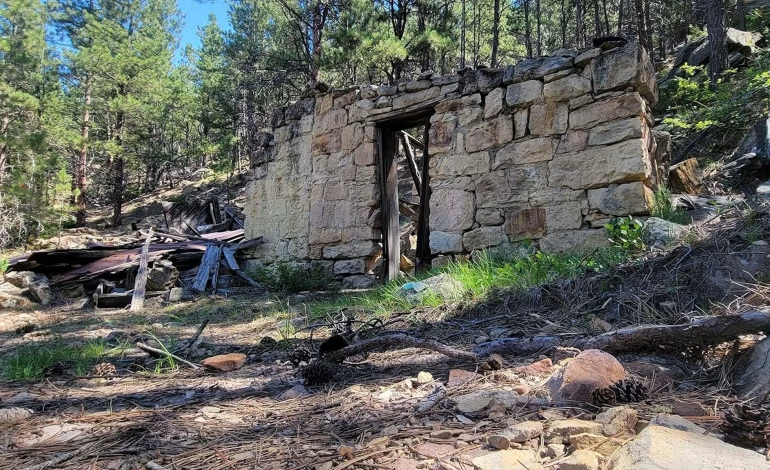
At its peak in the 1890s, the town had more than 1,200 residents and a bustling business district with an opera house, bank, general store, doctor’s office and company headquarters. Today, only foundations and mine shafts remain.
“Standing on that main street with nothing there is kind of heartbreaking,” Kessler said. “Even in the 1940s, people wrote that buildings were still standing. But history still happened here.”
Through research, Kessler also uncovered the human stories – including strict company rules. Saloons were banned in this company town. Once a week, a beer wagon was allowed in, and miners might bribe the driver to leave behind whiskey.
“They didn’t want drunkenness,” Kessler said. “They wanted work done, and done fast.”
Kessler is careful to stress that abandoned mines are no place for casual exploration. He consults mining engineers and safety officers before entering any site.
“If there’s no airflow, I’m not going in,” he said. “Bad air will kill you.”
He’s backed out of tunnels when conditions felt wrong and avoids pushing his luck. That caution comes from knowing the history – including fatal accidents involving airmen from Ellsworth Air Force Base who died exploring abandoned mines decades ago.
“These places are fascinating, but they’re unforgiving,” he said.
Kessler also understands the liability landowners face when abandoned structures exist on their property – especially with the rise of trespassing “urban exploration” videos online.
“People don’t ask permission, they damage stuff, and they put themselves in danger,” he said.
That’s why he believes quiet documentation, not publicity, is often the best way to protect history.
History Under The Pines is now expanding into Wyoming and Montana, working with private landowners to document everything from mines and ghost towns to abandoned ranches and defunct tourist attractions.
The service is free. The motivation is simple.
“History is fading,” Kessler said. “Things are changing fast, and if we don’t document them now, they’ll be gone.”
To reach younger audiences, Kessler is preparing to launch a podcast and website, making history interactive and digital.
“That’s how you keep it alive,” he said. “You show people what’s beneath their feet before it disappears forever.”

The latest news in your social feeds
Subscribe to our social media platforms to stay tuned