

Venezuela moves to privatise oil sector as US pressure pays off
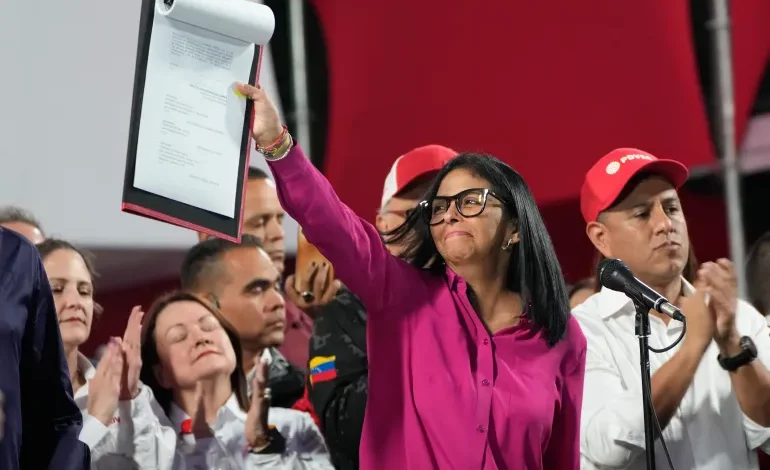

Venezuela’s interim president Delcy Rodriguez has signed into law a sweeping reform that opens the country’s long-nationalised oil sector to increased private control, a move that aligns closely with demands from the United States and marks a sharp turn in Caracas’s economic direction.
Rodriguez signed the bill into law on Thursday during a ceremony with state oil workers, presenting the overhaul as a necessary step to revive an economy battered by years of crisis.
“We’re talking about the future. We are talking about the country that we are going to give to our children,” Rodriguez said.
The signing came just hours after Venezuela’s National Assembly, dominated by lawmakers from Rodriguez’s United Socialist Party, approved the reform. The speed of the process underscored the political urgency surrounding the changes.
“Only good things will come after the suffering,” said Jorge Rodriguez, the head of the assembly and the interim president’s brother.
The legislation follows weeks of intense pressure from Washington after the US military abducted Venezuela’s former president Nicolas Maduro and his wife, Cilia Flores, on January 3. Since then, the Trump administration has pushed Rodriguez to dismantle long-standing barriers to foreign investment in the oil industry.
US President Donald Trump has publicly warned that Rodriguez could “pay a very big price, probably bigger than Maduro” if she failed to comply.
Under the new law, private firms will gain control over the production and sale of Venezuelan oil, a fundamental shift for a sector that has been state-run for decades. The reforms also require that legal disputes be settled outside Venezuelan courts, a key demand from foreign companies that have long argued the country’s judiciary is dominated by the ruling party.
The bill caps government royalties at 30 percent, another measure aimed at making investment terms more attractive to international oil companies.
As Rodriguez signed the law, Washington moved in parallel. The Trump administration announced it would ease some sanctions on Venezuela’s oil sector, signalling a coordinated quid pro quo.
The US Treasury Department said it would permit limited transactions by Venezuela’s government and the state oil company PDVSA that are “necessary to the lifting, exportation, reexportation, sale, resale, supply, storage, marketing, purchase, delivery, or transportation of Venezuelan-origin oil, including the refining of such oil, by an established US entity”.
Until now, Venezuela’s oil industry had been under sweeping US sanctions imposed in 2019 during Trump’s first term, effectively cutting the country off from global energy markets.
Thursday’s measures are designed to lure back foreign petroleum firms, many of which remain cautious after years of political repression, contract disputes and economic volatility under Maduro. Much of the former leader’s governing apparatus remains in place, though Maduro himself is now awaiting trial in a New York prison.
Maduro’s abduction triggered violent unrest and dozens of deaths, with critics accusing the United States of violating Venezuelan sovereignty.

The latest news in your social feeds
Subscribe to our social media platforms to stay tuned