


EXCLUSIVE: Venezuela After Maduro. The Long Shadow of the White House.

On January 3, 2026, the White House released a gallery of photographs under the blunt title: Operation Absolute Resolve. In the images, US special operators move with clinical precision through a dimly lit compound outside Caracas. Hours later, President Donald Trump announced that Nicolás Maduro had been captured and removed from power. The 25-year arc of Chavista rule – stretching back to Hugo Chávez – had been snapped in a single night.
The operation, described by the Pentagon as a “decapitation strike,” now sits in the history books alongside other abrupt regime interventions. But unlike Iraq in 2003 or Panama in 1989, this one came wrapped in a new justification: oil stabilization, regional security, and the restoration of democratic order – on Washington’s terms.
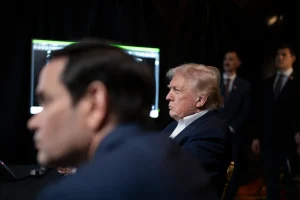
Now the dust is settling. Maduro is gone. The oil is flowing again – under American oversight. And Venezuela is suspended in a strange, uneasy transition where sovereignty and dependency blur.
This is what Venezuela looks like after Maduro. And this is what US-controlled oil really means.
Coverage in the days after January 3 painted a picture of a meticulously choreographed operation. According to reporting by The New York Times, Trump personally greenlit the mission after weeks of CIA and Pentagon planning. A classified briefing to congressional leaders framed it as a narrow counter-narcotics and national security action. By sunrise, Maduro was in US custody.
The Pentagon account, later amplified by the Department of Defense, described the strike as a limited intervention to prevent “state collapse and external malign influence.” Analysts at the Center for Strategic and International Studies argued that the move sent a pointed signal not only to Caracas but to Moscow and Beijing. The crisis had become geopolitical theater.
Investigative reporting by Drop Site News described months of preparation. There were clandestine contacts with dissident military officers. A parallel information campaign. Economic pressure timed with military readiness. The blockade of Venezuelan oil shipments – detailed in our exposé on tanker seizures – choked off the regime’s last revenue streams.
By mid-January, Operation Absolute Resolve had a second phase: securing oil infrastructure and maritime routes. US forces boarded tankers in international waters suspected of carrying sanctioned crude. The Guardian later reported a second boarding in the Indian Ocean, signaling that enforcement extended far beyond the Caribbean.
Republican senators like John Cornyn celebrated the action as proof that “America is back.” Critics raised War Powers concerns. NPR, BBC, Reuters – each chronicled the same split-screen reality: jubilation among some Venezuelan exiles and unease among Latin American governments wary of precedent.
Washington insisted this was not an invasion. It was stabilization.
But stabilization, in practice, meant control.
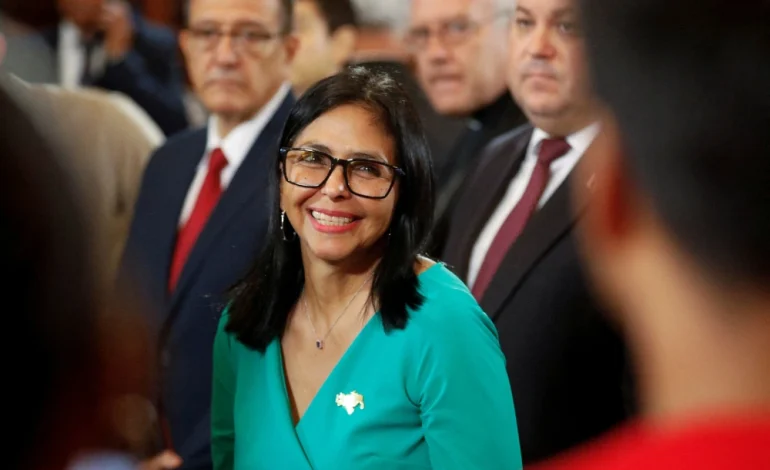
Maduro’s removal left a vacuum. Into it stepped Delcy Rodríguez – long a fixture of the Chavista inner circle, now recast as interim president.
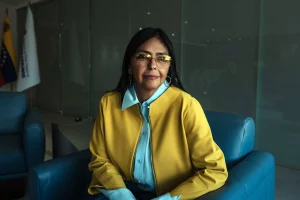
The transformation was abrupt. One day, she was Maduro’s vice president and enforcer. The next, she was standing beside US Energy Secretary Chris Wright discussing oil recovery plans.
AP News reported that Rodríguez quickly signaled openness to US investment and limited political reforms. NBC News noted that the Trump administration recognized her authority as a pragmatic step toward stability. CIA Director John Ratcliffe confirmed that the agency had established “new channels” in Caracas.
Phillip Gunson, Crisis Group’s senior analyst for the Andes region, describes Rodríguez as indispensable in the short term:
“Delcy Rodriguez is seen as a safe pair of hands by the Trump administration with regard to the initial phases of Rubio’s three-stage plan. She is happy to open up the economy and establish friendly relations with Washington, despite the “extraction” of Maduro and a quarter-century of ideological confrontation. For now, the internal forces that might oppose what she is doing have either been marginalised or are participating on the understanding that resistance at this point is not an option. Down the road, if a genuine political transition is contemplated, elements of the security forces might start pushing back, especially if US pressure diminishes. The genuinely ideological wing of Chavismo has long been marginalised and has little influence.
Delcy’s advantage is that the US needs her for its stabilisation plan and the security forces need her to do the negotiating with Washington.”
Rodríguez governs with a delicate balancing act. Human Rights Watch is pressing her to dismantle the security apparatus that jailed thousands of political opponents. Protesters in Caracas are demanding the release of prisoners. The European Union is watching closely, maintaining a sanctions framework tied to democratic benchmarks.
John Polga-Hecimovich, an Associate Professor of Political Science at the US Naval Academy, sees Rodríguez as a political survivor:
“More than anything, Delcy Rodríguez has kept her position because she has managed to satisfy the demands of Washington in maintaining stability inside Venezuela, showing a willingness to adopt (limited) political reform, and welcoming US oil companies and investors. Simultaneously, she has also made changes in the bureaucracy and military to help maintain the delicate internal balance of power.
The two other chief actors in the country she has had to placate are Minister of Defense Vladimir Padrino López, who leads the armed forces, and Minister of Interior Diosdado Cabello, who commands the loyalty of many of the paramilitary and non-state armed actors in the country.
It is unclear to what degree the US is providing material aid or bodies to help stabilize Venezuela. At the moment, the US strategy appears to be one of delegating this responsibility to the Rodríguez government.”
In other words: Washington runs the perimeter. Rodríguez runs the state.
For now.
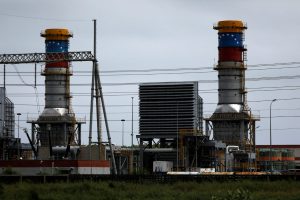
Venezuela holds the largest proven oil reserves in the world – some 303 billion barrels, according to Al Jazeera’s recent deep dive. Most of it is heavy, sour crude buried in the Orinoco Belt. Extracting it requires technology, capital, and refining capacity tailored to thick hydrocarbons.
Before the intervention, production hovered around 900,000 barrels per day. Infrastructure was decaying. Skilled labor had fled. Corruption hollowed out PDVSA.
Now, US policy is explicit. The State Department and the Department of Energy have rolled out “actions to implement President Trump’s vision for Venezuelan oil.” That vision centers on reopening the sector to private investors – especially American firms.
Deutsche Welle reports that Venezuela is inviting joint ventures. Reuters describes Energy Secretary Wright’s “Herculean task” of restoring output. Bloomberg notes that Washington sees oil recovery as a way to blunt Chinese and Russian influence.
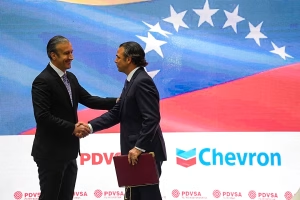
Chevron is already betting heavily on Venezuelan heavy crude. Economies.com and CNBC report expanded commitments contingent on political stability. The Financial Times details negotiations over revenue sharing and debt restructuring.
Yet the scale of the prize needs context. Tom Kloza, an independent oil analyst, keynote speaker, and co-founder of OPIS, tempers expectations:
“The takeover of Venezuelan oil production was startling, but it does not look to have much impact on US fuel prices in 2026 or even in 2028. We’ll probably see a very modest increase in Venezuelan production that will benefit companies that can run heavy sour crude from that country (Chevron, Valero, PBF, Marathon, Phillips 66). Before the US action, Venezuela was producing about 900,000 b/d of heavy crude, and it might possibly be increased in months to say 1.1-million b/d. But that is a small percentage of world needs – the planet will use about 104-million barrels of oil this month, for example.
Longer term one would hope that higher output there could be restored, but that will depend on stability on the ground, working utilities, and investments that have yet to be committed. In the meantime, talks between the US and Iran seem friendly, and peace there, or in the Russia-Ukraine war, would pressure global crude oil prices lower. Figure that a real lasting peace initiative might lead to a loss of the $7-$10/bbl current geopolitical premium for crude.
In the meantime, folks may be a bit confused when they look at gasoline prices. Much of the country, and certainly the Rocky Mountain states, are seeing increases in gasoline tied to the change of specifications from easy-to-make winter oil to the tougher specs for spring/summer oil. The difference implies an upcoming pump price increase of 15-25cts/gal in many corners of the country.”
The oil matters strategically more than economically in the short run. Control over Venezuelan exports denies revenue to adversaries and locks in supply for Gulf Coast refiners designed for heavy crude.
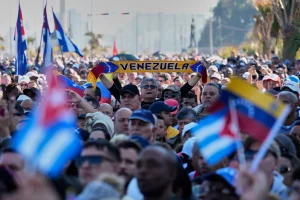
Cubans attends a rally in Havana, Jan. 3, 2026, in solidarity with Venezuela after the US captured President Nicolas Maduro and flew him out of Venezuela (Ramon Espinosa / AP)
The symbolism is powerful. The US military boards tankers in the Indian Ocean. The Energy Secretary flies into Caracas. Congressional Democrats question where oil revenues are going. The narrative writes itself: Washington has taken custodianship of the hemisphere’s largest hydrocarbon reserve.
Latin America’s response has been mixed. Reuters documented applause from conservative governments and condemnation from others wary of sovereignty violations. NPR reported protests in Mexico City and Buenos Aires. The European Parliament issued a briefing weighing democratic hopes against legal precedent.
The European Union Institute for Security Studies warned that the intervention could recalibrate norms around regime change. Just Security catalogued reactions from Maduro’s allies – Russia demanding clarification, Iran denouncing “neo-imperial aggression,” and China urging non-interference.
The Kremlin publicly stated it would seek clarification on oil restrictions affecting Russian firms. Beijing signaled displeasure but avoided direct confrontation. Bloomberg quoted US officials who framed oil recovery as a means of blunting Chinese and Russian clout.
At a CSIS event on what some speakers provocatively called a revival of the Monroe Doctrine, panelists debated whether Venezuela marks the beginning of a more assertive hemispheric policy.
Iran’s networks in Latin America – documented by Gulf International Forum – add another layer. Washington sees oil stabilization as part of a broader push to squeeze Tehran’s reach.
Colombia watches nervously. The Council on Foreign Relations has warned that instability in Venezuela can spill across borders, reigniting conflict dynamics in Colombia’s fragile peace process.
The region is adjusting to a reality in which US force has once again reshaped a government in the Americas.
Inside Venezuela, daily life remains precarious. Inflation has slowed but not vanished. Utilities are unreliable. Public trust is thin.
Human Rights Watch is pressing for dismantling the repressive apparatus. Venezuelans are rallying more openly, demanding political prisoners be freed. The Oxford-based COMPAS project describes a society caught between relief and suspicion.
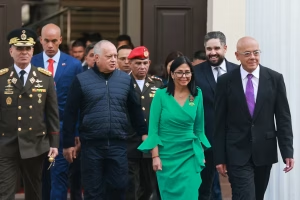
The Conversation bluntly notes that while Maduro may be gone, much of the regime remains intact – with a “new chief in Washington.”
That phrase stings because it captures a widespread fear: that sovereignty has simply shifted from one strongman to another, more distant power.
Rodríguez has promised elections. Timelines are vague. The US has tied sanctions relief and oil licensing to incremental reforms. It is a transactional democratization.
International Viewpoint and openDemocracy question whether oil interests will eclipse democratic commitments. Carnegie’s Emissary argues that economic recovery and political reform must proceed together or risk collapse.
The United States insists it is delegating governance to Venezuelans. Yet the presence of US advisers in energy ministries and security coordination centers suggests deep involvement.
This is not occupation in the classical sense. There are no American tanks in Caracas plazas. But economic sovereignty now runs through Washington.
There is another layer. Oil is priced in dollars. Control of Venezuelan supply reinforces the petrodollar system at a moment when China and others are experimenting with alternatives.
An analysis in openDemocracy argues that reasserting control over Venezuelan oil shores up US monetary dominance. Critics call it resource geopolitics dressed up as democratic rescue.
Energy Secretary Wright has framed the policy differently: stability first, markets second. CNBC reports that Venezuela has begun tentative sales discussions with Qatar, under US oversight, to diversify export routes while keeping transactions within a dollar-clearing framework.
Tom Kloza notes that gasoline price fluctuations in the US are more tied to seasonal blends than Venezuelan output. That undercuts claims that American drivers will see dramatic benefits. The intervention is less about the pump and more about positioning.
Peace talks elsewhere – in Iran, in Ukraine – could shave the geopolitical premium off crude. Venezuela is one variable in a larger equation.
The question that hovers over Caracas is whether this arrangement can endure.
Gunson warns that security forces may push back if US pressure eases. Polga-Hecimovich underscores the delicate balance between Rodríguez, Defense Minister Padrino López, and Interior Minister Cabello.
If oil revenues start flowing – and flowing transparently – Rodríguez could consolidate authority and shepherd a managed transition. If revenues are siphoned off or reforms stall, public unrest could surge.
The United States faces its own constraints. Domestic political divisions over the intervention persist. War Powers debates simmer. Congressional oversight of oil revenue management is intensifying, as reported by The New York Times.
Internationally, China and Russia will probe for openings. SAIS Review notes that Beijing’s investments in Venezuela predate the crisis and will not vanish overnight. Reuters quotes Russian officials seeking clarity on restrictions.
The Monroe Doctrine rhetoric excites some in Washington. It alarms others in the region. History rarely announces itself clearly. Sometimes it slips in under the cover of a night raid.

The latest news in your social feeds
Subscribe to our social media platforms to stay tuned