



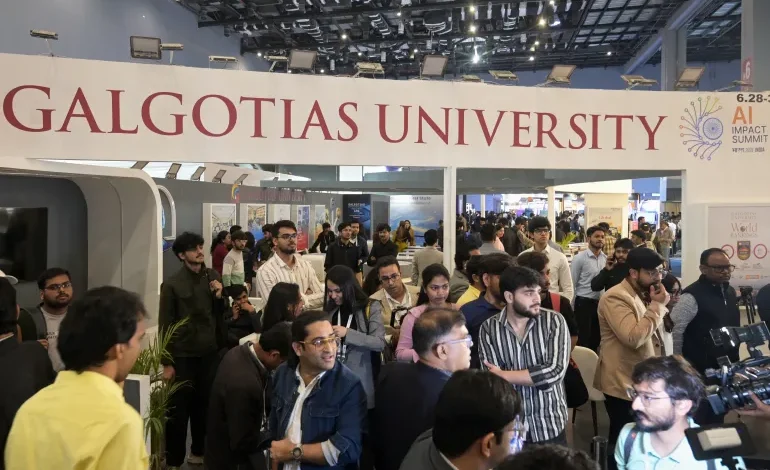

An Indian university has found itself at the centre of an unexpected credibility crisis after a professor presented a commercially available Chinese robot dog as a homegrown innovation at a major artificial intelligence summit, a moment that quickly migrated from conference floor to social media and into the country’s political debate.
“You need to meet Orion. This has been developed by the Centre of Excellence at Galgotias University,” Neha Singh, a communications professor, said in an interview with state broadcaster DD News as she introduced the machine at the event.
Online users soon identified the device as the Unitree Go2, a widely known research platform produced by the Chinese company Unitree Robotics and sold internationally for around $2,800. The speed of that identification turned what might have been a minor misrepresentation into a broader discussion about the gap between ambition and delivery in India’s push to position itself as a global AI hub.
The episode was amplified when Electronics and Information Technology Minister Ashwini Vaishnaw shared the video on his official social media account before later deleting the post. By then the clip had already circulated widely, shifting the focus from a single university stall to the optics of the summit itself, where India is hosting world leaders and technology delegations.
Both Galgotias University and Singh moved to clarify that the robot was not their creation.
“Let us be clear, Galgotias has not built this robodog, neither have we claimed,” the university said, adding that its role is to train students who will eventually develop such technologies.
Opposition politicians seized on the moment as a symbol of overstatement in official narratives. The Indian National Congress said the incident had made the country a “laughing stock globally” and used it to criticise Prime Minister Narendra Modi, who is presiding over the multi-day summit.
On the ground, the university’s stall has remained open, with representatives continuing to answer questions from journalists while saying they have received no formal notice about being asked to leave the event.
The controversy arrives at a sensitive time for India’s technology policy. The country is investing heavily in artificial intelligence as both an economic strategy and a geopolitical positioning tool, seeking to present itself as an alternative centre of innovation in a field dominated by the United States and China. That makes the narrative around capability almost as important as the capability itself.


The latest news in your social feeds
Subscribe to our social media platforms to stay tuned