



The fourth day of the global AI summit in New Delhi has the atmosphere of a forum that knows history is moving faster than its communiqués. World leaders are talking about regulation, access and risk, while the real contest — over who builds, controls and profits from the technology — continues just beneath the surface.
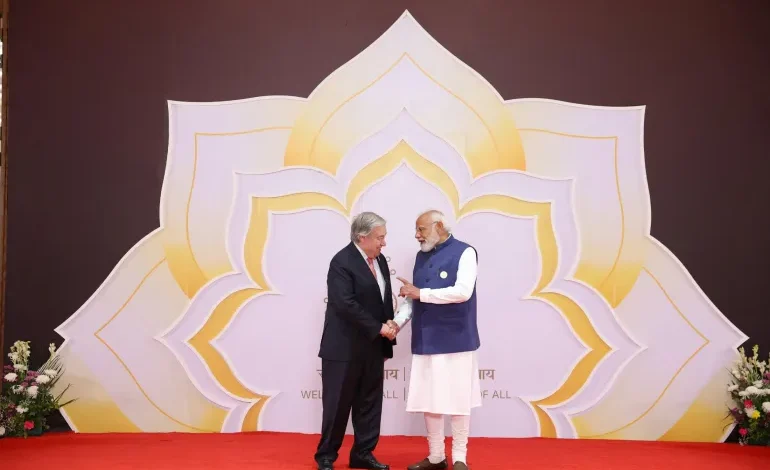
United Nations Secretary-General Antonio Guterres set the tone with a warning that went straight to the governance question. The future of artificial intelligence, he said, cannot be left to “the whims of a few billionaires”, urging technology leaders to back a $3bn global fund to make the systems more widely accessible. It was a familiar UN argument reframed for a new industry: innovation without distribution deepens inequality.
French President Emmanuel Macron approached the same tension from a different angle, trying to position Europe — and its partnerships — as both a regulatory and investment force.
“The message I have come to convey is what is that we are determined to continue to shape the rules of the game, and to do with our allies such as India,” he said. “Europe is not blindly focused on regulation – Europe is a space for innovation and investment, but it is a safe space.”
That framing — safety and scale at the same time — is exactly what India wants to project by hosting the first edition of the summit in a developing country. New Delhi is using the event to argue that the next phase of AI cannot be written solely in Silicon Valley or Beijing.
Prime Minister Narendra Modi leaned into that narrative, presenting India as both a market and a laboratory.
“The AI model which succeeds in India can be deployed all over the world,” he said, linking domestic scale to global relevance. He pushed the idea that openness is not just a philosophical position but an economic strategy. “India believes that AI technology will only be beneficial when it is shared and its core systems are open; only then will our millions of young minds be able to make it better and safer.”
“We must resolve that AI is used for the global common good,” he added, before switching to English for a line that sounded designed for an international audience: “We are entering an era where humans and intelligence systems co-create, co-work and co-evolve.”
The ambition is real. India has climbed to third place in Stanford’s global AI competitiveness ranking and is pitching itself as a destination for massive investment. But the summit’s discussions about job disruption, child safety and regulation also underline the distance between aspiration and capacity. Experts broadly agree that matching the United States and China will require not just talent and data, but sustained infrastructure, capital and research ecosystems on a scale that takes years to build.
The politics of reputation has also intruded. Microsoft founder Bill Gates, once expected to deliver one of the event’s most visible speeches, withdrew hours before taking the stage, with the Gates Foundation saying the decision was made “to ensure the focus remains on the AI Summit’s key priorities”. His absence — tied to renewed scrutiny over past links to Jeffrey Epstein — has become part of the summit’s narrative, a reminder that in a sector driven by personalities and capital, individual controversies can reshape the agenda.
Even without him, the gathering remains the largest in the summit series that began in 2023 in France and moved through South Korea and the United Kingdom. What distinguishes the New Delhi edition is not just its size but its setting. Holding the meeting in a developing economy forces the conversation to widen from frontier research and corporate power to access, affordability and global distribution.
That shift explains the recurring theme running through the speeches: who benefits.
Guterres is pushing for shared infrastructure. Macron is pushing for rule-making coalitions. Modi is pushing for scale and openness as a development model. All three are responding to the same reality — that AI is advancing faster than the political frameworks meant to guide it.

The latest news in your social feeds
Subscribe to our social media platforms to stay tuned