


Iran fortifies bombed sites as diplomacy inches forward under threat of force
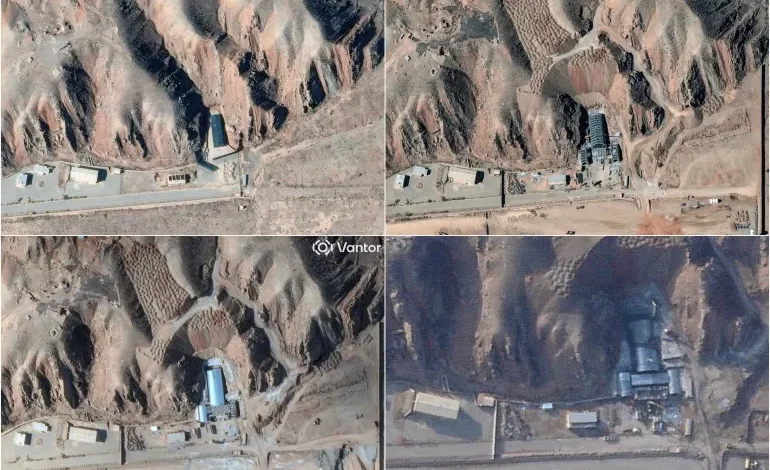

Fresh satellite imagery suggests Iran is not waiting for the outcome of nuclear diplomacy before reshaping the physical landscape of its most sensitive military and nuclear locations. The pictures show new layers of concrete, buried tunnel entrances and repaired missile infrastructure at sites hit during last year’s war with Israel — a pattern that points to long-term hardening rather than temporary repair.
The most striking activity is at the Parchin complex, about 30km southeast of Tehran, a facility that has been at the centre of Western suspicions for more than two decades. Israel is reported to have struck the site in October 2024, and early images showed heavy damage to a large rectangular building. By November of that year, reconstruction had begun. A year later, the structure had taken on a very different form.
Imagery from February 16 shows the building no longer visible, concealed beneath what analysts describe as a thick concrete cover. The Institute for Science and International Security, which has been tracking the site, identified the project as the burial of a new facility known as Taleghan 2. Its founder, David Albright, wrote:
“Stalling the negotiations has its benefits: Over the last two to three weeks, Iran has been busy burying the new Taleghan 2 facility … More soil is available and the facility may soon become a fully unrecognizable bunker, providing significant protection from aerial strikes.”
The timing is difficult to separate from the diplomatic track. Washington and Tehran have resumed indirect negotiations, and both sides are publicly describing the talks as serious but incomplete. At the same time, the United States continues to threaten military action if an agreement cannot be reached, while Israel is pressing for a broader deal that would cover not only uranium enrichment but also Iran’s missile programme and regional alliances.
Iran has drawn its own red lines, saying it is willing to discuss limits on its nuclear programme in exchange for sanctions relief but that missiles and its network of partners are not on the table.
The satellite images also show activity at the sites directly hit by US strikes during the 12-day war. At Isfahan, one of the uranium-enrichment facilities bombed last June, analysts say tunnel entrances have been completely buried. Near Natanz, where Iran operates its other enrichment plants, work has been under way to reinforce entrances to a mountain tunnel complex, suggesting a shift toward deeper and more protected underground infrastructure.
Missile bases damaged in the conflict appear to have been repaired.
All of this is happening in a political environment where the possibility of escalation is openly discussed. On Thursday, Poland’s Prime Minister Donald Tusk urged Polish citizens to leave Iran “immediately … and do not go to this country under any circumstances”, an unusually direct public warning that reflects the degree of regional anxiety.
The strategic logic behind the construction is straightforward even if the diplomatic implications are not. Hardened, buried facilities are far more difficult to destroy from the air, raising the cost of any future military operation and changing the calculations of both attackers and negotiators. It also means that the physical programme continues to evolve regardless of what is said at the negotiating table.
At the same time, the political narrative around Iran’s nuclear ambitions remains contested. Tehran insists its programme is civilian. Neither US intelligence nor the UN nuclear watchdog reported evidence last year that Iran was actively pursuing nuclear weapons, even as the infrastructure around its enrichment capability became a central target in the war.
The current round of talks has produced what both sides call an understanding on “guiding principles”, but no breakthrough. Iranian officials are expected to present more detailed proposals in the coming weeks, while Washington continues to push for a wider agreement.
That leaves the process moving along two parallel tracks. Diplomats talk about frameworks and sequencing in Geneva and Oman. On the ground, concrete is poured, tunnels are sealed and damaged bases are rebuilt.

The latest news in your social feeds
Subscribe to our social media platforms to stay tuned