


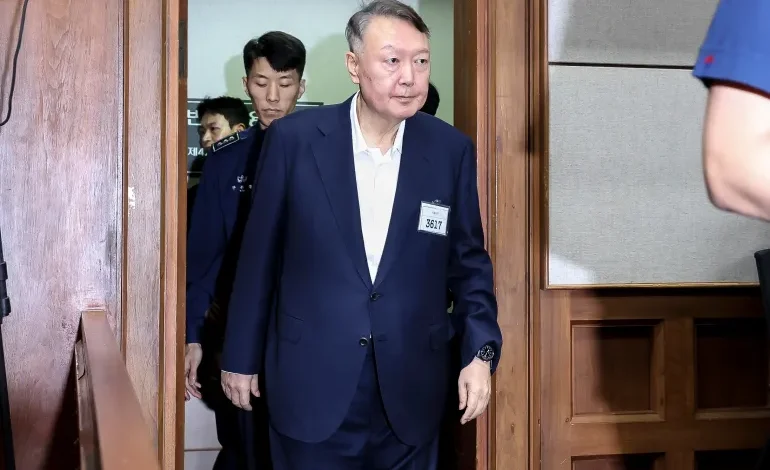

South Korea’s political upheaval over the 2024 martial law declaration reached its most decisive legal moment on Thursday, when a Seoul court found former President Yoon Suk-yeol guilty of leading an insurrection and sentenced him to life in prison, a ruling that reshapes the country’s recent history as much as it does his personal fate.
“The declaration of martial law resulted in enormous social costs, and it is difficult to find any indication that the defendant has expressed remorse for that,” Presiding Judge Ji Gwi-yeon said from the bench. “As to defendant Yoon Suk-yeol, the crime of insurrection leadership is established. We sentence Yoon to life imprisonment.”
The verdict centres on a single core act: the deployment of troops to the National Assembly on December 3, 2024. The court concluded that the move was intended to prevent the legislature from functioning for a significant period, a finding that turned what Yoon had framed as a constitutional exercise of presidential authority into a criminal attempt to override the democratic process.
Prosecutors had pushed for the death penalty, underscoring how seriously the state viewed the case. The court stopped short of endorsing the argument that Yoon sought to build a long-term dictatorship, but its ruling still defined the episode as an insurrection — one of the most severe charges in South Korean law.
For months, the martial law declaration had existed in two competing narratives. Yoon insisted it was a necessary step to break political gridlock and counter what he described as obstruction by the opposition. Investigators and prosecutors argued it was an abuse of power that used the military to intimidate elected lawmakers and remove opponents. The court’s decision firmly places the weight of the law behind the latter interpretation.
The security cordon around the Seoul Central District Court reflected the sensitivity of the moment. Police buses sealed off surrounding streets, and officers stood guard against possible unrest — a reminder that the legal process has been unfolding alongside deep political divisions and sustained street protests since the crisis began.
Yoon’s legal team rejected the ruling almost immediately, calling it a “pre-written script” and saying it was not supported by evidence. They indicated that an appeal is under consideration, a step that would extend a case already likely to move more slowly than standard judicial guidelines, which formally call for first-instance trials to conclude within six months and appeals within two years.
Even with that caveat, the decision marks a turning point.
Those milestones matter in a country where the presidency has repeatedly collided with the courts. South Korea has built a modern political identity around the idea that even its most powerful figures can be investigated, impeached and jailed. The life sentence reinforces that pattern, but it also reflects how close the 2024 crisis came to paralysing the state.
For now, Yoon remains in custody at the Seoul Detention Centre, and the political system that removed him from office continues to function under the shadow of what the court has formally declared an insurrection.

The latest news in your social feeds
Subscribe to our social media platforms to stay tuned