

Board of Peace: money first, politics later
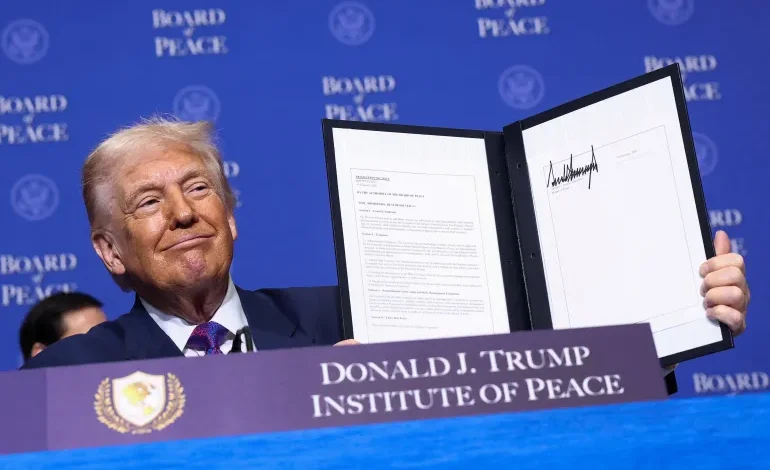

Donald Trump used the first meeting of his newly formed Board of Peace to present what he framed as a concrete start to Gaza’s post-war reconstruction: pledges of $7bn from nine countries and commitments from several states to send troops to an international stabilisation force.
Speaking in Washington, DC, on Thursday, the US president said Kazakhstan, Azerbaijan, the United Arab Emirates, Morocco, Bahrain, Qatar, Saudi Arabia, Uzbekistan and Kuwait had provided the initial funding for a reconstruction pool.
“Every dollar spent is an investment in stability and the hope of a new and harmonious [region],” Trump said, adding that “The Board of Peace is showing how a better future can be built right here in this room.”
The United States, he said, would contribute $10bn to the board, though he did not specify how that money would be allocated.
Even taken together, the pledges remain far below the estimated $70bn needed to rebuild Gaza after more than two years of devastation. The gap between the political announcement and the scale of the reconstruction task underlines how early the process still is, despite the effort to present the meeting as a turning point.
Alongside the funding, Trump outlined the security component of his plan. Indonesia, Morocco, Kazakhstan, Kosovo and Albania have agreed to send troops to a proposed stabilisation force, while Egypt and Jordan have committed to training a new Palestinian police structure.
Indonesian President Prabowo Subianto said his country was ready to contribute up to 8,000 personnel “to make this peace work”. Under the plan, the force would initially deploy in the Israeli-controlled city of Rafah, operate under a US general with an Indonesian deputy, and work towards a structure of 20,000 troops and 12,000 trained police.
The security arrangements remain tied to one of the most politically sensitive elements of Trump’s broader 20-point proposal: the disarmament of Hamas. The group has not agreed to that condition. Its spokesperson Hazem Qassem said any international deployment must “monitor the ceasefire and prevent the [Israeli] occupation from continuing its aggression,” adding that disarmament could be discussed without committing to it.
That position reflects the central tension in the plan — reconstruction and stabilisation are being presented as technical processes, but they are inseparable from unresolved political and military questions on the ground.
Trump first introduced the Board of Peace last September as a mechanism to end the war in Gaza. Since the October ceasefire, the concept has expanded. The administration now presents it not only as a Gaza framework but as a model that could be applied to other conflicts.


The latest news in your social feeds
Subscribe to our social media platforms to stay tuned